


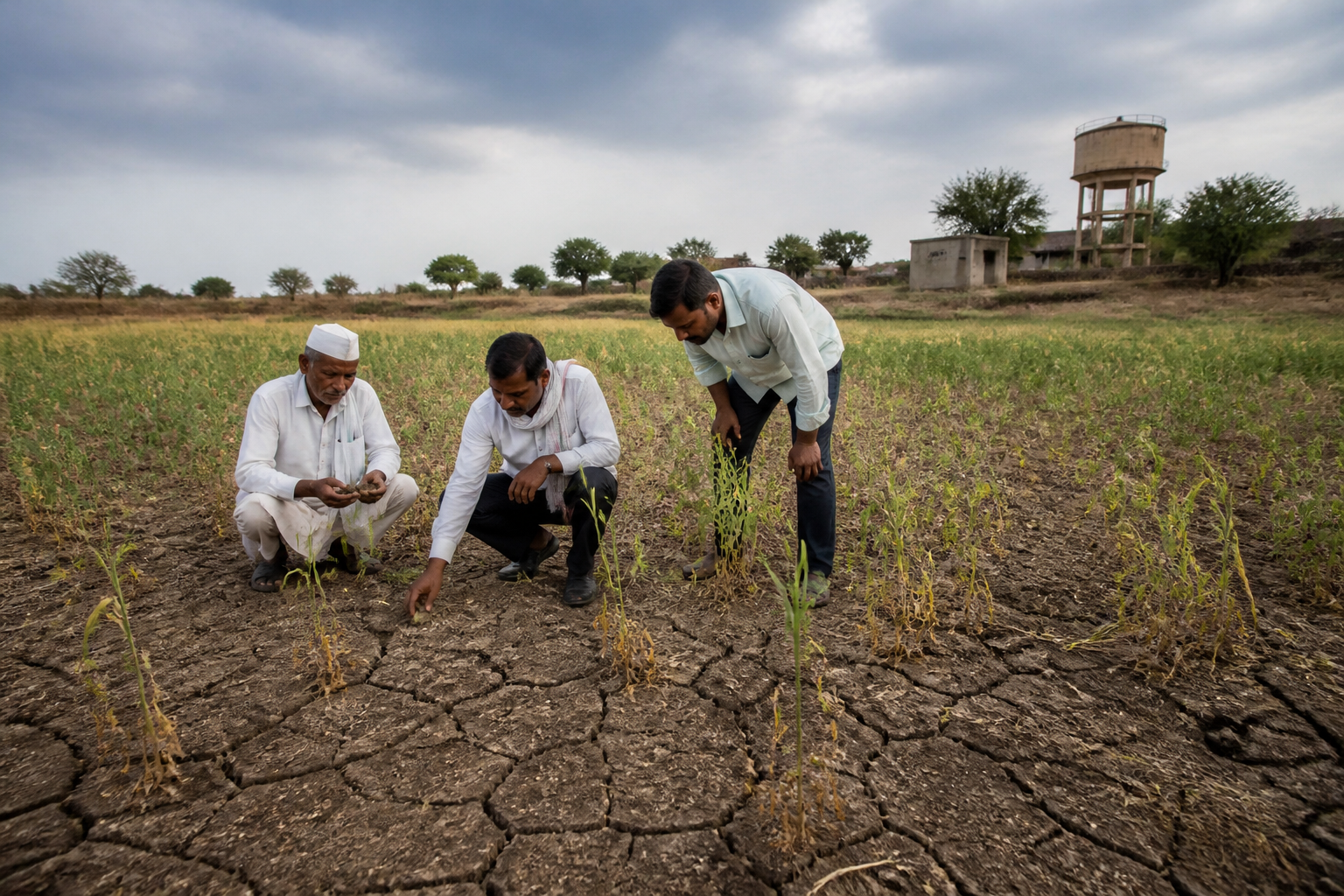
Maharashtra has expanded its drought-hit list from 265 to 305 talukas, bringing Pune district’s Junnar and Ambegaon under the state’s relief framework after deficient rainfall affected crops, water availability and electricity access for agricultural operations.
The declaration is expected to make eligible farmers in the two talukas eligible for an initial financial assistance of Rs 5,000, which the state government has said will be transferred directly into their bank accounts before Diwali. Crop-loss assessments, known locally as crop panchanamas, will also be conducted in the newly included areas.
Pune district collector Jitendra Dudi said the assessments in Junnar and Ambegaon would be carried out at the earliest, following the process adopted in other drought-affected tehsils. The surveys will determine the extent of crop damage and help establish eligibility for relief under the state’s drought management framework.
Farmers in Junnar said the rainfall deficit had affected standing kharif crops and increased the cost of cultivation. They reported spending on seeds, fertilisers, pesticides and labour without certainty that the crops would survive or generate adequate returns. Deepak Ukirde, a farmer from Junnar, said water shortages and electricity supply problems had made it difficult to sustain crops and meet agricultural expenses.
Ramesh Bangar, another farmer from the taluka, said crops needed watering at least twice a week, while higher daytime temperatures and low soil moisture had affected crop growth and contributed to disease. Farmers also said that shortages were placing pressure on drinking-water sources in villages and limiting the operation of agricultural pumps.
The drought declaration provides access to a package of concessions, subject to applicable conditions. These include land revenue relief, restructuring of crop loans, relief from agricultural loan recovery, examination-fee waivers for students, concessions on electricity bills and support for rural livelihoods.
The state government said the expansion followed a review of rainfall deficiency and other drought indicators after the initial assessment. The review was intended to include areas where conditions had worsened within the formal relief framework.
Farmers and local representatives, however, said the effectiveness of the declaration would depend on how quickly the measures reach households. They have sought faster crop-loss surveys, reliable electricity for irrigation and action to secure drinking water for villages facing shortages. Farmer activist Jitendra Bidwai said the availability of soil moisture and irrigation water would be important as farmers consider the next rabi sowing season.
The water stress is also affecting rural supply planning across Pune district. The Zilla Parishad’s rural water supply department has provided 294 borewell connections across 13 talukas in 2026, with one borewell generally serving a hamlet of about 100 people. Executive engineer Amit Patharwate said the department was preparing a fresh plan because demand had increased as rainfall declined and existing village water sources depleted. The plan will be submitted to the district collector for approval before new work begins.

