


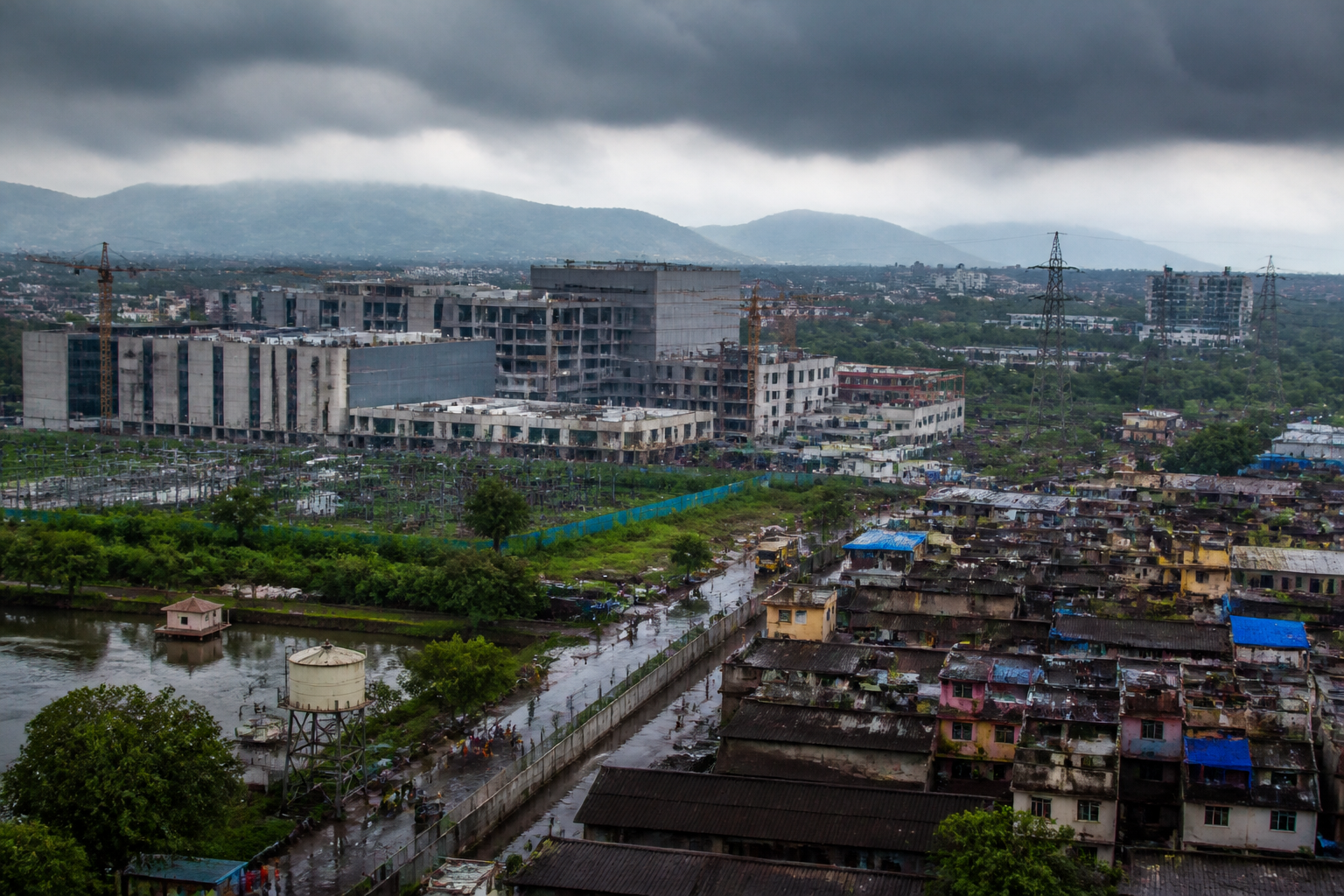
Maharashtra’s decision to appoint a 17-member committee to study the effects of data centres marks an important shift in how the state is approaching one of the fastest-growing forms of urban infrastructure. The panel, to be led by former National Atomic Energy Commission chairman Dr Anil Kakodkar, will examine whether the expansion of data centres can be reconciled with demands on water, electricity, land, local infrastructure and basic amenities.
The committee’s creation follows concerns raised during the recent monsoon session of the state legislature. According to a government resolution reported by the Times of India, legislators questioned the large requirements of data-centre projects and their possible effects on existing water sources, infrastructure, temperatures, the environment and the daily lives of local residents. The government’s response is not a moratorium or a cancellation of projects. It is an attempt to create a policy framework before the sector expands further.
That distinction matters because data centres are often discussed as digital infrastructure, even though their physical footprint is substantial. They require land for large facilities, reliable electricity, cooling systems, water or alternative cooling arrangements, access roads and supporting networks. Their effects are therefore experienced not only through internet services and cloud computing, but also through local utility systems and the neighbourhoods in which the facilities are built.
The state government has said that the Mumbai Metropolitan Region will have the highest number of data centres and the largest data centre, while the Mahayuti government is seeking to develop Maharashtra as a leading data-centre hub. The scale of that ambition makes the committee’s terms of reference significant. The state is attempting to define the conditions under which data-centre growth should take place, rather than treating individual projects only as investment proposals.
The immediate policy question is how the additional demand created by these facilities will be assessed. The government resolution identifies water, electricity, environmental effects, heat emissions and noise pollution as subjects for scientific study. It also asks the committee to examine the effects on local people. This places utility capacity and community experience within the same policy discussion as industrial development and investment promotion.
The water question is particularly important because cooling is central to the operation of large data centres. The resolution specifically refers to water conservation, reuse and alternative cooling technologies. It also calls for recommendations on sustainable and energy-efficient green data centres. The source material does not establish the water consumption of any individual facility or the precise cooling technology proposed for projects in Maharashtra. It does, however, show that the state considers resource use sufficiently significant to require a dedicated technical review.
Electricity presents a parallel challenge. Data centres depend on continuous and reliable power, making them different from many conventional commercial developments. The committee includes senior officials from the energy, water conservation, industry and investments departments, as well as representatives of the Maharashtra Industrial Development Corporation and the industry commissioner. That composition reflects the cross-departmental nature of the problem: approvals, industrial land, utility planning and environmental management cannot be handled in isolation.
The committee’s mandate also includes heat emissions and noise pollution. These concerns connect the internal operation of data centres to the external urban environment. Cooling equipment, backup systems and other technical infrastructure can influence the conditions around a facility, while construction and operations can affect nearby residents in different ways. The government has not yet published, in the material supplied, the technical thresholds or monitoring standards that would govern such impacts. Those details will be important if the eventual policy is to guide approvals rather than merely describe concerns.
The proposed Amazon Web Services hyperscale data centre in Thane illustrates why the debate is moving beyond state-level investment policy. Residents of the Balkumbh area have opposed the proposed 53-acre project through the ‘Wake Up Thanekar’ movement. The reported resistance indicates that the location of a data centre can become a local land-use issue, involving questions about neighbourhood conditions, infrastructure pressure and the distribution of the benefits and costs of development.
The state resolution recognises this social dimension by asking the committee to study the causes of misconceptions in society about data centres and to prepare principles for awareness and information dissemination. It proposes engagement with local villagers, local self-government institutions and public representatives, along with technical workshops and seminars where necessary. This is a notable part of the mandate because it treats public communication as an administrative requirement, not simply as a public-relations exercise.
At the same time, describing public concerns as misconceptions could become problematic if it is used to dismiss objections before project-level evidence is made available. The resolution’s emphasis on objective, scientific and technical information provides a basis for a more credible approach: concerns would need to be tested through disclosed assessments, measurable standards and accessible explanations. The supplied material does not say how the committee will consult residents, publish findings or allow communities to challenge project-specific data.
The institutional structure proposed by the government suggests that data-centre approvals may require stronger coordination than a single industrial clearance. The committee has been asked to recommend administrative reforms through coordination between departments and to prepare a standard operating procedure for data centres. Such an SOP could potentially bring consistency to approvals and monitoring, but its scope, legal status and relationship with existing environmental and local-government processes remain unspecified in the government resolution described by the Times of India.
This is where Maharashtra’s data-centre strategy intersects with urban planning. A facility may be located within an industrial zone, but its resource needs are connected to wider systems: electricity generation and transmission, water supply, drainage, roads, emergency access and land-use planning. Whether a project is technically permitted on a parcel of land does not by itself establish that the surrounding infrastructure can absorb its demands. The committee’s cross-departmental structure acknowledges this wider system, although the source does not yet provide a framework for measuring cumulative impacts across multiple facilities.
Cumulative impact could become the central issue as the Mumbai Metropolitan Region attracts more projects. The state’s stated ambition is not limited to one data centre; it is to make Maharashtra a leading hub. The policy challenge therefore extends beyond whether each proposal meets minimum requirements on its own. It includes how several facilities in the same region could affect electricity demand, water sources, land availability, heat and local services over time. The government resolution’s reference to existing water sources and infrastructure suggests that this broader concern is already present in the legislative debate, even though no regional capacity figures have been supplied.
The committee has also been asked to examine best practices in India and abroad and to recommend ways of increasing local employment, skill development and corporate social responsibility through data-centre projects. These terms of reference indicate that the government wants the sector to produce local economic benefits alongside investment. The source material does not quantify expected employment or identify the skills that would be required. It therefore remains unclear how the benefits will be measured, who will receive them and whether they will correspond to the scale of land and infrastructure used by the facilities.
The appointment of Dr Kakodkar gives the exercise a technically prominent chair, but the credibility of the final policy will depend on the evidence and process used by the committee. Its mandate includes scientific and technical study, policy guidelines, administrative reform, public information and local economic benefits. These are wide responsibilities. The government will eventually need to translate them into specific standards, disclosure requirements, departmental responsibilities and monitoring arrangements if the study is to shape real approvals.
Maharashtra’s data-centre push has therefore created a governance test alongside an investment opportunity. The state wants the Mumbai Metropolitan Region to become a major centre for digital infrastructure, while residents and legislators are asking how that growth will affect water, power, land, heat, noise and basic services. The committee’s report will be important not simply because it may support expansion, but because it can establish whether expansion is planned around the capacity and rights of the cities that host it. The next questions are when the committee will complete its study, what evidence it will publish and how its recommendations will be incorporated into the proposed standard operating procedure.

