


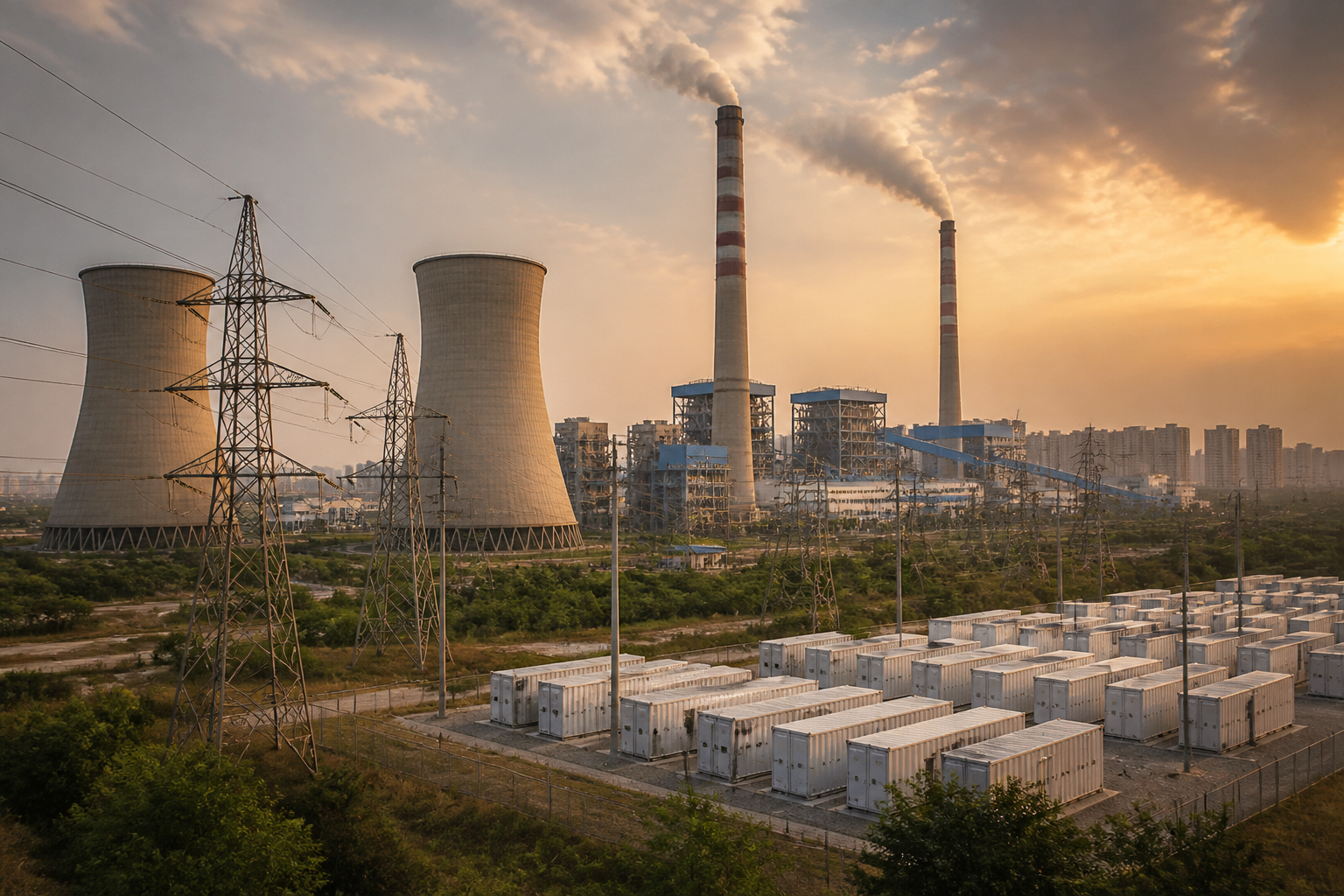
NTPC’s plan to invest Rs 17 lakh crore over the next decade is not merely a capacity-expansion announcement. It is a signal that India’s power system is being pushed into a more demanding phase, in which the central challenge is no longer only how much electricity can be generated, but whether it can be delivered reliably and affordably across longer periods of high demand.
The state-run power generator has earmarked about Rs 7 lakh crore of the proposed investment for the next five years, according to Chairman and Managing Director Gurdeep Singh, who disclosed the plan at the India Energy Summit organised by the Indian Chamber of Commerce. The investment will cover thermal, gas, nuclear and storage technologies.
That combination matters because India’s electricity demand is becoming more persistent and less concentrated in a short daily peak. Singh said the period during which the system must meet elevated demand has expanded from roughly four hours to between 10 and 12 hours. This changes the infrastructure problem. A grid designed to manage a narrow peak can depend on a different mix of generation and storage than one that must sustain high loads for much of the day.
The demand drivers identified by NTPC include weather conditions linked to El Nino, baseline economic growth, rising cooling requirements, and the expansion of artificial intelligence systems and data centres. Cooling demand is particularly important for cities and industrial areas, where electricity consumption rises with warmer conditions and where interruptions can affect homes, businesses, transport systems and essential services. The reference to data centres also points to a new category of electricity user whose operations require continuous supply rather than occasional access to power.
Singh said coal-based generation continues to provide almost 70 per cent of the country’s electricity, while output from coal-based stations had risen 18 per cent in the current month. His argument was that the immediate policy question should not be reduced to a contest between thermal power and renewable energy. The more practical question, he said, is whether the system can supply electricity on demand while keeping it affordable.
This framing places reliability at the centre of India’s energy transition. Adding renewable generation can increase the supply of electricity, but the system also needs resources that can respond when demand rises or when generation from variable sources is unavailable. NTPC’s investment plan therefore combines conventional generation with nuclear capacity and several forms of storage. The company’s stated objective is to build 30 gigawatts of nuclear capacity as part of the national goal of 100 GW by 2047.
NTPC has submitted three identified nuclear sites for clearance to the Department of Atomic Energy and the Atomic Energy Commission. The disclosure establishes the scale of the company’s ambition, but the supplied information does not specify the locations, project costs, construction schedules or approval timelines for those sites. Those details will determine how quickly the proposed nuclear capacity can move from an investment target to operational supply.
The company currently has 91 GW of operational capacity and another 37 GW under construction. About 17 GW of the construction pipeline consists of coal-based projects. This pipeline illustrates the transitional character of India’s power system: even as the sector pursues nuclear generation, storage and hydrogen-related technologies, coal remains a major part of the capacity being built and the electricity being produced.
The institutional challenge is to manage these different assets as one system rather than as isolated technology programmes. Thermal and nuclear plants can provide firm generation, while storage can help shift electricity across time. NTPC is pursuing pumped storage, vanadium flow batteries and carbon dioxide batteries as non-lithium alternatives. The company said its first carbon dioxide battery installation is scheduled for commissioning in November, although the supplied report does not provide its capacity or location.
The emphasis on non-lithium storage also reflects a procurement and industrial-policy concern. NTPC is seeking technologies that can reduce reliance on external imports, but the report does not establish the comparative costs, operating performance or commercial scale of the alternatives under development. Their importance will ultimately depend on whether they can store electricity for the longer periods now required by the grid and do so at a cost compatible with affordable power.
This is where the investment announcement intersects with the urban built environment. Cities do not consume electricity only through households. Their electricity needs are embedded in commercial buildings, cooling systems, manufacturing clusters, digital infrastructure, water services and other networked operations. The report specifically links rising demand to cooling, economic growth and data centres, but it does not provide a city-wise breakdown of consumption or identify which regions will receive the planned capacity.
For industrial consumers, NTPC is also exploring a 26 per cent equity participation model to support captive consumers and co-generation. Singh said the company was open to working with industries on solar plans, with the stated aim of reducing carbon footprints and power costs while improving industrial competitiveness. Such arrangements would move some power planning closer to individual industrial users, but the report does not clarify the proposed projects, participating companies, investment structure or regulatory approvals required.
The company’s programme extends beyond electricity generation. NTPC is working on a hydrogen hub intended to produce green methanol and green ammonia. At Simhadri, a 20-kilometre pipeline is under construction to connect the supply with overseas off-takers. This links the utility’s power strategy to industrial fuels and export-oriented infrastructure, although the report does not give production volumes, commissioning dates or the identity of the overseas buyers.
Taken together, the figures show a utility attempting to cover several layers of the energy system at once: existing coal generation, new thermal capacity, nuclear expansion, long-duration storage, industrial co-generation and hydrogen-related production. That breadth can be read as a response to uncertainty over how demand will evolve and which technologies will provide reliable power at acceptable cost. It also creates a substantial implementation challenge because each technology has different approval, construction, financing and operating requirements.
The central evidence in the announcement is therefore not simply the Rs 17 lakh crore headline. It is the mismatch between the speed and duration of new demand and the time required to build dependable infrastructure. NTPC’s operational 91 GW, its 37 GW construction pipeline and its proposed future investment indicate that capacity addition will remain a defining feature of India’s power system. Yet the company’s own emphasis on storage and longer demand windows shows that installed capacity alone will not settle the reliability question.
Several elements remain unresolved in the supplied material. NTPC has not detailed the allocation of the Rs 17 lakh crore across technologies, the financing structure, the expected commissioning schedule, the tariff implications or the geographic distribution of projects. The nuclear sites remain subject to clearances, while the commercial performance of the proposed storage technologies is not established in the report. These are not minor details: they will determine whether the investment plan delivers firm, affordable electricity or remains a broad strategic intention.
What is clear is that India’s power challenge is becoming an urban and industrial infrastructure challenge as well as a generation challenge. Higher cooling demand, expanding economic activity and data-centre growth require power systems that can sustain supply for longer periods. NTPC’s plan acknowledges that reality by combining conventional and low-carbon generation with storage and industrial partnerships. The next milestones to watch are the clearances for the identified nuclear sites, the commissioning of the first carbon dioxide battery in November, progress on the 37 GW construction pipeline and further details on how the proposed investment will be deployed.

