


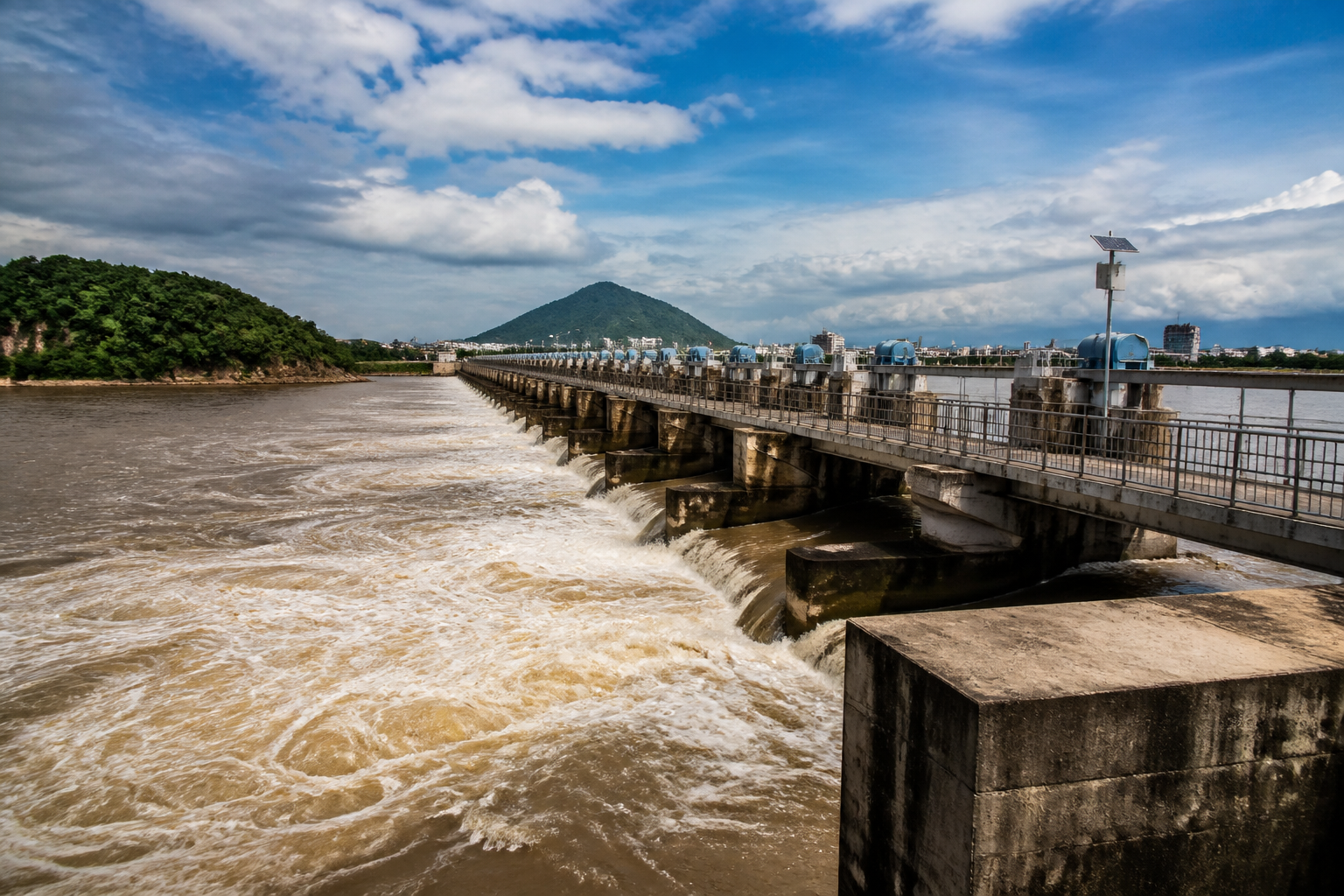
A report by Dinamalar – Tamil Nadu says the Tamil Nadu chief minister identified as Vijay is expected to travel to Vijayawada on October 13 for discussions with Andhra Pradesh Chief Minister N. Chandrababu Naidu, Deputy Chief Minister Pawan Kalyan and other ministers over river-water allocations, proposed dams and river-linking issues. The report does not include an official government statement confirming the visit or clarify the identity of the chief minister referred to as Vijay.
The central issue identified in the report is the Telugu Ganga project agreement, under which Andhra Pradesh is required to provide 12 TMC of Krishna river water annually to Tamil Nadu at the state border. According to the report, Tamil Nadu had received only 2.251 TMC by October 9 this year. The gap between the annual allocation mentioned in the agreement and the quantity reported as received is the immediate reason cited for the proposed talks.
The report also says Andhra Pradesh is taking steps to construct dams on rivers flowing from the state into Tamil Nadu. It does not name the rivers, identify the proposed locations, specify the projects’ status or provide details of any approvals. Those details are important because the impact of a dam proposal would depend on its location, storage capacity, downstream flows and the legal and administrative clearances involved.
The proposed meeting, if confirmed, would place the dispute within the wider framework of interstate river-water management. Water flowing across state boundaries is governed through agreements, project arrangements, tribunal or court directions where applicable, and decisions by state and central authorities. A shortfall in an annual allocation can therefore involve more than a political discussion: it may require records of reservoir levels, release schedules, conveyance losses, seasonal rainfall, infrastructure capacity and compliance with the relevant project agreement.
The Telugu Ganga project has particular significance for Tamil Nadu because the arrangement links Krishna basin water in Andhra Pradesh with supply to the Chennai region. The supplied report, however, does not provide the current storage position of the reservoirs involved, the period over which the 2.251 TMC was measured, or whether the reported figure represents water received at the state border or water ultimately delivered to a specific city or distribution system. Without those details, the scale and operational consequences of the reported shortfall cannot be independently assessed from the available material.
The proposed agenda also reportedly includes river interlinking. River-linking discussions can cover a range of proposals, from transfers between basins to project-level changes in storage and conveyance. The report does not specify which rivers or schemes would be discussed, whether any formal proposal exists, or which agency would be responsible for evaluating the environmental, financial and engineering implications.
For urban residents, the issue is connected to the reliability of water systems rather than only to an interstate political disagreement. Chennai and other urban areas in Tamil Nadu depend on a combination of surface-water projects, reservoirs, imported or transferred supplies and local sources. Any change in the timing or volume of water entering the state’s system can affect planning by utilities and the management of seasonal demand. The supplied report does not, however, quantify any present or expected impact on municipal water supply.
The report’s account requires clarification on three basic points before the proposed meeting can be treated as established news. First, the identity and official position of the person referred to as Vijay must be confirmed. Second, the October 13 Vijayawada meeting should be verified through an official statement, government schedule or other primary document. Third, the reported Telugu Ganga water figure and the claims about proposed dams should be checked against records from the governments of Tamil Nadu and Andhra Pradesh or the relevant project authorities.
If confirmed, the meeting could provide a formal channel for discussing the reported shortfall, the operation of the Telugu Ganga agreement and the status of proposed projects on inter-state rivers. The next verifiable milestone is the publication of an official schedule or statement on the reported October 13 meeting and its agenda.
