


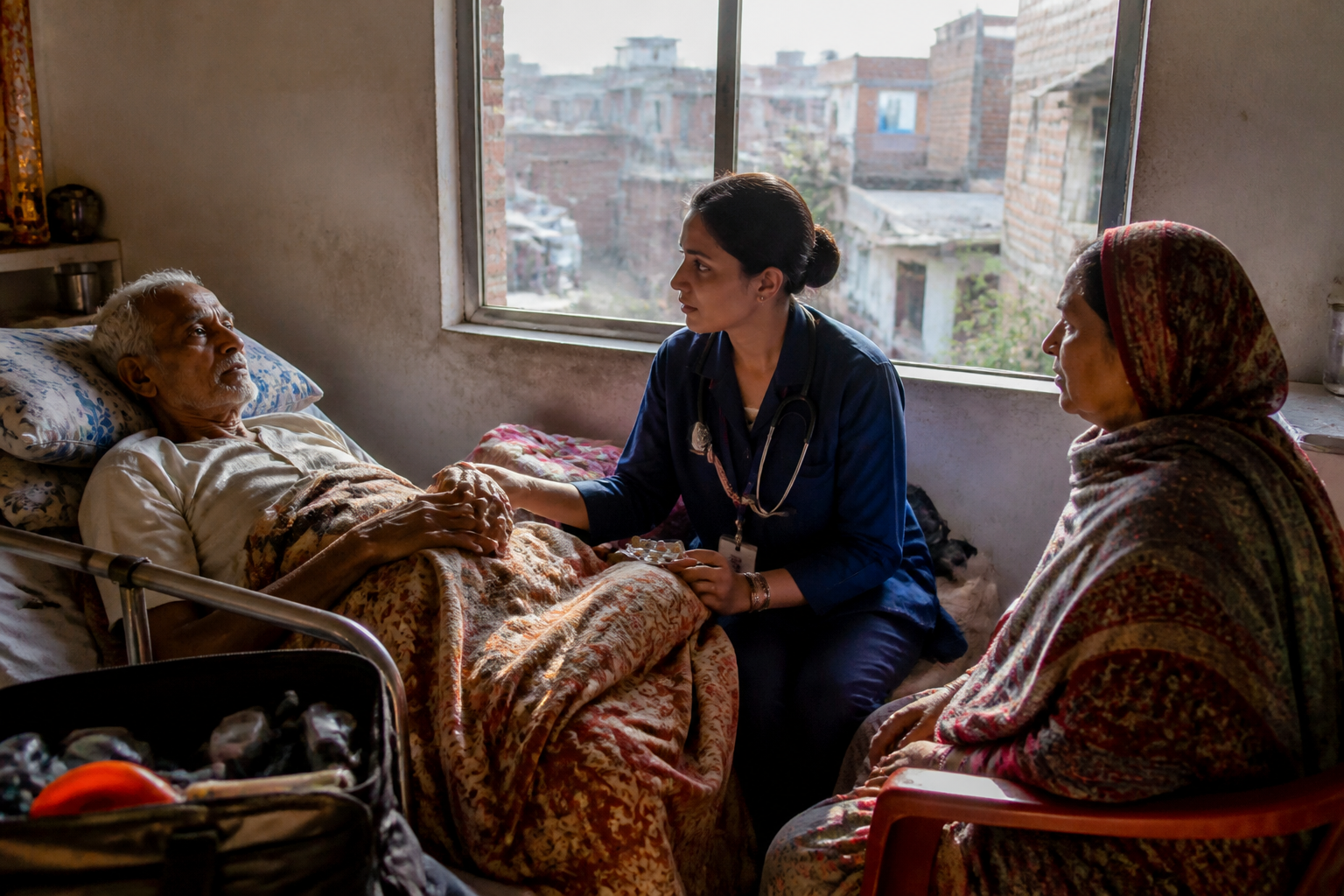
India’s palliative-care challenge is no longer only about the availability of pain medicines or hospital departments. It is about whether a seriously ill person can receive care at home, especially when age, frailty, disability or distance makes repeated travel to a hospital unrealistic. The contrast between Kerala’s community-based network and Uttar Pradesh’s limited reach shows how the country’s healthcare system still struggles to connect institutional services with patients’ everyday lives.
The issue has received renewed attention around World Hospice and Palliative Care Day, observed on October 10. For people living with cancer, advanced heart or lung disease, neurological conditions, frailty and multiple chronic illnesses, treatment may not remove all suffering. Palliative care is designed to manage pain and other symptoms while also addressing psychological, social and spiritual needs. It can be provided alongside disease-directed treatment and does not necessarily signal that medical care has ended.
Yet the way services are organised determines who can benefit from them. A hospital-centred model assumes that patients can reach a facility, return for follow-up and depend on family members for transport and care. That assumption breaks down for bedridden patients, older adults with limited mobility and households in rural or semi-urban areas. For these groups, the key question is not simply whether a palliative-care unit exists, but whether the health system can reach the patient.
Kerala’s experience demonstrates what that shift can look like. The state’s community-based palliative-care initiatives began through voluntary efforts in 1993, and Kerala announced India’s first comprehensive palliative-care policy in 2008. Over time, government institutions, local self-government bodies, voluntary organisations, healthcare professionals and community volunteers became part of a wider service network.
According to the figures cited in the report, Kerala currently has 1,141 primary palliative-care units covering gram panchayats, municipalities and corporations. It also has 113 secondary-level units in major hospitals and 231 units at community health centres. More than 500 non-government and community organisations provide home-based medical and nursing services. The system’s defining feature is that care continues beyond the hospital through home visits, trained local volunteers and neighbourhood-level support.
Kerala’s Kerala Care palliative-care grid, launched in March 2025, is intended to connect this network more systematically. The state Health Department says the grid includes more than 1,300 government institutions and over 1,000 voluntary organisations, with information on more than 158,000 bedridden patients. The state also estimates that more than one lakh volunteers are active in palliative-care activities.
These arrangements matter because palliative care is not a single clinical intervention. A patient may need pain management, nursing, physiotherapy, help with mobility, psychological support or guidance for caregivers. A family may need to learn how to administer medicines, manage wounds, recognise behavioural changes and identify when professional help is necessary. These needs are often spread across days and weeks rather than concentrated in a hospital consultation.
The nature of pain itself also makes a purely hospital-based approach inadequate. Dr Abhishek Shukla, a geriatric and palliative-care specialist quoted in the report, said pain should not be assessed only through a numerical score. The more important question is what the pain prevents a patient from doing: sleeping, eating, walking to the dining room, communicating with family or participating in a meaningful daily activity.
This is particularly important among older people with dementia, communication difficulties or several chronic illnesses. Pain may appear as agitation, withdrawal, disturbed sleep, loss of appetite, reduced mobility or a change in behaviour rather than as a direct verbal complaint. Identifying these signs requires time, continuity and familiarity with the patient’s home environment—conditions that home-based care can provide more effectively than occasional facility visits.
The numbers cited for Kerala and Uttar Pradesh illustrate the scale of the institutional gap. In 2024–25, Kerala recorded 9,77,879 patients visited at home for palliative care, while Uttar Pradesh recorded 33,832. Kerala reported 13,47,566 patients using palliative outpatient services, compared with 3,68,834 in Uttar Pradesh. The figures cannot be treated as a simple ranking because the two states differ in population, geography, healthcare infrastructure and reporting arrangements. They nevertheless show a substantial difference in the scale of home-based delivery.
Uttar Pradesh began implementing the National Programme for Palliative Care in 2016–17. Its stated objectives include improving the availability and accessibility of palliative services, developing facilities at different levels of the healthcare system and increasing community participation. However, government data cited in the report showed functional NPPC services in 23 districts of Uttar Pradesh as of October 2025, compared with all 14 districts of Kerala.
The challenge for Uttar Pradesh is partly one of scale. Its large geographical area and substantial rural and semi-urban population make it difficult for specialist teams to provide continuous care from centralised facilities. A patient who is too frail to travel may be technically covered by a district-level service but practically excluded from it. This is the distinction between nominal availability and usable access.
The policy implication is not necessarily that Uttar Pradesh should reproduce Kerala’s institutional structure exactly. The two states have different administrative capacities, settlement patterns and health-system conditions. The more transferable principles are the integration of palliative care with primary healthcare, the training of nurses and frontline workers, the participation of local governments and the use of community organisations to support home visits.
This approach would also change the role of primary-care workers. They could help identify patients who need palliative support, monitor symptoms during home visits, educate families and refer complex cases to higher-level facilities. Specialist hospitals would remain important, but they would function as part of a connected chain of care rather than as the only point at which support is available.
Families are central to that chain. Much of the care of a seriously ill person takes place between professional visits, and relatives often manage medicines, feeding, movement, wounds and emotional support. Without clear instructions and access to a professional contact, families can be left to interpret changes in pain, sleep, appetite or behaviour on their own. Community-based systems can provide continuity, but they also require defined responsibilities, trained personnel and a reliable referral process.
The report’s evidence also challenges the perception that palliative care is simply an alternative to treatment. A patient may continue cancer therapy or treatment for heart, lung or neurological disease while receiving support for pain, breathlessness, anxiety, mobility or nutrition. The appropriate goal may differ from one person to another. One patient may prioritise pain relief, another may value alertness, while someone else may want to remain mobile or continue eating independently.
That makes the patient’s own priorities an important part of service delivery. A health system that measures only the number of facilities or consultations may miss whether patients are sleeping comfortably, communicating with their families or remaining at home with dignity. The quality of palliative care depends not only on clinical capacity but also on whether care is organised around the realities of daily life.
Kerala’s model does not eliminate the challenges of ageing, chronic illness or limited medical resources. It does show the value of treating palliative care as a community service rather than a hospital specialty alone. For Uttar Pradesh and other states, the central task is to strengthen the last-mile connection between existing facilities and people who cannot reliably reach them.
The evidence establishes a clear gap in the scale of home-based care and in the geographic spread of functional services. What remains less clear from the available material is how consistently services operate within each district, how many trained workers are available for home visits and how states measure outcomes for patients and caregivers. Those are the indicators that will determine whether palliative care becomes a real public service or remains a facility that many of the most vulnerable patients cannot use.
