


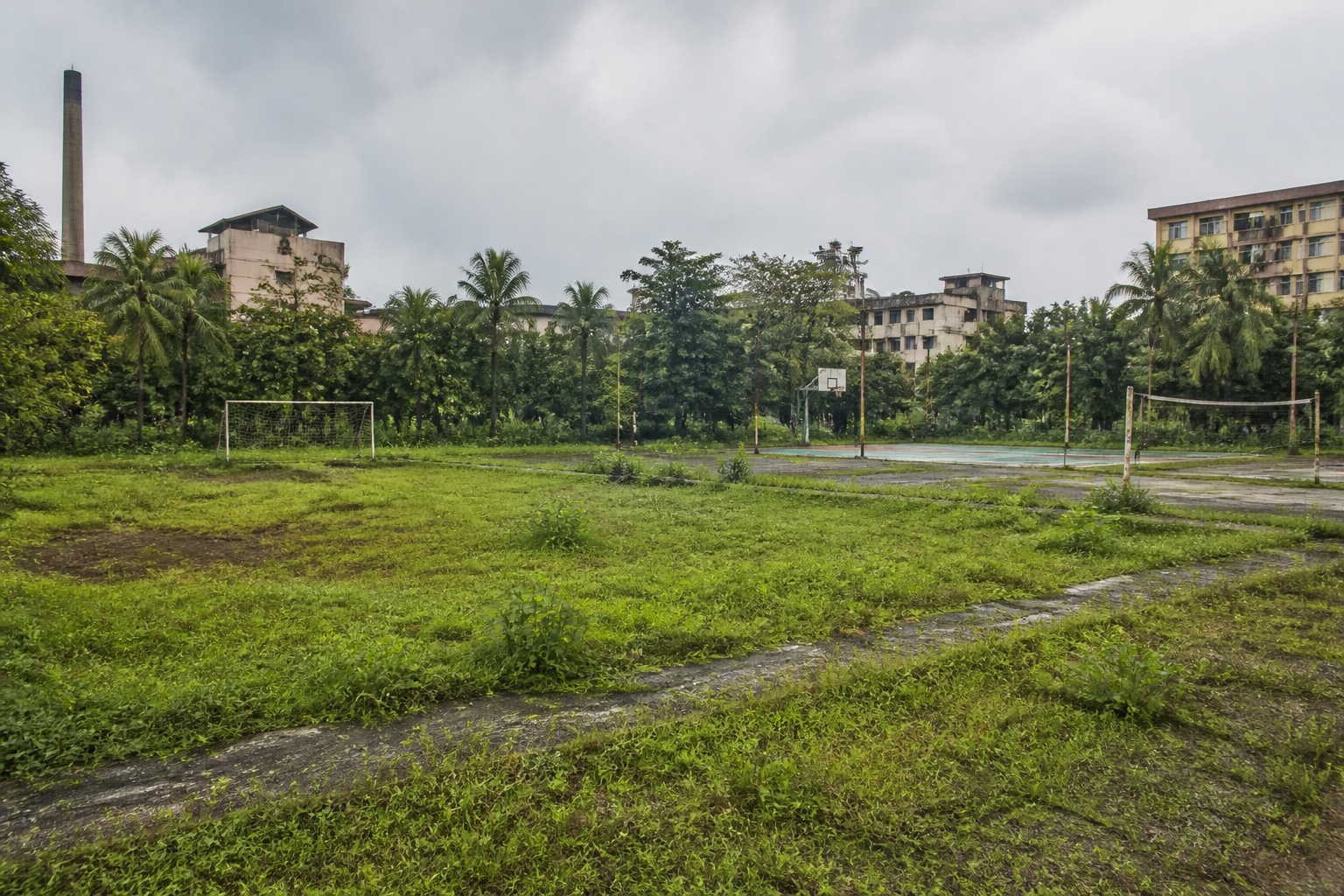
Five sports grounds linked to the Fertilisers and Chemicals Travancore (FACT) in Kalamassery are reportedly lying neglected, revealing how the decline of an institution can also weaken the public infrastructure built around it. Once associated with national-level athletes, major tournaments and organised teams across several disciplines, the grounds are now described as overgrown and inadequately maintained.
The report by Kerala Kaumudi identifies the FACT Stadium, the FACT High School ground and four other grounds near schools and residential quarters as part of this neglected network. The larger question is not only why these facilities have deteriorated, but what happens to urban assets when the institution that created and maintained them loses its earlier strength.
FACT was once a major sporting force in the area. Its football, volleyball, basketball, cricket, table tennis and shuttle badminton teams included national-level players and were regarded as a source of institutional pride. As that period ended, the grounds reportedly lost regular attention. The decline of the sports facilities therefore appears closely connected to the decline of the organisation’s sporting culture and institutional support.
That link is important in understanding the condition of the grounds. Sports infrastructure does not remain useful merely because a playing surface, court or stadium exists. It needs routine maintenance, organised access, repairs, safety checks and a system that assigns responsibility for its upkeep. When those functions weaken, an asset can survive physically while becoming unavailable in practice.
The FACT Stadium, also known as the FACT Sports Association ground, is described as having capacity for more than 5,000 people and parking facilities. It was used for training by players, including those associated with the Santosh Trophy, and had separate facilities for volleyball, cricket, basketball, tennis and kabaddi. The report says the ground continues to host local football and cricket tournaments, but the basketball and volleyball courts near the Udyogamandal Theatre have almost disappeared.
The condition of those courts illustrates the difference between occasional use and a functioning sports complex. A ground may still accommodate a local tournament while the wider sporting system around it has collapsed. Without usable courts, changing facilities, equipment, regular coaching and maintenance, the site can no longer support the range of sports for which it was originally designed.
The main ground also has a distinctive physical history. It was raised about five feet above road level and levelled using a mixture of sand and coir, according to the report. This method was intended to create a scientifically prepared playing surface. The ground hosted Ranji Trophy cricket matches in 1965 and 992, as stated in the source report, and has consequently been part of the sporting history of the area for decades.
The FACT High School ground represents a different layer of that history. At a time when 400-metre running tracks were rare in Kerala, the ground served as a venue for state and national competitions. It reportedly had space for multiple athletics events to be conducted at the same time, including hurdles, slow hurdles, long jump, high jump, hammer throw, javelin, pole vault and shot put.
The list of athletes associated with the ground includes P. T. Usha, Shiny Abraham, M. D. Valsamma, Yohannan and Mercy Kuttan. Their presence connects the site to a period when institutional grounds served not only employees and their families, but also the wider competitive sports ecosystem. A well-maintained athletics ground could provide training space, competition infrastructure and visibility for young athletes before they reached national prominence.
The reported deterioration of the FACT sports grounds therefore involves more than the loss of recreational space. It represents the weakening of a local pipeline through which young people could access organised sport. The source does not provide current user numbers or details of any formal redevelopment proposal, so the present scale of this impact cannot be quantified. It does, however, establish that the facilities remain significant to sports enthusiasts who want them restored for use by a new generation.
The other grounds mentioned in the report are located near Udyogamandal School, Eastern School, Central School and the OD Quarters. Their proximity to educational institutions and residential areas gives them a potential role beyond FACT’s internal sporting history. Such locations can serve schoolchildren, local clubs and community tournaments when access and maintenance are clearly structured.
At the same time, the history of the grounds shows how urban land can be vulnerable to competing institutional demands. The Western School ground was lost when an ammonia plant was established. The site had earlier included football, volleyball and basketball facilities. Its disappearance demonstrates that sports space within an industrial township is not permanently protected simply because it has community value.
This is a familiar governance problem in built environments managed by large institutions. Land may be controlled by a public-sector company, while its social use extends beyond the company. Decisions about maintenance, redevelopment or conversion can therefore affect schools, residents, athletes and local associations even when those groups do not control the land.
The report does not identify the current agency responsible for each ground, the maintenance budget, the ownership arrangements or the condition of individual facilities. These gaps matter because restoring the grounds would require more than a general appeal for attention. The responsibility for the stadium, school ground and other sites would need to be mapped, along with the permissions required for public or community use.
The facilities also differ in their requirements. An athletics ground needs a safe running surface and event areas. A cricket ground requires a suitable playing field and supporting arrangements. Basketball and volleyball courts need hard surfaces, markings, nets and regular repairs. A stadium capable of hosting large crowds additionally requires access management, parking, sanitation and safety systems. Treating all five grounds as a single maintenance problem could overlook these differences.
The evidence in the report points to a broader institutional transition. During FACT’s stronger period, the company’s sports teams and grounds formed part of its identity. As that sporting prominence faded, the infrastructure appears to have lost the institutional purpose that sustained it. The challenge now is whether the facilities can be assigned a new public purpose without erasing their history or creating unclear obligations.
For Kalamassery, the grounds are also part of the area’s physical memory. They connect industrial employment, school education, residential life and competitive sport. The presence of national athletes and major tournaments gives the sites historical importance, but their continued value depends on whether they can function safely and regularly today.
The demands from sports enthusiasts reported by Kerala Kaumudi are centred on making the grounds usable for the new generation. That demand places the question of restoration within a wider public-space debate: whether existing urban land should be allowed to deteriorate, converted to another use or renewed as shared infrastructure. The source supports the case that the grounds have substantial sporting potential, but it does not establish the cost, timeline or institutional plan required for revival.
What the available evidence confirms is that Kalamassery still has a sports infrastructure network shaped by FACT’s earlier years, but parts of that network are no longer being maintained at the level required for its original purpose. The FACT Stadium continues to host some local tournaments, while specialist courts and the athletics ecosystem have suffered visible decline. The next important developments would be an official assessment of the grounds, clarity on ownership and maintenance responsibility, and a documented plan for restoring facilities that can still serve schools, local athletes and the wider district.
