


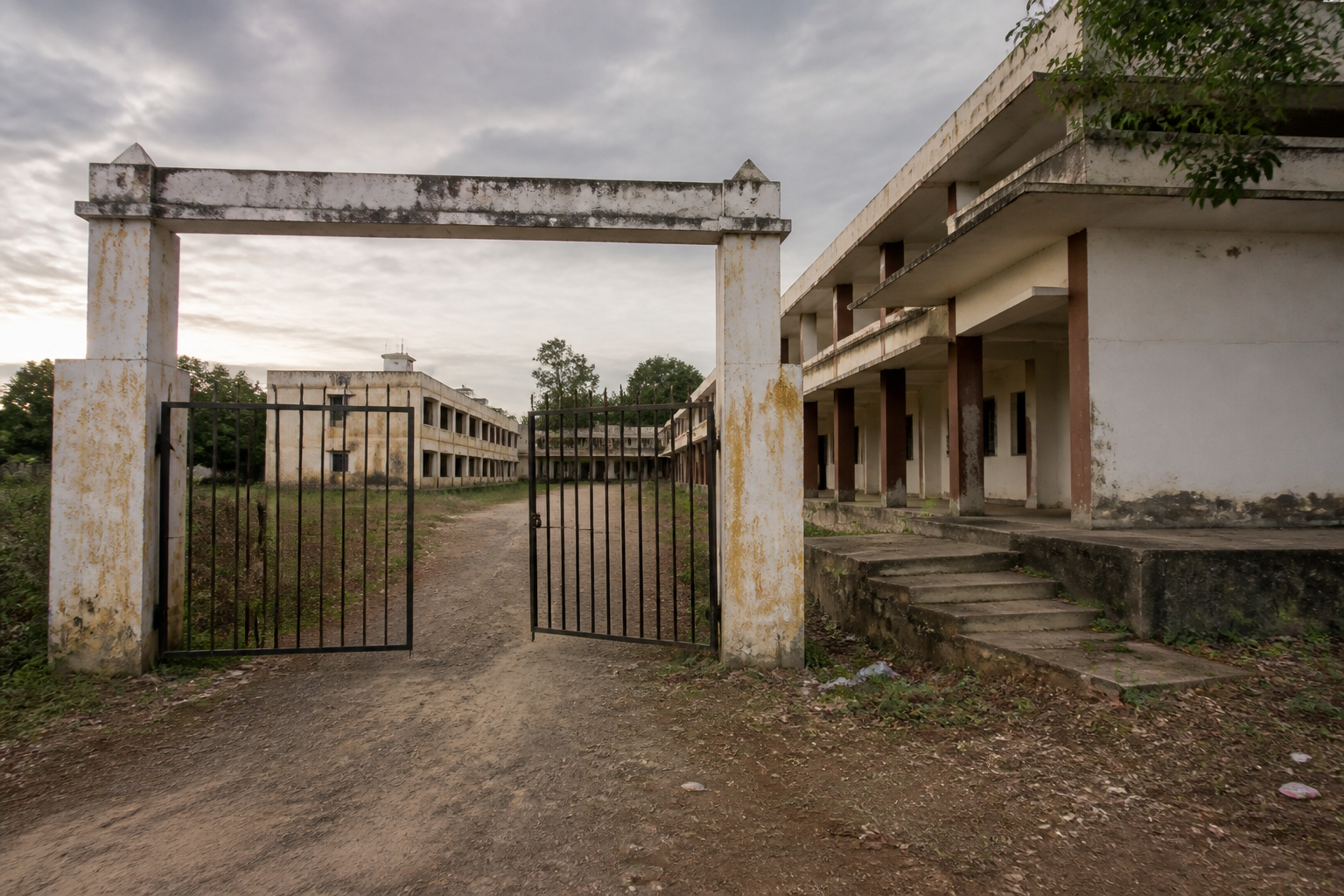
An inspection at the Government Sandipani Higher Secondary School in Bada Malhera, Chhatarpur, has exposed a wide gap between Madhya Pradesh’s branding of the institution as a flagship public school and the conditions recorded on the ground. The findings, reported by the Times of India and attributed to a special inspection team, cover not one isolated defect but a chain of failures involving security, teaching, laboratories, sanitation, enrolment, sports and administrative supervision.
The education department has issued show-cause notices to 58 teachers and staff members, including the in-charge principal. The inspection was conducted on October 3 under the directions of the Commissioner of Public Instruction as part of statewide monitoring of Sandipani schools. District Education Officer P K Raikwar confirmed that teachers had been asked to respond, saying that they were under scrutiny. The department has indicated that unsatisfactory explanations could lead to disciplinary proceedings.
The significance of the episode lies in the distance between physical investment and institutional performance. The Bada Malhera school was being projected through government hoardings as a model learning institution with facilities comparable to private schools. Yet the inspection described a campus where basic systems were not functioning reliably. The evidence reported from the inspection suggests that a building or a flagship label cannot, by itself, create a working public institution.
The inspection record, as reported, began with a basic security failure. The main gate was shut and no security personnel was present at the entrance. One guard was posted against a sanctioned strength of 10 and reportedly opened the gate only after considerable effort. The absence of a guard is not merely an administrative irregularity in a school campus. It raises questions about access control, student safety and the ability of the institution to account for who enters and leaves the premises.
The timing of the inspection made the attendance and supervision concerns more serious. A National Means-cum-Merit Scholarship examination was scheduled at the school that day, but the inspection team reportedly did not find a single staff member present when it reached the campus. Local reports cited in the source said students had been dismissed at 2.30 pm, well before the team arrived. Of the school’s seating capacity of 2,190 students, only 375 appeared for the examination.
The reported attendance figures do not, by themselves, establish why students or staff were absent. But they do show why routine monitoring matters. A large government school operates through predictable systems: timetables must be signed and followed, classrooms must be staffed, examinations must be supervised, and the principal’s office must enforce attendance and accountability. The inspection found weaknesses across several of these functions.
Teachers had allegedly not signed the timetable, while higher-secondary teachers were reportedly not taking classes for Standards 9 and 10 or teaching during assigned periods. Classrooms were frequently found empty. The in-charge principal was also accused in the notice of maintaining an irregular attendance record, leaving before the scheduled closing time and shielding negligent staff rather than correcting deficiencies. These are allegations recorded in departmental notices and require responses from the staff concerned; they should not be treated as final findings of misconduct before the departmental process concludes.
The school’s laboratories illustrate another part of the delivery gap. The Physics, Chemistry and Biology laboratories were reportedly locked and extremely unhygienic. If laboratories remain inaccessible or unusable, the presence of designated rooms and equipment does not translate into practical learning. The same distinction applies to the library, which the inspection team reportedly found without books, and to sports facilities, where equipment was considered insufficient.
The reported condition of the campus also points to a failure of everyday maintenance. Corridors, toilets and other parts of the premises were described as dirty and foul-smelling. Music instruction reportedly had only a harmonium and a dholak, while transportation arrangements for students were found inadequate. These details may appear secondary beside teaching and staffing, but they shape whether students experience a school as safe, usable and capable of supporting learning beyond textbook instruction.
The enrolment figures add a demand-side dimension to the problem. Against a target of 880 students in Classes 9 to 12, only 527 were enrolled, according to the inspection findings reported by the Times of India. In Classes 1 to 8, enrolment was 1,280 against a target of 1,160. Taken together, the figures indicate that the school had 120 vacant seats in the lower classes while remaining substantially below its target in the senior section. The available material does not establish why enrolment patterns differ between the two levels, but the gap is relevant to any assessment of whether the institution is attracting and retaining students as a flagship public school.
The inspection also found that some teachers were on medical leave without submitting medical certificates. The department asked staff to provide written explanations and supporting documents. The source contains two different response timelines: the report says notices asked for replies within a week, while the department’s direction in the notice reportedly referred to three days. The district education officer confirmed that teachers had been asked to reply within a week. This discrepancy is part of the administrative record and should be clarified in the final departmental process.
The Bada Malhera case is therefore less about one dirty toilet or one locked laboratory than about how public education infrastructure is monitored after it is created. A flagship school requires several institutions to work together: the state education department must set standards and monitor them; district and block officers must conduct meaningful inspections; the school leadership must enforce attendance and timetables; and staff must deliver teaching and maintain facilities. The inspection report suggests that earlier block- and district-level inspections had already identified similar deficiencies, but that no improvement followed.
That reported history is particularly important. Monitoring has value only when it produces correction. If the same issues appear in successive inspections, the problem moves beyond individual negligence and becomes a question of institutional follow-through. Notices may establish accountability, but they do not automatically restore laboratory use, improve sanitation, secure the gate or bring students back to vacant seats. The next administrative step—how explanations are assessed and what corrective action is ordered—will determine whether the inspection becomes a repair mechanism or another document in the school’s records.
The case also complicates the meaning of “private school-like” infrastructure. Public investment is often assessed through visible assets: a large campus, designated laboratories, classrooms, sports areas and promotional signage. Students, however, encounter institutions through daily operations. They need classrooms that are open and staffed, toilets that are clean, laboratories that can be used, teachers who attend assigned periods, and a campus that is secure. The inspection findings suggest that the operational layer has not kept pace with the institution’s public image.
For families, the consequences are practical. A school may have capacity on paper but fail to provide dependable instruction. It may advertise laboratories but keep them locked. It may have sanctioned posts for security but lack guards at the gate. It may have seats available but struggle to fill them in senior classes. These conditions can influence whether households trust a government school, even when the state has invested in its physical appearance.
What the inspection confirms is a serious breakdown across multiple aspects of the Bada Malhera Sandipani school’s functioning, as reported by the inspection team and the education department. What remains unresolved is the extent to which the problems are concentrated at this campus or reflect wider weaknesses across the Sandipani network. The department’s review of the 58 responses, the disciplinary decisions that follow, and evidence of actual improvements in teaching, sanitation, security and facility use will show whether the state can convert a flagship claim into a functioning public institution.
