


The Nandan Nilekani-led High Powered Task Force on examination reforms has held about 18 panel meetings and 40 consultations in two months, while receiving more than 50,000 suggestions from students, parents, doctors’ associations, examination bodies and government institutions. The scale of the exercise points to a problem that extends beyond question papers and recruitment rules: India’s examination system also depends on the reliability of testing centres, technology vendors, security arrangements and public institutions spread across cities, towns and rural areas.
The task force was constituted on July 26, a day after the resignation of Education Minister Dharmendra Pradhan following student protests at Jantar Mantar. Its progress is being monitored by the Supreme Court. On September 18, the court directed the Joint Secretary of the Department of Personnel and Training, who is coordinating with the task force, to file an affidavit setting out the committee’s progress. The affidavit submitted earlier this week said the task force was proceeding within its prescribed timeframe and would submit its final report and recommendations to the government by the end of October.
That timetable gives the consultations an administrative urgency, but the content of the proposals shows why reform cannot be limited to changing the agency responsible for conducting an examination. Suggestions received by the task force include restructuring the National Testing Agency, making a larger share of its technical and security workforce permanent, creating specialised divisions and separating different stages of the examination process among multiple agencies.
The United Doctors Front has suggested that 75 per cent of the NTA’s technical and security posts should become permanent statutory positions within three years, with outsourced personnel capped at 25 per cent of the total strength. It has also proposed reconstituting the NTA through an Act of Parliament as a Statutory National Examination Authority, with independent divisions for cybersecurity, psychometrics, digital forensics and vigilance.
These proposals identify a central weakness in a system that has increasingly relied on technology and outsourced capacity while handling examinations at national scale. When question setting, paper security, test-centre management and technology operations are concentrated in a single service-provider structure, a failure in one part of the chain can damage confidence in the entire examination. The task force has received suggestions to debundle these functions so that different agencies handle question-paper setting, security and test centres. The stated objective is greater transparency through separation of responsibilities.
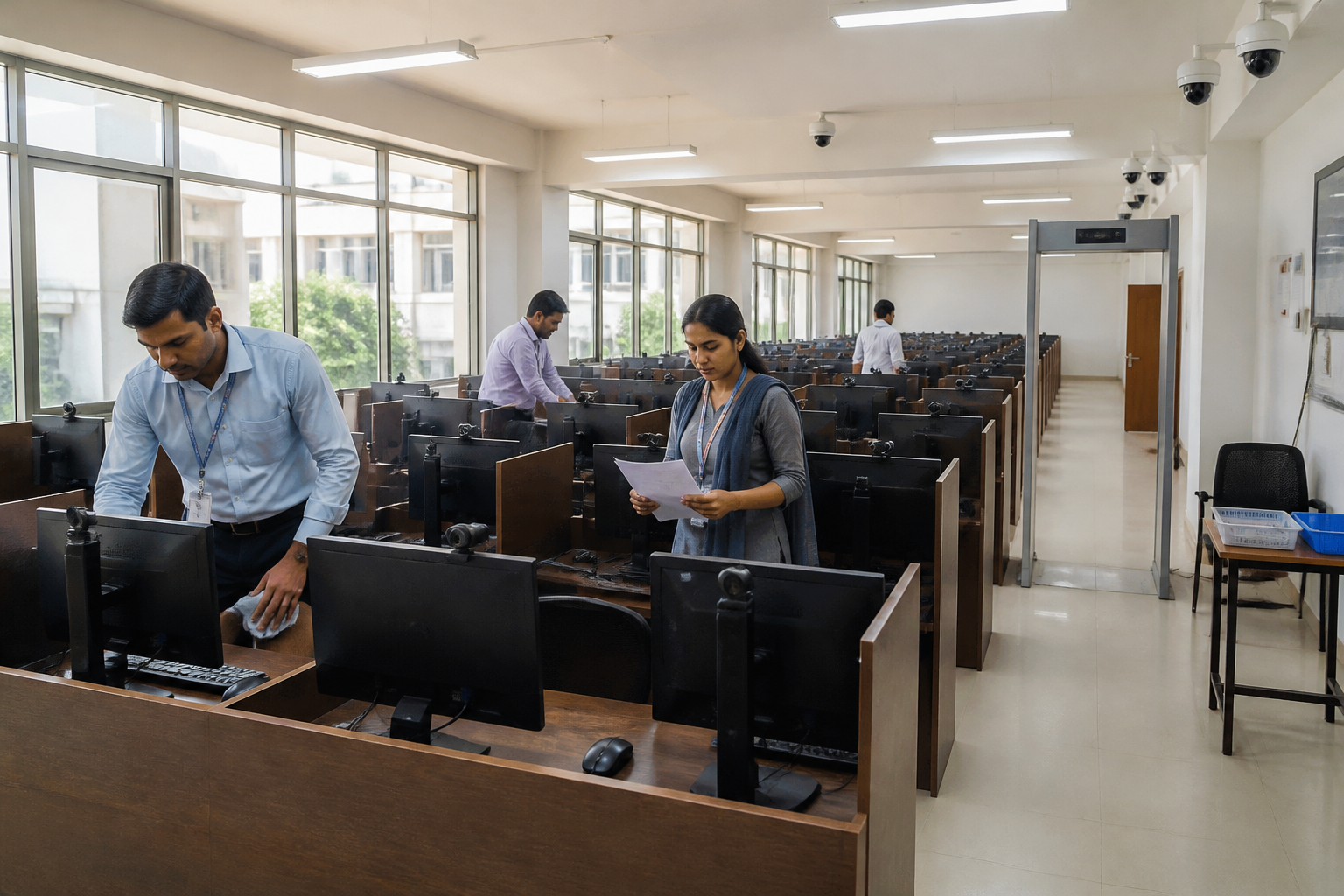
The physical network of examination centres is an equally important part of the reform challenge. The Indian Express report quoted an official as saying that vendors currently operate centres on lease. The issue becomes more significant as the government plans to shift the National Eligibility-cum-Entrance Test from pen-and-paper mode to computer-based testing from next year. A computer-based national examination requires reliable premises, secure devices, connectivity, power systems, trained personnel and procedures that work consistently across locations.
The NTA has asked the All India Council for Technical Education to identify spaces in government technical institutions that could be used to establish standard testing centres. This indicates a possible move away from a network dependent primarily on leased vendor facilities towards greater use of institutional premises. However, the supplied information does not establish how many centres will be required, how they will be funded, or how quickly they can be audited and brought to a common standard.
That gap is important because examination access is shaped by geography. A national test may be administered through a common digital platform, but the student experience still depends on the centre assigned to them. The reliability of equipment, security screening, seating, power supply, staff training and local connectivity can vary between a major city, a regional centre and a rural location. The task force’s consultations with Chief Secretaries and Directors General of Police of states and Union Territories, conducted in coordination with the Ministry of Home Affairs, suggest that examination security is being treated as a system involving both central and state-level administration.
The consultations have covered a wide institutional field. According to the affidavit, the task force spoke to the Department of Higher Education, the Department of School Education and Literacy, the Ministry of Health and Family Welfare, examination and recruitment organisations, technology providers, vendors and domain experts. It also consulted the National Recruitment Agency, Staff Selection Commission, Railway Recruitment Board and Institute of Banking Personnel Selection, along with the National Medical Commission, National Board of Examinations in Medical Sciences, University Grants Commission, Central Board of Secondary Education and National Council of Educational Research and Training.
This range of participants reflects the fact that India does not operate one examination system. Medical admissions, higher education, school examinations, recruitment and banking tests involve different institutions, legal mandates and operational requirements. Yet they share some risks: dependence on testing infrastructure, the need to protect examination content, the management of large candidate volumes and the consequences of irregularities for students whose academic and professional timelines are difficult to recover.
The public feedback platform, ‘Listen at Scale’, has added another channel to the process. The affidavit said that suggestions received through the platform, along with institutional and expert consultations, were being collated and considered. More than 50,000 suggestions have reportedly been received. The number indicates the breadth of concern, but it does not by itself show which proposals will be accepted, how they will be prioritised or whether they can be implemented within existing administrative and financial arrangements.
Several proposals made by the United Doctors Front focus on creating auditable systems rather than relying only on assurances. These include a National Registry of Certified Centres, annual centre inspections, a physical audit 15 days before an examination and a minimum three-cycle ban for centres that fail inspection. The group has also proposed a centralised, searchable record of every irregularity, multiple panels for question setting, a question bank eight to ten times larger than the number of questions required for a cycle, traceable markers on finalised questions, artificial intelligence to detect paper leaks and digital locking of question papers.
Such measures would shift examination governance towards documentation and traceability. A registry could establish which centres are currently eligible to host national examinations. Inspection records could make it easier to identify repeated failures. A searchable irregularity database could help authorities detect patterns across examinations rather than treating each incident as isolated. But the supplied material does not confirm whether the task force has endorsed these specific proposals or how their legal and technical requirements would be resolved.
The government has already said in an earlier affidavit that the NTA is moving from examination-specific units to a functional vertical structure, with specialised capabilities across core operational areas. That restructuring is consistent with the wider direction of the proposals: building permanent institutional knowledge instead of assembling examination capacity separately for each test. Yet the success of such a model would depend on staffing, procurement, accountability and coordination between the NTA, state authorities, examination bodies and centre operators.
The central urban question is therefore not simply whether examinations will become computer-based or whether one agency will be reorganised. It is whether India can create a dependable, distributed public infrastructure for high-stakes testing. The answer will involve buildings and equipment, but also the less visible systems that govern them: centre certification, security protocols, inspection schedules, trained staff, data records and clear responsibility when something fails.
The task force’s 58 meetings and more than 50,000 suggestions show the breadth of the reform exercise. They do not yet establish the final architecture of the examination system. The next decisive step is the submission of the task force’s report and recommendations to the government by the end of October. Its treatment of testing centres, permanent technical capacity, responsibility-sharing and audit mechanisms will determine whether the exercise produces a new institutional framework or mainly a reorganisation of existing arrangements.
