


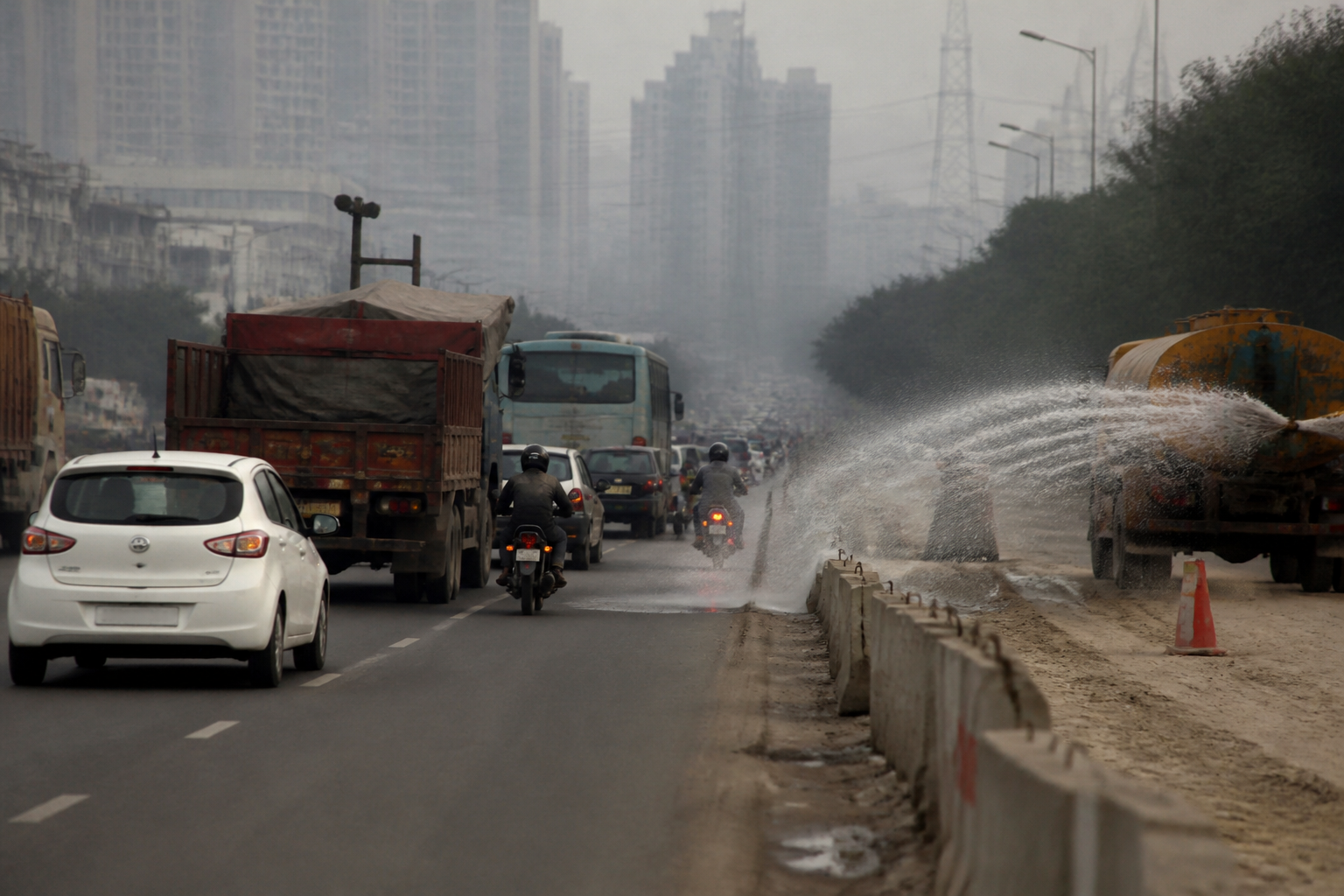
The Delhi pollution plan reported from an interim expert committee report submitted to the Commission for Air Quality Management is not merely a proposal to remove older vehicles. It is a broad attempt to reorganise how the National Capital Region moves people and goods, supplies electricity, manages construction, regulates parking and delivers municipal services. The committee has recommended immediate removal of BS-1 to BS-3 vehicles, a phased withdrawal of BS-4 vehicles by 2030, and a longer transition for BS-6 vehicles. It has also proposed that new vehicle sales increasingly shift towards zero-tailpipe-emission vehicles, with private cars reaching a 100 per cent target by 2030.
That breadth matters because the report itself rejects a single-source explanation for Delhi-NCR’s air pollution. It identifies vehicle exhaust alongside road dust, brake and tyre particles, construction and demolition, waste burning, industries, power plants, diesel generators, coal use and agricultural burning. The central policy question is therefore not whether older vehicles should be removed. It is whether the region can build the institutions, infrastructure and financing systems needed to make such a transition workable for households, businesses and public agencies.
The committee’s starting point is the composition of the regional vehicle fleet. According to the report, the NCR has 2.21 crore active and fitness-approved vehicles, while electric vehicles account for only 3.6 lakh, or 1.6 per cent. Around 57 per cent of the fleet is BS-4 or older. BS-1 to BS-3 vehicles account for approximately 30 per cent of the fleet but are estimated to contribute about 74 per cent of particulate-matter emissions from vehicles. By contrast, BS-6 vehicles make up more than 41 per cent of the fleet and contribute around 7 per cent of particulate emissions, according to the committee’s assessment.
These figures explain the proposed sequencing. The committee has recommended the immediate removal of BS-1, BS-2 and BS-3 vehicles, followed by a pilot restriction on BS-4 vehicles in Delhi and the NCR from the winter of 2026. It has proposed expanding that restriction from the following year and removing BS-4 vehicles by 2030. BS-6 two-wheelers and four-wheelers would be phased out later, by 2035 and 2040 respectively. These are recommendations, not an announced final regulation, and their implementation would require decisions by the relevant governments and agencies.
The report also moves beyond scrappage by proposing controls on the vehicles entering the fleet. It recommends that zero-tailpipe-emission vehicles account for 20 per cent of new private four-wheeler sales in Delhi-NCR in 2027, 45 per cent in 2028, 70 per cent in 2029 and 100 per cent in 2030. Vehicle companies would have to report their overall sales and zero-emission sales each month. Companies missing the targets could face progressively stronger restrictions on the registration of new petrol and diesel vehicles.
The proposal is significant because it shifts part of the responsibility from vehicle owners to manufacturers and registration authorities. In 2025, about 21.8 lakh new vehicles were registered in Delhi and the NCR, the report says. Medium and heavy goods vehicles accounted for 55.3 per cent of the particulate emissions associated with these new registrations, followed by two-wheelers at 15.6 per cent, passenger three-wheelers at 12.1 per cent and buses at 8.1 per cent. The numbers suggest that a transition focused only on private cars would leave major commercial sources untouched.
For that reason, the committee has proposed different zero-emission deadlines for different vehicle categories. Three-wheelers, two-wheeler taxis, delivery vehicles and light goods vehicles would be targeted from 1 April 2027. Four-wheeler taxis and medium and heavy buses would follow from 1 April 2028. Medium goods vehicles would have a target date of 1 January 2031, while heavy goods vehicles would be targeted from 1 April 2032. Private four-wheelers have a proposed target date of 1 January 2031, although the separate sales target for new private vehicles reaches 100 per cent in 2030.
This timetable exposes the infrastructure challenge behind the vehicle policy. The committee has recommended a Right to Charge law for Delhi and the NCR, giving homeowners, tenants and electric-vehicle owners with designated parking a statutory right to install 3, 7 or 11-kilowatt chargers. Resident welfare associations and builders would not be able to refuse installations arbitrarily, and a separate no-objection certificate requirement would be removed under the proposal. Electricity distribution companies would be expected, where technically feasible, to provide domestic or community charging connections within 15 days.
The recommendation is particularly relevant to the region’s apartment-heavy housing stock and buildings without individual parking spaces. Where individual parking is unavailable, residential and office complexes would be expected to create shared charging facilities in at least 20 per cent of their total parking capacity. The proposal also suggests keeping electricity tariffs for such connections no higher than the supply cost for at least three years. Whether these provisions can be implemented will depend on building rules, electrical capacity, parking allocation and the willingness of state and local authorities to coordinate with distribution companies.
The committee has extended the zero-emission requirement to government and public-sector procurement. From 1 April 2027, government offices and public-sector undertakings would, where technically possible, purchase, hire or contract only zero-tailpipe-emission vehicles. All municipal services would be shifted to such vehicles by 1 April 2030. Construction vehicles and equipment would be targeted for conversion by 1 April 2028. These recommendations would directly affect waste collection, road maintenance, public works and construction logistics, areas where procurement decisions are distributed across multiple departments and agencies.
The report’s treatment of non-exhaust emissions is another important departure from a narrow vehicle policy. It calls for immediate road repairs, continuous monitoring of dust hotspots, and standards for regular vacuum cleaning and water sprinkling. It also recommends reviewing vehicle material and construction standards by April 2027 to reduce particles from tyres and brakes. From 1 April 2028, remote sensing of emissions from private and commercial vehicles has been proposed. This would allow authorities to identify real-world emissions from vehicles on the road and send high-emitting vehicles for inspection, repair, retesting or, where necessary, recall.
The proposed low-emission zones would add a spatial layer to enforcement. In highly polluted or heavily trafficked areas, entry by non-zero-emission vehicles could be restricted according to location, time, weather and vehicle category. Automatic number-plate recognition cameras could identify vehicles, control access and collect charges. The committee has also proposed parking-management plans, differentiated parking fees and congestion pricing in selected areas. These measures would connect air-quality regulation to the management of scarce road and parking space, although the report supplied in the source does not specify the locations, charges or enforcement agencies for such zones.
Construction and waste management form another part of the proposed system. The committee has recommended that construction sites be covered with fine mesh, vehicles transporting construction materials be fully covered, and construction equipment move to zero-emission technology from 2028. Burning waste at landfill sites would be made completely illegal. The recommendations indicate that the urban pollution challenge is also a problem of site supervision, contracting and municipal enforcement. A rule on paper will have limited effect unless local bodies can inspect sites, track violations and enforce penalties across the region.
The report also proposes replacing diesel generators with battery energy storage and rooftop solar power, shifting coal-based industrial heating to electricity, and supporting agricultural-residue management through custom-hiring centres. Each of these measures involves a different institution: electricity regulators and distribution companies for charging and power supply, urban local bodies for waste and dust, industrial authorities for fuel transitions, and agricultural agencies for crop-residue management. The regional nature of the pollution means that Delhi’s administration cannot deliver the entire programme alone.
The urgency cited by the committee is substantial. It says the NCR’s air-quality index has crossed 460, that around six crore people are affected, and that winter PM2.5 levels have reached nearly 35 times the World Health Organization limit. The report therefore frames the problem as a multi-sector transition over the next decade rather than a seasonal emergency. At the same time, its proposed deadlines create a governance test: authorities must coordinate vehicle registration, charging access, power connections, public procurement, road maintenance, construction regulation and regional enforcement.
What the committee’s interim report establishes is the scale of the proposed response and the evidence it uses to prioritise older and high-emitting vehicles. What remains unsettled is the legal and administrative pathway from recommendation to enforceable policy, including the treatment of vehicle owners, financing for replacement, charging access, commercial-vehicle operations and coordination across NCR jurisdictions. The next stage will depend on how CAQM and the concerned governments assess the interim recommendations and convert them, if accepted, into notified rules, budgets and implementation schedules.
