


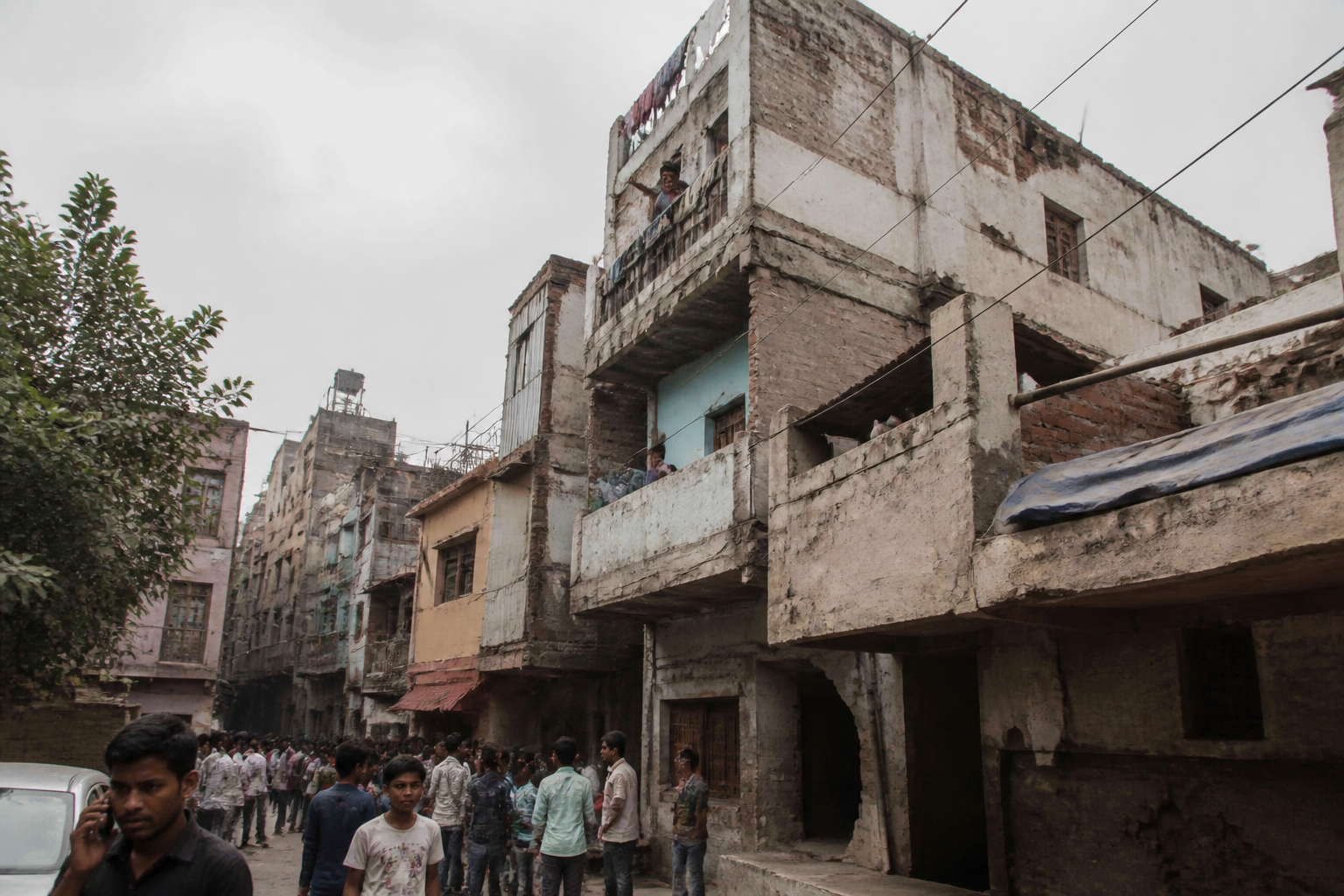
The collapse of a five-storey building in Seemapuri, following recent deaths in other parts of Delhi, has exposed a problem larger than one unsafe structure: the city’s systems for identifying, recording and acting against dangerous buildings are failing to keep pace with the risks visible on the ground. Jagran – New Delhi reported that more than 120 people have died in incidents involving illegal construction and dilapidated buildings over the past decade.
The immediate concern is the gap between official inspection promises and neighbourhood-level reality. A month before the Seemapuri collapse, after a paying guest accommodation in Satya Niketan fell on 6 September, Delhi’s mayor Pravesh Wahi announced that all 12 municipal zones would conduct a fresh survey of dangerous and dilapidated buildings. The stated plan was to identify such structures and take immediate action under the Delhi Municipal Corporation Act and other applicable rules.
But, according to the report, the survey team did not reach the allegedly unauthorised and deteriorated houses in Seemapuri before the collapse. The Municipal Corporation of Delhi subsequently said that the house had been built around 25 years ago. The report also said that residents told civic officials that Bangladeshi and Rohingya people were living there, but that the corporation did not explain why action had not been taken earlier. That detail points to a central administrative question: whether inspections are identifying structural danger systematically, or only after a building has already become a public emergency.
The Seemapuri incident was reported as the third fatal building-related event in Delhi within roughly a month. On 29 September, an illegally constructed first floor collapsed in Tahirpur, killing one person. The Satya Niketan collapse had occurred earlier in the month. The incidents were different in their immediate circumstances, but the report connects them through recurring features: unauthorised additions, ageing or weak structures, complaints that allegedly did not lead to timely action, and enforcement that intensified briefly after a collapse before slowing again.
That pattern matters because illegal construction is not simply a question of planning violations. In densely occupied neighbourhoods, additional floors, altered layouts and structures built without adequate safety standards can increase the exposure of tenants, owners, neighbours and emergency workers. When these buildings are also old or poorly maintained, the distinction between a construction violation and a life-safety threat becomes difficult to sustain. The administrative response therefore has to identify both the legal status of a building and its physical risk.
Delhi’s illegal construction problem is also an inspection problem
The report describes the E Block in Seemapuri as an area where houses lack pillars and many structures are in poor condition. Whether every building in the locality meets that description would require an independent technical survey, but the reported conditions illustrate why broad claims of seasonal inspection need to be tested against street-level coverage. The corporation is said to claim that thousands of buildings are surveyed before the monsoon, while only a few dozen across Delhi are officially declared dangerous.
That difference between the number of buildings examined and the number formally classified as hazardous is not, by itself, proof that inspections are inaccurate. A survey may find that many structures do not meet the threshold for formal condemnation or evacuation. But the figures raise a question about the criteria being used, the quality of inspections and what happens to buildings that are unsafe but not immediately declared dangerous. A system that records buildings without creating a clear path to repair, evacuation, demolition or continued monitoring can leave residents in the same risk environment after the inspection is complete.
The source report also refers to earlier investigations into the Saket and Satya Niketan incidents. It says local residents had complained to the MCD about illegal construction months before those collapses. It further states that a magisterial inquiry found that, in several cases, officials prepared show-cause notices with earlier dates after buildings had collapsed, allegedly to shield themselves from responsibility on paper. These are serious claims and should be read as findings and allegations reported by the source, not as a blanket conclusion about every municipal official. If established, however, they would show that the problem extends beyond weak enforcement to the integrity of administrative records.
A building-safety regime depends on an auditable chain of action. A complaint must be received, logged, inspected, technically assessed, assigned to an officer, communicated to the owner or occupier, and followed through until the danger is removed or controlled. Each stage creates a record that can be reviewed before and after an incident. If notices are generated only after a collapse, the paperwork may show activity while failing to demonstrate prevention. The question for Delhi is therefore not only how many notices were issued, but when they were issued and what physical action followed.
Why post-collapse enforcement cannot substitute for prevention
Former East Delhi mayor Shyam Sundar Aggarwal, quoted in the report, described building collapses as the result of administrative support rather than natural disasters and compared them to killings. His language is political and accusatory, but it reflects a wider institutional concern: structural failures in occupied buildings are rarely sudden in the administrative sense. Cracks, unauthorised additions, overloading, poor maintenance, visible deterioration or repeated complaints may precede the final collapse.
Jagdish Mamgain, who previously chaired the MCD’s construction committee, said action often accelerates for three or four days after such incidents and then loses momentum. This claim, attributed to a former municipal office-bearer, describes a familiar enforcement cycle: a fatal event triggers inspections, public statements and visible action, but the system does not sustain the same intensity once media and political attention move elsewhere.
That cycle is especially consequential in a city divided into 12 municipal zones and containing large numbers of older, dense and informally modified buildings. A citywide survey cannot be judged only by the announcement of its launch. Its effectiveness depends on whether teams reach vulnerable locations, whether inspection methods are consistent, whether residents can report risks safely, and whether the corporation has the authority and resources to act against buildings that are occupied and politically sensitive.
The Seemapuri case also exposes the limits of attributing risk to the age of a building after the event. Saying that a house was built 25 years ago may establish part of its history, but age alone does not explain whether construction standards were followed, whether additions were made later, whether maintenance was neglected or whether previous complaints existed. Those details determine whether the collapse was preventable and which institution or process failed before it occurred.
The governance gap behind unsafe buildings
MCD action operates within a difficult enforcement environment. Illegal structures are often occupied, and any intervention can affect tenants, owners and neighbouring households. Evacuation, demolition or sealing requires coordination, communication and, in many cases, a plan for people who may lose their accommodation. That complexity cannot justify inaction, but it does explain why a notice alone may not resolve a dangerous building.
The report’s account suggests that Delhi’s challenge is not the absence of rules. The mayor referred to action under existing municipal law and other applicable regulations. The reported inquiries into Saket and Satya Niketan also indicate that complaint and notice mechanisms exist. The unresolved issue is implementation: whether information travels from residents to inspectors, from inspectors to decision-makers, and from decisions to timely physical action.
This is where institutional accountability becomes important. If a complaint is ignored, responsibility may be distributed across local offices, engineering staff, building departments and senior administrators. If a survey misses a dangerous structure, the city needs to know whether the failure resulted from incomplete mapping, limited staffing, inaccurate records, inaccessible premises or inadequate technical assessment. Without that diagnosis, every new survey risks repeating the same weaknesses.
The available evidence does not establish how many buildings in Delhi are currently at risk, how many complaints remain unresolved, or how many structures have been repaired, vacated or demolished following earlier surveys. It also does not provide the full findings of the inquiries cited in the report. Those gaps matter because the reported death toll and recent incidents show the scale of the public-safety concern, but not yet the complete size or distribution of the underlying building-risk inventory.
What the evidence does establish is a recurring sequence: fatal collapses, public commitments to fresh surveys, allegations of delayed or ineffective enforcement, and renewed attention to illegal construction only after lives are lost. More than 120 deaths over a decade, as reported by Jagran – New Delhi, make this a sustained urban governance issue rather than a series of isolated accidents.
The next test is whether the announced survey across all 12 zones produces a verifiable list of dangerous and dilapidated buildings, with clear action taken against each identified risk. The credibility of that exercise will depend not on the number of inspections announced, but on whether vulnerable buildings are found before collapse, whether records show when complaints were received and acted upon, and whether residents can see a meaningful change in the safety of the neighbourhoods where they live.
