


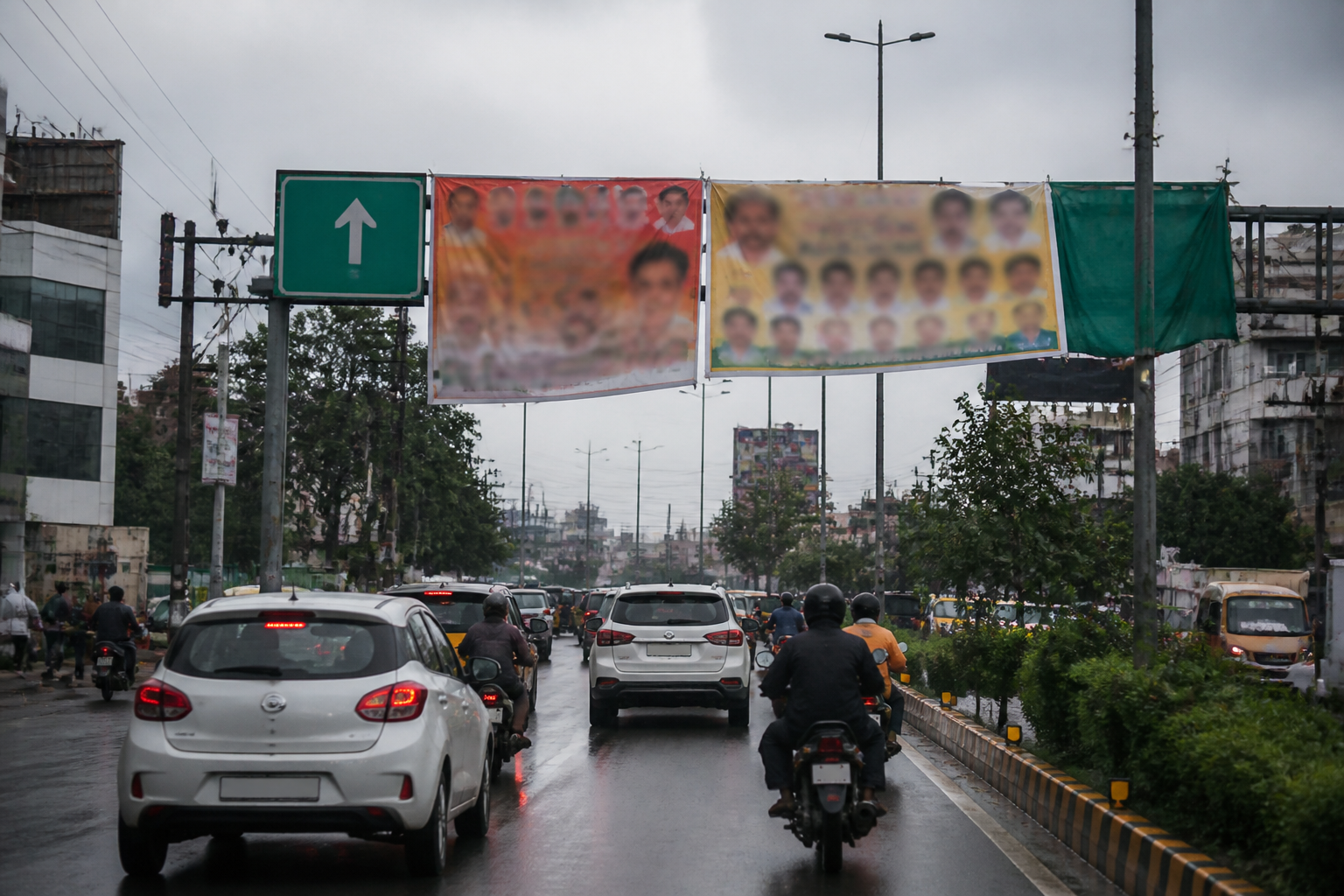
Illegal political hoardings and banners are obstructing road and traffic signs across Bhopal, raising fresh road-safety concerns despite a 2014 Madhya Pradesh High Court order directing authorities to remove unauthorised hoardings within 48 hours.
The advertisements have appeared on VIP Road, TT Nagar, Arera Colony and inner roads, covering poles, road infrastructure and other public spaces. Many promote birthdays, political events and anniversaries of local leaders, with large photographs of politicians and political aspirants displayed on flex banners and hoardings.
At several intersections, the banners reduce the visibility of traffic signs and approaching vehicles. Motorists told the Times of India that they are sometimes forced to move forward before they can see traffic coming from another direction. The obstruction is particularly concerning at busy junctions, where signs provide information about directions, traffic movement and road regulations.
The banners can also create a physical hazard during the monsoon. Loosely secured flex sheets may swing in strong winds, potentially affecting visibility and creating risks for commuters. A local resident said posters along the airport route were shifted during a recent VVIP visit, apparently to reuse existing frames, but later returned to VIP Road after the visit.
The practice cuts across political parties, with supporters using public infrastructure and prominent road locations to establish a political presence. The continued installation of such material has brought renewed attention to whether civic enforcement is addressing only the visible advertisements or also identifying the people and organisations responsible for putting them up.
Bhopal Municipal Corporation deputy commissioner Hirendra Singh Kushwaha said illegal hoardings had been largely brought under control. He said the civic body uses a GPS-enabled pole-tracking mechanism to monitor advertisements and takes action when unauthorised posters or banners are brought to its notice.
However, the BMC could not provide details of penalties imposed specifically for political advertisements. The lack of publicly available penalty information has raised questions about the enforcement of existing rules, particularly when the same locations repeatedly see the return of unauthorised publicity material.
The Madhya Pradesh Outdoor Advertisement Media Rules, 2017 give authorities powers to regulate outdoor advertising, remove unauthorised installations and impose penalties. The Madhya Pradesh Municipal Corporation Act, 1956 also provides for action against unauthorised advertisements. The Madhya Pradesh Sampatti Virupan Nivaran Adhiniyam, 1994 provides for action against defacement of public and private property.
The High Court’s intervention in 2014 followed concerns that illegal hoardings were obstructing traffic and contributing to road accidents. The order required the state government to remove illegal hoardings within 48 hours. Court proceedings on the issue are continuing, according to the report.
The latest instances leave the BMC with two immediate enforcement tasks: removing banners that obstruct signs or create hazards, and establishing whether penalties are being imposed on those responsible. The civic body’s GPS-based monitoring system and the existing legal provisions remain the stated mechanisms for regulating such advertisements.
