


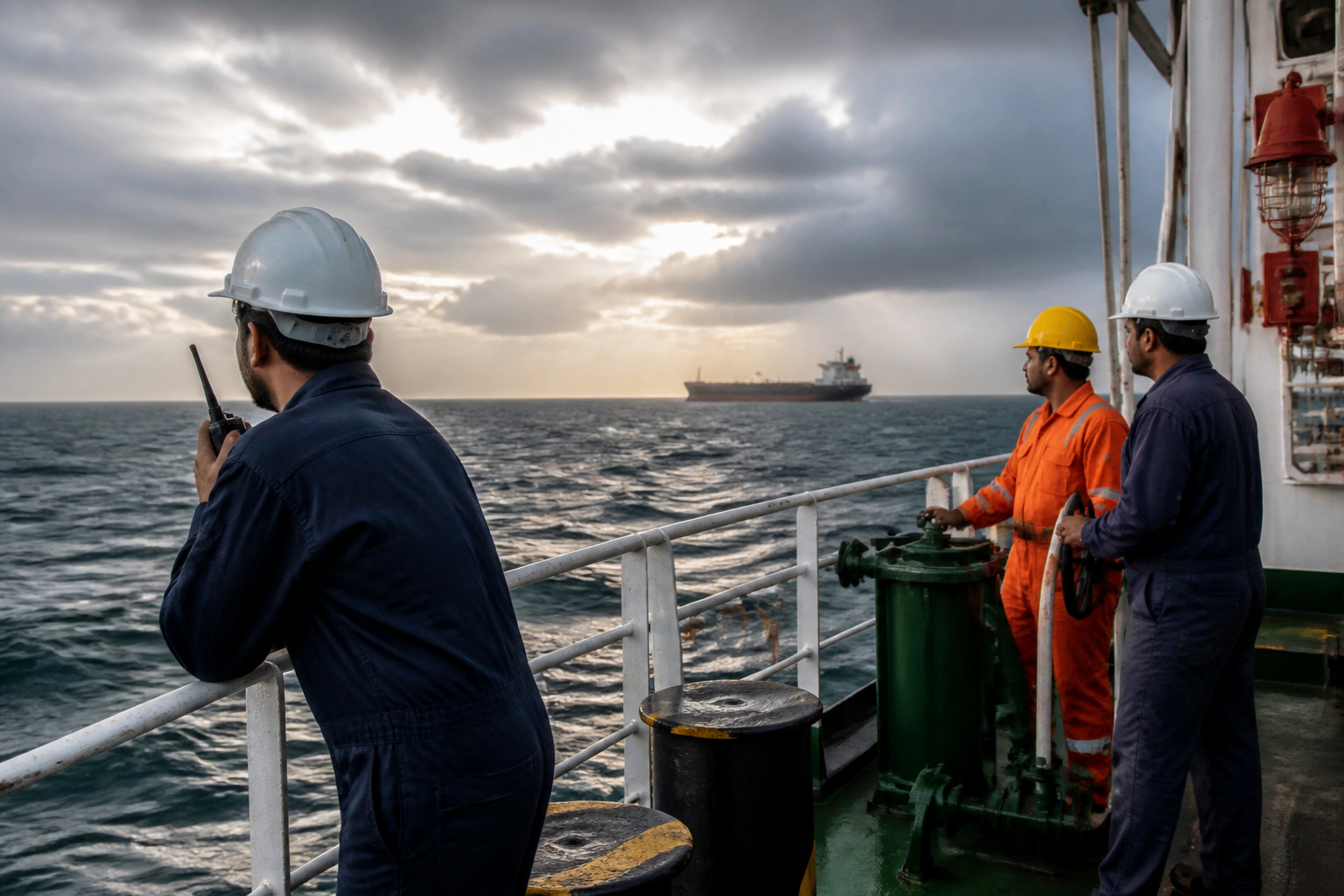
India’s rise as the world’s second-largest supplier of seafarers has created a new policy challenge: protecting Indian workers on foreign ships operating through conflict zones, pirate-infested waters and jurisdictions where employers can be difficult to hold accountable. Recent attacks in the Black Sea and off Oman have made that challenge visible, but the underlying problem is larger than any single incident. It concerns how a country protects citizens whose nationality, employer, vessel and place of work may all fall under different legal systems.
Three Indian crew members were injured when a commercial vessel was attacked in the Black Sea, while 11 Indians were injured in a strike on an oil tanker off Oman, according to the Economic Times report that forms the basis of this analysis. These incidents came as India’s maritime workforce reached 311,936 professionals, accounting for 12.16% of the global seafarer workforce. The scale of that presence means that maritime safety is no longer only a shipping-sector concern. It is also a labour-policy, consular and national economic issue.
The numbers explain why India has become central to the global merchant fleet. The 2026 BIMCO-ICS Seafarer Workforce Report places India behind only the Philippines in the supply of seafarers and ahead of China, Russia and Indonesia. In 2015, India ranked fifth and accounted for 5.2% of the global workforce. The increase reflects India’s technical training capacity, maritime education system, English-language capability and long-established relationships between Indian workers, recruitment agencies and international shipowners.
India’s workforce is not concentrated only among senior officers. Indian officers number 140,718, representing 13.41% of the global officer workforce. The larger expansion has taken place among ratings, the operational and technical crew working below officer rank. India’s officer-to-rating ratio moved from 60:40 in 2010 to 35:65 in 2024, while the global ratio is about 45:55. That shift shows that India’s importance rests on the breadth of its labour pool as much as on the supply of captains and marine engineers.
The global industry is already operating with a significant labour requirement. BIMCO and the International Chamber of Shipping estimate that 2.57 million seafarers serve 85,148 merchant ships. The industry is short of about 39,100 STCW-certified officers and could require another 113,735 by 2030. India’s Mission 20% target seeks to make one in every five global seafarers Indian. The opportunity is substantial, but so is the exposure created by sending more Indian workers into an unstable maritime environment.
A seafarer’s legal and administrative position is unusually fragmented. An Indian citizen may be recruited through an Indian agency, employed by a foreign company, work aboard a ship registered in another country and travel through waters affected by a war involving entirely different states. The flag state has responsibilities for the vessel, the employer controls the employment relationship, the coastal state controls waters around its territory and India remains responsible for assisting its citizen. In an emergency, these overlapping responsibilities can slow decisions on evacuation, compensation, medical care and repatriation.
The vulnerability does not begin when a vessel enters a conflict zone. Recruitment practices, contract terms, wage arrangements, insurance and repatriation provisions determine how much protection a worker has once the ship leaves Indian waters. This is why India’s regulatory response has increasingly focused on the recruitment chain rather than only on naval or diplomatic action after an attack.
In May, India’s shipping regulator barred 366 foreign-flagged vessels from recruiting Indian seafarers through Indian agencies. Of these, 278 were placed in a restricted category and 88 were blacklisted. The cases involved unpaid wages, denial of compensation after deaths or disappearances, hardship and failures to repatriate abandoned crew. The measure uses India’s labour supply as regulatory leverage. For a foreign shipowner, losing access to Indian recruitment channels can become a commercial disadvantage, particularly when the global market already faces a shortage of qualified personnel.
The government has also taken a more interventionist position when security risks rise. After attacks on merchant ships in the Gulf, the Directorate General of Shipping advised recruitment and placement agencies in June to restrict the deployment of Indian seafarers to conflict areas until further orders. Emergency crew changes could take place with the consent of the seafarers. The response followed earlier monitoring and security measures in West Asia and involved coordination between the foreign ministry, Indian missions, the Navy and shipping companies.
By June, more than 3,500 Indian seafarers had been safely repatriated from the Gulf region, while the DG Shipping control room had handled thousands of calls and emails from seafarers, families and maritime stakeholders. This indicates a shift from general safety advisories to an administrative system designed to identify, contact and move workers during a crisis. The effectiveness of such a system depends not only on instructions issued in New Delhi, but also on whether individual workers can be located quickly and receive reliable assistance through the chain of agencies involved.
The Merchant Shipping Act, 2025, which came into force in March, provides a broader legal basis for this approach. The law strengthens safeguards for abandoned seafarers and gives regulators greater oversight of recruitment and placement services. It also provides a stronger framework for implementing international maritime labour standards. Its significance lies in addressing vulnerabilities before a worker becomes stranded: the quality of the contract, the reliability of the employer, the availability of insurance and the obligations attached to repatriation.
Following attacks in the Strait of Hormuz, Shipping Minister Sarbananda Sonowal ordered a “Seafarer-First” system under which every Indian seafarer in the affected region would be individually accounted for, regardless of the vessel’s flag. Each affected worker was to have a dedicated liaison officer, supported by vessel-by-vessel monitoring and round-the-clock coordination. The government later formalised a wider framework involving real-time tracking, a 24-hour control room and regular situation reports. Indian missions across West Asia and the Black Sea were brought into reviews with the shipping ministry and the maritime regulator.
The launch of E-Samudra in August added a digital layer to the system. The platform includes services for seafarers and a 24-hour grievance-redressal mechanism. Digital tracking and complaint systems cannot remove the physical risks of war or piracy, but they can reduce the information gap that often leaves families and authorities uncertain about a worker’s location and condition. In maritime emergencies, that information gap can affect the speed of medical assistance, communication, evacuation and wage or compensation claims.
India’s policy response has also moved beyond domestic regulation. At the BRICS summit in September, Prime Minister Narendra Modi proposed a Seafarers Emergency Support Network linking maritime authorities and diplomatic missions. The proposed network would coordinate distress alerts, medical assistance, communication with families and evacuation when ships come under threat. During the United Nations General Assembly week, India and Liberia launched the Group of Friends on Safety and Security of Shipping and Seafarers. External Affairs Minister S. Jaishankar linked the initiative to the earlier BRICS proposal.
The India-Liberia partnership reflects the fragmented structure of global shipping. India is one of the largest suppliers of seafarers, while Liberia operates one of the world’s largest ship registries. The sailor’s nationality and the vessel’s nationality are therefore represented by different states, each with different responsibilities and capacities. Any system that seeks to improve maritime safety must work across that divide rather than treat the worker, vessel and employer as part of a single national system.
India’s maritime strategy now contains a clear tension. The country wants to expand its share of a global industry facing a shortage of officers and other qualified personnel. At the same time, every additional Indian seafarer working internationally may be exposed to risks that Indian authorities cannot eliminate through domestic regulation alone. Preventing deployment to dangerous waters can protect workers in the short term, but broad restrictions could also limit employment opportunities and undermine the Mission 20% ambition.
The emerging response is therefore based on layers of protection: restricting access to unsafe employers, monitoring recruitment agencies, limiting deployment to conflict zones, repatriating crews, tracking vessels, maintaining emergency control rooms and building diplomatic coordination. The evidence supplied in the report shows that India is treating seafarers less as an invisible export workforce and more as a strategic labour population requiring continuing state support.
The larger urban and infrastructure question is how global transport systems distribute risk. Merchant shipping connects ports, supply chains and economies, but the workers who keep those systems operating may be governed by institutions that are separated by geography and law. India’s seafarer expansion gives it economic influence, yet it also exposes the limits of national protection when employment and infrastructure are international. The next test will be whether the new regulatory, digital and diplomatic systems can provide consistent protection not only during major attacks, but also in the less visible cases involving abandoned ships, unpaid wages, missing compensation and failed repatriation.

