


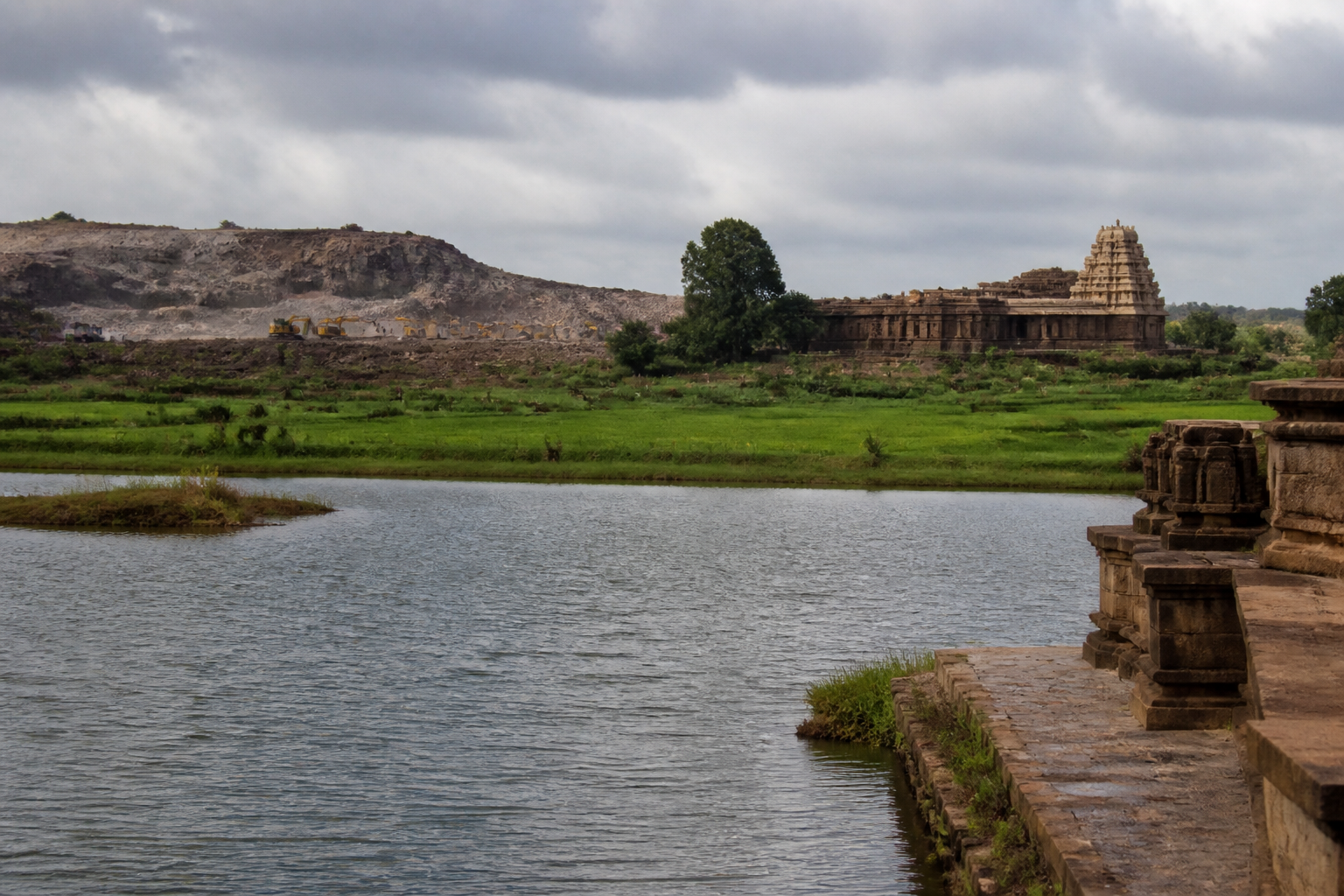
The proposed Venkatapur open-cast coal mine in Mulugu district has exposed a difficult urban and regional planning question: how should public authorities weigh energy extraction against the protection of a living heritage landscape, its water systems and the communities dependent on them? The project has triggered opposing claims. Former MP and BRS leader B Vinod Kumar has urged the Centre and Telangana government to withdraw it, while Singareni Collieries Company Limited (SCCL) has rejected concerns about damage and said mining will proceed only after scientific studies assess the risks.
The immediate dispute concerns the distance and depth of the proposed mine. According to Vinod Kumar, citing a report submitted by the Kakatiya Heritage Trust to Union Coal Minister G Kishan Reddy, the open-cast mine could be around 300 metres deep and approximately five kilometres downstream of Ramappa Temple and Ramappa Lake. He has argued that the location creates risks for an internationally recognised heritage site as well as the ancient Kakatiya irrigation system associated with it.
SCCL has described reports of a threat to Ramappa as misconceptions and baseless allegations. In its statement, the public-sector mining company said it would conduct a comprehensive scientific assessment of the possible impact on the heritage site and surrounding areas before proceeding. It said studies would be carried out by the Archaeological Survey of India and other reputed institutions, and that further action would follow their findings and recommendations.
That disagreement makes the scientific assessment more than a procedural step. It is the point at which the project’s location, geological conditions, groundwater behaviour, vibration risks and heritage obligations will have to be examined together. The supplied report does not establish that mining will damage Ramappa Temple, nor does it provide the findings of an completed impact assessment. It does, however, identify the specific risks raised by the heritage trust and the safeguards promised by SCCL.
A heritage site is rarely limited to the structure that appears in official photographs. In this case, the debate includes Ramappa Temple, Ramappa Lake, canals and an irrigation network that Vinod Kumar describes as part of the wider Kakatiya heritage landscape. His intervention comes as efforts are reportedly under way to extend the buffer zone of the Ramappa site to cover this wider system.
According to Vinod Kumar, the World Heritage Committee at its 2026 session welcomed efforts by the Centre and Telangana government to extend the buffer zone. He said UNESCO had encouraged submission of the proposal by February 1, 2027. The proposed expansion, as described in the report, would recognise that the temple’s heritage value is linked not only to its architecture but also to the historic water infrastructure and landscape around it.
This creates an institutional tension. A mining project is assessed through permissions, clearances and technical studies, while heritage protection operates through conservation obligations and the management of a wider cultural setting. If the proposed buffer-zone extension proceeds, the question will be how the mine is evaluated against a heritage boundary that may become broader than the existing protected site.
The water system is also central to the dispute. Vinod Kumar said Ramappa Lake has a storage capacity of about three thousand million cubic feet and supports irrigation over nearly 30,000 acres. These figures were presented by him during a press conference at Telangana Bhavan and are not independently assessed in the supplied material. They nevertheless indicate the scale of the issue he wants authorities to consider: the proposed mine is not being debated only as a potential threat to a monument, but also as a possible intervention in an operating irrigation landscape.
His argument rests on the physical relationship between the mine and the heritage system. The Kakatiya Heritage Trust report, as cited by him, raised concerns about geological faults, fractures, groundwater movement and repeated blasting vibrations. Each concern points to a different pathway of possible impact. Geological faults and fractures may affect how ground disturbance travels. Groundwater movement may connect excavation with the lake, canals or surrounding areas. Blasting vibrations raise questions about structural stability, particularly when a historic building is located within the wider zone of concern.
The report supplied for this story does not contain technical measurements, baseline surveys or modelling results for any of these risks. It therefore cannot establish the scale or probability of damage. What it does show is that the debate has moved beyond a general objection to coal mining. The dispute is now framed around specific environmental, geological, hydrological and structural questions that authorities will have to answer before permissions are granted or operations begin.
SCCL’s position places the Archaeological Survey of India and other reputed institutions at the centre of that process. The company has said it is conscious of its responsibility as a Telangana public-sector undertaking and would not undertake activity that could damage Ramappa Temple. It has also reiterated that it must meet the state’s energy requirements through responsible mining practices.
That response establishes a proposed sequence: scientific assessment first, followed by action based on findings and recommendations. The available report does not specify the studies’ terms of reference, the institutions other than the ASI that may participate, the timeline for completion, or whether the assessment will cover the temple alone or the lake, canals, groundwater system and irrigation command area as well. Those details matter because the boundaries of assessment will determine which risks are visible to decision-makers.
Vinod Kumar has demanded that the Centre and Telangana government withdraw the project, deny all permissions and clearances, protect the temple, lake and irrigation network, and explore alternative mining locations. He said he was not opposed to development, Singareni Collieries or the country’s energy needs, but argued that coal could be extracted from other locations while Ramappa could not be relocated or recreated.
This distinction is important for understanding the policy choice. The conflict is not presented as heritage conservation against all economic activity. It is a question of whether a particular extraction project should be allowed at a particular location, given the stated proximity to a UNESCO site and a historic water system. SCCL’s statement similarly does not announce an immediate start to mining; it makes the project conditional on scientific assessment.
The project’s status therefore remains a matter of process as much as principle. The report does not state that final permissions or clearances have been granted, nor does it provide a mining schedule, production target or approved environmental management plan. It identifies a proposed open-cast operation and a public dispute over its potential consequences. The next decisive information will come from the studies and from the permissions process that follows them.
For regional planning, the case illustrates why heritage protection cannot be treated as a narrow monument-management exercise. Ramappa Temple is the visible symbol of the dispute, but the concerns raised involve landform, water movement, irrigation, infrastructure and the cumulative effects of industrial activity. A decision that examines only the temple structure could miss the relationship between the monument and the historic systems that sustain its setting.
It also illustrates the importance of clarity in public-sector project governance. SCCL has offered an assurance that studies will precede further action. Vinod Kumar has asked the governments to stop the project and consider alternatives before permissions are issued. Between those positions lies the practical question of who will define the study area, what evidence will be accepted, how conflicting findings will be resolved and whether the wider heritage landscape will receive the same protection as the temple itself.
The evidence currently confirms a proposed mine, an active political and heritage-based objection, and SCCL’s promise of scientific assessment before proceeding. It does not confirm that Ramappa Temple will be damaged, nor does it establish that the project is safe. The key developments to monitor are the scope and findings of the ASI-led and other scientific studies, the proposed buffer-zone submission by February 1, 2027, and the Centre and Telangana government’s decisions on permissions, clearances and the project’s future.
