


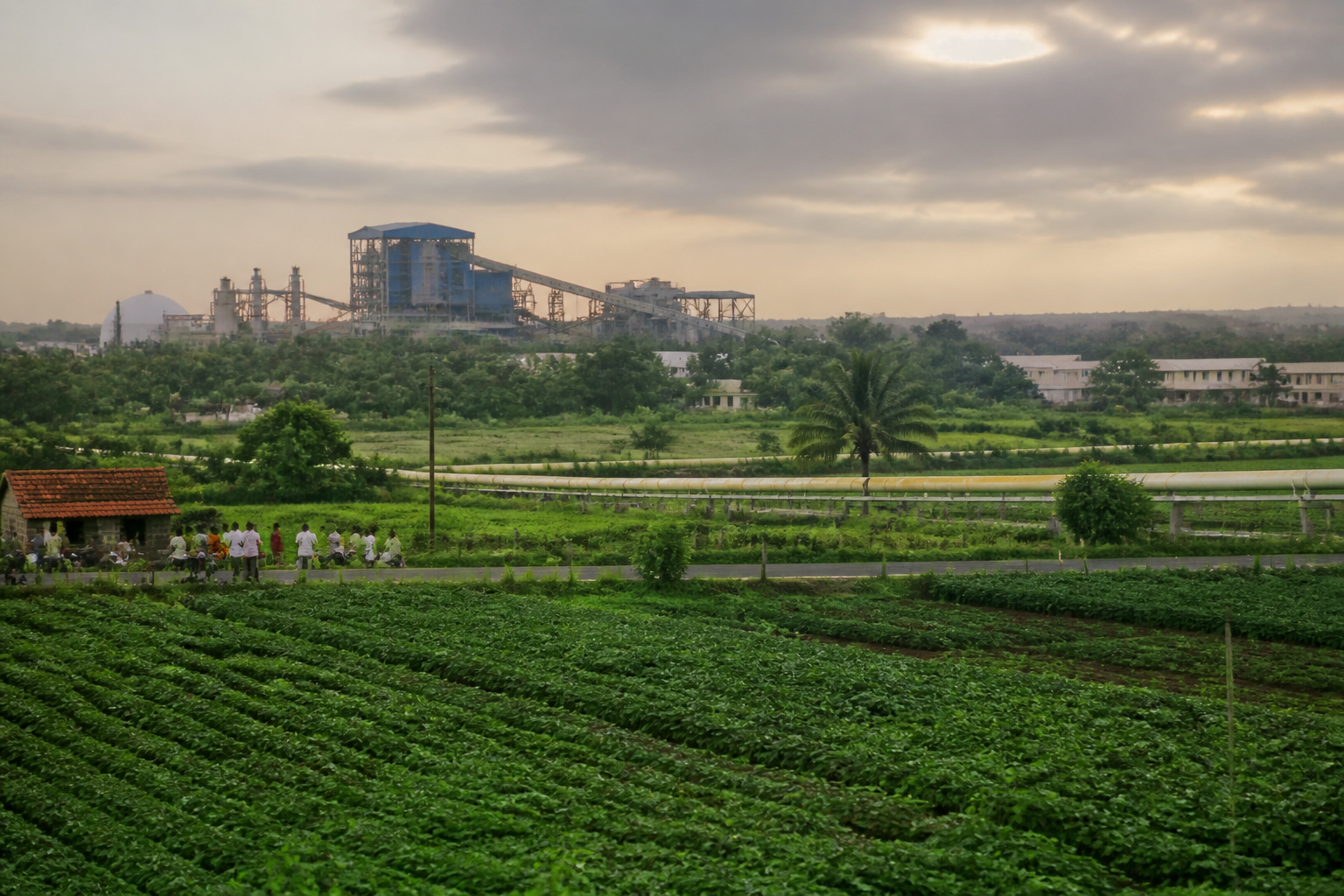
Residents of Siddapur in Telangana’s Kothur mandal have begun a relay hunger strike against the proposed Siddapur solid waste facility, but the dispute is larger than a single site. It exposes a recurring urban question: when cities generate growing volumes of waste, which communities are expected to absorb the environmental, land-use and health risks of managing it?
According to a report by Times of India – Hyderabad, the villagers began the protest on October 4, demanding the withdrawal of Government Order 641. Issued on July 2, the order ratified the transfer of 86 acres in specified survey numbers to the Greater Hyderabad Municipal Corporation for a solid waste management facility. The project is linked to the proposed Siddapur Eco-Town and to a Telangana-Kitakyushu, Japan partnership focused on a circular economy and net-zero goals.
The official purpose of the project places it within a broader effort to build waste-processing infrastructure for Hyderabad. However, the village representation described in the report shows that the dispute is also about where that infrastructure is placed, how its risks are assessed and whether communities near the proposed facility have a meaningful role in the decision.
This distinction matters because waste management is not only a question of collection and disposal. It is also a land-use decision involving transport routes, processing technology, emissions, residue management, groundwater protection and the safety of neighbouring settlements. A facility can be described as part of a circular-economy programme while still generating local concerns if the waste stream is poorly segregated or if the safeguards for processing and storage are not publicly established.
The Siddapur protesters have raised concerns about the proposed facility’s proximity to agricultural land, groundwater sources, forest and wildlife corridors, tribal habitations and an existing LPG pipeline. Their representation to the Ranga Reddy district administration has sought a site-specific scientific assessment before construction, processing or waste handling begins. It has also asked that implementation be kept in abeyance pending joint assessments by environmental, pollution-control, forest, groundwater, health, revenue and safety authorities.
The list of authorities sought by the villagers points to the institutional complexity of the project. No single department can assess all of the risks described in the representation. Environmental and pollution-control authorities would address emissions and regulatory safeguards. Groundwater and health authorities would examine possible effects on water and public health. Forest and wildlife officials would be relevant because the representation refers to forest areas and wildlife corridors. Revenue authorities would have a role in land records and surrounding land use, while safety agencies would be relevant to the LPG pipeline and other operational risks.
That multi-agency structure also creates a test of accountability. If assessments are conducted separately, the cumulative impact of the facility may be harder to establish. A site may satisfy one department’s requirements while still creating unresolved risks when its relationship with farmland, habitations, water sources, ecological corridors and hazardous infrastructure is considered as a whole. The villagers’ demand for joint assessments is therefore a request for an integrated decision rather than a single technical clearance.
The report also identifies a core weakness in the proposed waste system: segregation. G Vijay, an economics professor at the University of Hyderabad who has researched Kothur for nearly three decades, said urban waste is not systematically separated into wet and dry streams, or between biohazardous and other waste. He warned that pellets made from mixed waste could carry contaminants and that storage and processing could create risks of emissions and leaching.
These concerns connect the proposed facility to the quality of waste generated upstream. Processing infrastructure cannot by itself solve a system in which different waste categories are mixed before reaching a facility. The report does not establish the precise technology proposed for Siddapur, the expected daily waste volume, the planned segregation process, the design of residue storage or the monitoring arrangements. Those details are central to evaluating whether the facility can meet its stated circular-economy and net-zero objectives.
The absence of those details in the supplied material is itself significant for public understanding. A government order can establish land transfer and administrative authority, but it does not, on its own, explain the facility’s operating model or demonstrate that local risks have been addressed. The public dispute is therefore likely to remain unresolved unless the authorities disclose the project’s site plan, processing method, waste composition assumptions, pollution-control measures, emergency safeguards and monitoring responsibilities.
The land question is equally important. Villagers have said land values could fall and that future generations could face difficulty accessing clean air, water and food. These are claims made by the protesters, not independently established findings in the report. But they identify the economic dimension of waste infrastructure: decisions about land use can affect not only immediate health and environmental conditions but also the perceived security and value of agricultural and residential property.
Pinapaja Prabhakar, convener of the Siddapur Dumping Yard Anti-Struggle Joint Action Committee, said the surrounding agrarian economy could be particularly vulnerable to pollution and called for a decentralised waste management approach instead of concentrating facilities at one location. This raises a policy choice between centralised and distributed systems. The report does not provide comparative cost, capacity or performance data for either model, so it cannot establish which approach would be more effective. It does show, however, that the location of waste infrastructure is inseparable from the distribution of urban benefits and burdens.
Hyderabad’s urban waste problem is consequently also a peri-urban governance problem. The city’s waste may be generated by households, commercial establishments and institutions within the urban system, while the land required for treatment or disposal may lie in villages outside the core city. That arrangement can create an administrative distance between waste producers and affected communities. Residents near a facility experience the land, traffic, environmental and safety consequences even when they are not the primary generators of the waste.
The Telangana-Kitakyushu partnership adds an international and policy dimension to the proposal, but the presence of a circular-economy or net-zero objective does not remove the need for local consent, transparent assessments and enforceable safeguards. Sustainability claims have to be tested at the point where waste is received, sorted, processed and stored. They also have to account for the people and ecosystems surrounding the facility.
For the Greater Hyderabad Municipal Corporation and the state administration, the immediate institutional issue is whether implementation proceeds while the villagers’ requested assessments remain pending. The report records the demand for withdrawal or reconsideration of GO 641, but it does not include a response from GHMC, the state government or the district administration to the protesters’ specific concerns. Their positions, along with the project’s technical documents and clearance status, will be necessary to establish how the facility is intended to operate.
The Siddapur dispute therefore should not be reduced to a conflict between development and opposition to infrastructure. The available evidence points to a more precise question: can Hyderabad expand waste-processing capacity without transferring poorly assessed risks to agricultural, tribal and peri-urban communities? The answer will depend on the quality of segregation, the facility’s design, the transparency of environmental and safety assessments, and the institutional mechanisms available to monitor operations.
What is established is that GO 641 transferred 86 acres to GHMC for a proposed solid waste management facility, that the project is linked to the Siddapur Eco-Town and Telangana-Kitakyushu partnership, and that villagers have begun a relay hunger strike seeking reconsideration of the order. What remains to be established publicly is the project’s technical design, operating capacity, safeguards, clearance status and the administration’s response to the demand for joint assessments. Those documents and decisions will determine whether the proposed facility becomes an example of integrated urban waste management or another point where the city’s waste burden is shifted to communities at its edge.
