


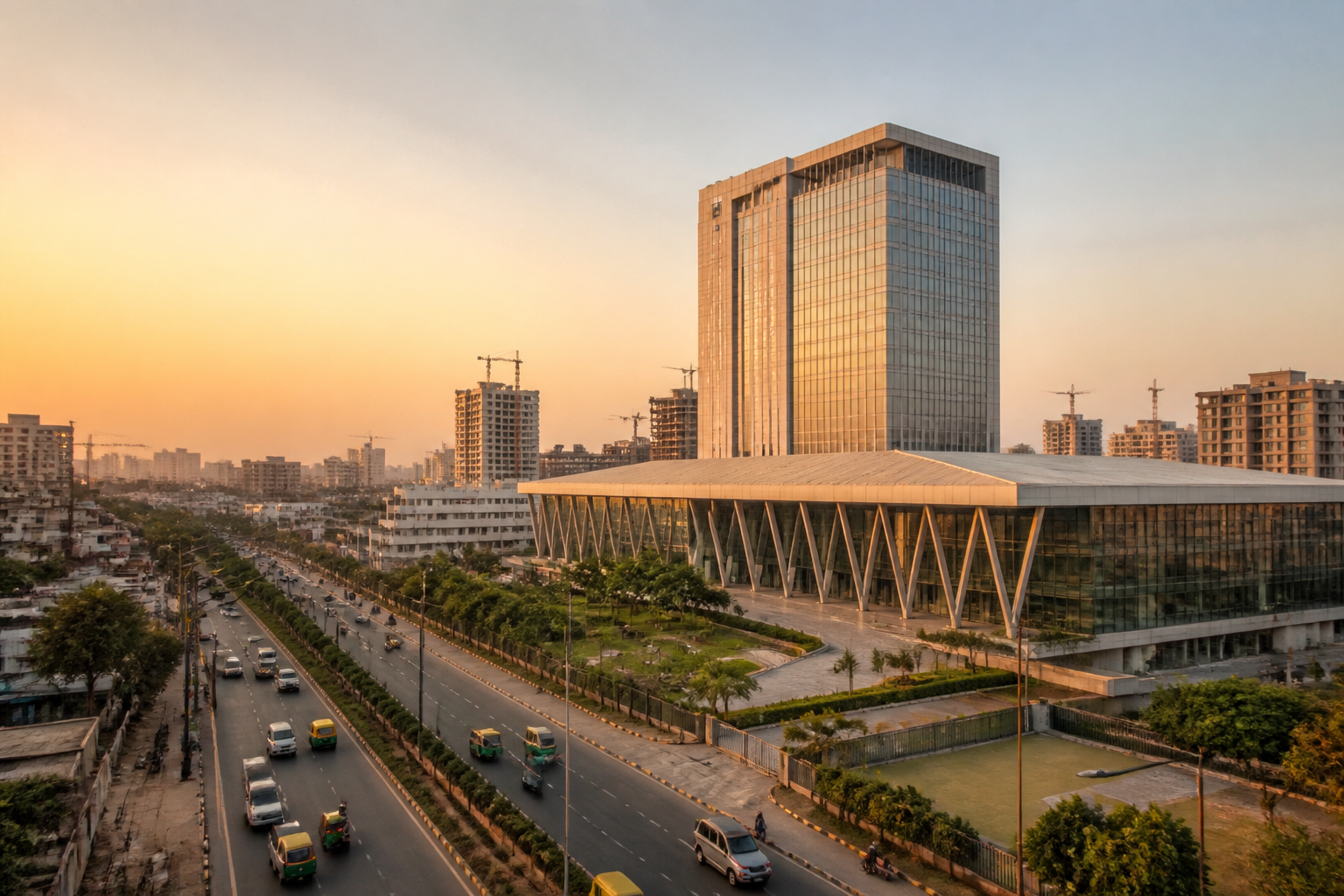
Ahmedabad and Gandhinagar may have five years to prepare for the 2030 Commonwealth Games, but a CEPT University study suggests the immediate challenge is not limited to stadiums or sporting venues. The twin cities could need nearly 22,000 additional hotel rooms, along with major expansion in airport hospitality and meetings infrastructure, to accommodate the 2029 World Police and Fire Games and the Commonwealth Games in 2030.
The assessment, titled ‘Enabling Hospitality, Tourism, and Mobility Infrastructure for CWG in Ahmedabad’, estimates that Ahmedabad and Gandhinagar currently have around 18,000 hotel rooms against a potential requirement of nearly 40,000. That gap makes accommodation a central part of the cities’ event-readiness question. It also raises a longer-term planning issue: whether new hospitality assets can be integrated into the urban economy after the sporting events end.
The study was prepared by Harsh Shah, a student in CEPT University’s Master’s in Urban Housing programme, under the guidance of faculty members Sejal Patel and Amruta Patel, with TA Vidhi Mehta. Its focus is the premium hospitality segment, defined in the report as accommodation with an average daily rate of Rs 5,000 or more. The researchers’ estimates place the accommodation challenge within a wider infrastructure system that includes hotels, short-term rentals, airport facilities, conference venues, financing and mobility.
Ahmedabad’s existing formal inventory includes 3,694 rooms across 22 five-star hotels, 1,557 rooms in 24 four-star hotels, 790 rooms across 18 resorts and 620 rooms in 16 boutique hotels. The study also identified around 141 properties listed on Airbnb and other short-term rental platforms. The rest of the city’s accommodation supply is distributed across three-star and lower-category hotels.
The figures show that the room shortage is not simply a question of adding more buildings. Different segments of the hospitality market face different levels of undersupply. The study estimates a 65% demand-supply gap for luxury hotels and a 60% gap for budget hotels. The estimated gap rises to 70% for airport hospitality and reaches 90% for MICE venues, covering meetings, incentives, conferences and exhibitions.
That distribution matters because major sporting events create several overlapping accommodation demands. Athletes, officials, spectators, media personnel, sponsors and event staff do not necessarily use the same kinds of rooms or facilities. A city can therefore have a significant total room inventory and still face shortages in specific locations, price bands or service categories. The CEPT assessment’s segmentation points to this more complex capacity problem in Ahmedabad and Gandhinagar.
The study estimates occupancy levels of 60% to 68% for five-star, four-star and boutique hotels. These figures indicate that the existing premium inventory is already operating with substantial utilisation, even before the additional requirements associated with the two sporting events are considered. The report does not present the proposed 22,000-room addition as a temporary event-only target. Instead, it argues that the expansion should be planned around future use once the events conclude.
This is the key urban planning question behind the room-count headline. Event-led construction can produce a rapid increase in capacity, but the value of that investment depends on whether the assets remain useful after the peak demand has passed. Hotels, conference venues and related infrastructure require sustained customers, transport access, maintenance and viable operating models. If these elements are not aligned, a city may gain physical capacity without securing equivalent long-term urban value.
CEPT University Faculty of Management dean Sejal Patel cited previous international sporting events to illustrate how major tournaments can accelerate hospitality expansion. According to the report, Barcelona added about 300% to its hotel-room capacity in five years in preparation for the 1992 Olympics, while Doha added about 70,000 new beds in four years through a public-private partnership model for the 2022 FIFA World Cup.
Patel’s stated caution was that cities should not add only temporary infrastructure, but should plan for its future utilisation. That distinction is important for Ahmedabad and Gandhinagar because a large, event-specific building programme could otherwise leave the cities with facilities whose financial and operational performance depends heavily on occasional large gatherings. The study’s emphasis is therefore on conversion of event preparation into a lasting hospitality and tourism ecosystem.
The report proposes public-private partnerships and innovative financing mechanisms to bridge the infrastructure gap. Harsh Shah suggested creating a real estate investment trust modelled on Singapore’s hospitality trusts, with a dedicated sports hospitality REIT category that could be created by the Securities and Exchange Board of India. The proposal is intended to attract institutional capital over the next five years.
A hospitality-focused REIT would represent a different financing approach from relying only on individual hotel developers or public expenditure. It could allow institutional investors to participate in a portfolio of hospitality assets, subject to the regulatory framework and market conditions. However, the supplied study presents this as a proposal rather than an established policy or approved financing mechanism. Its significance lies in identifying the scale of capital mobilisation that may be required if the room gap is to be addressed without treating the events as isolated construction deadlines.
The researchers also proposed using transfer of development rights, or TDR-plus mechanisms, in selected zones as an incentive. Shah said public-private partnerships could be used to create the required hospitality infrastructure. These suggestions connect the accommodation challenge to land-use policy. In practice, additional rooms require suitable sites, development permissions, access to transport and utilities, and a planning framework that can manage the concentration of new commercial activity.
The reference to selected zones is significant because hotel growth is not evenly distributed across a metropolitan region. Airport-oriented hospitality, premium hotels, budget accommodation and MICE facilities may each require different relationships with transport corridors, business districts, exhibition areas and urban services. The study’s separate estimate of a 70% gap in airport hospitality and a 90% gap in MICE venues indicates that capacity must be planned by location and function, not only by a citywide total.
The accommodation assessment also brings short-term rentals into the urban infrastructure conversation. The 141 Airbnb and similar listings identified by the researchers form only a portion of the overall inventory, but they show how event demand can extend beyond conventional hotels. These properties may provide additional flexibility, although the report does not establish how many rooms they contain, what standards they meet, or how they would be incorporated into formal event planning.
For municipal and state authorities, the central task is therefore coordination. Hospitality expansion touches tourism, urban development, land regulation, transport, airport access, finance and event administration. A hotel-room target cannot be delivered by the tourism sector alone. It depends on planning decisions that determine where new capacity can be built, infrastructure agencies that provide access and services, and private operators that can sustain the assets beyond the event period.
The study’s numbers also indicate that a narrow focus on luxury accommodation would not solve the entire problem. The estimated gap for budget hotels is 60%, only five percentage points lower than the reported luxury gap. That suggests the cities’ preparation will need to address different visitor groups and price segments rather than treating high-end capacity as the sole measure of readiness. The report’s identification of separate shortages in airport hospitality and MICE venues adds further evidence that the infrastructure requirement is layered.
The proposed five-year window for attracting institutional capital gives the financing discussion a defined timeframe, but the supplied material does not establish whether a sports hospitality REIT will be created, whether the suggested TDR-plus mechanisms will be adopted, or which agencies will lead implementation. It also does not provide a project-by-project construction pipeline, funding commitment or approved event accommodation plan. Those gaps will matter as the cities move from assessment to execution.
What the CEPT study establishes is the scale and structure of the challenge: around 18,000 existing hotel rooms against a potential requirement of nearly 40,000, with substantial shortages across luxury, budget, airport and MICE segments. What it proposes is a development strategy built around PPPs, new financing instruments and land-use incentives. What remains unresolved is how these proposals will be converted into coordinated projects that remain economically and operationally useful after 2030.
Ahmedabad and Gandhinagar’s preparation will ultimately be measured not only by whether they can accommodate major sporting events, but by whether the infrastructure created for them strengthens the twin cities’ wider hospitality, tourism and business economy. The next milestones will be the authorities’ response to the study, the emergence of an approved accommodation and infrastructure plan, and evidence of financing and implementation arrangements.
