


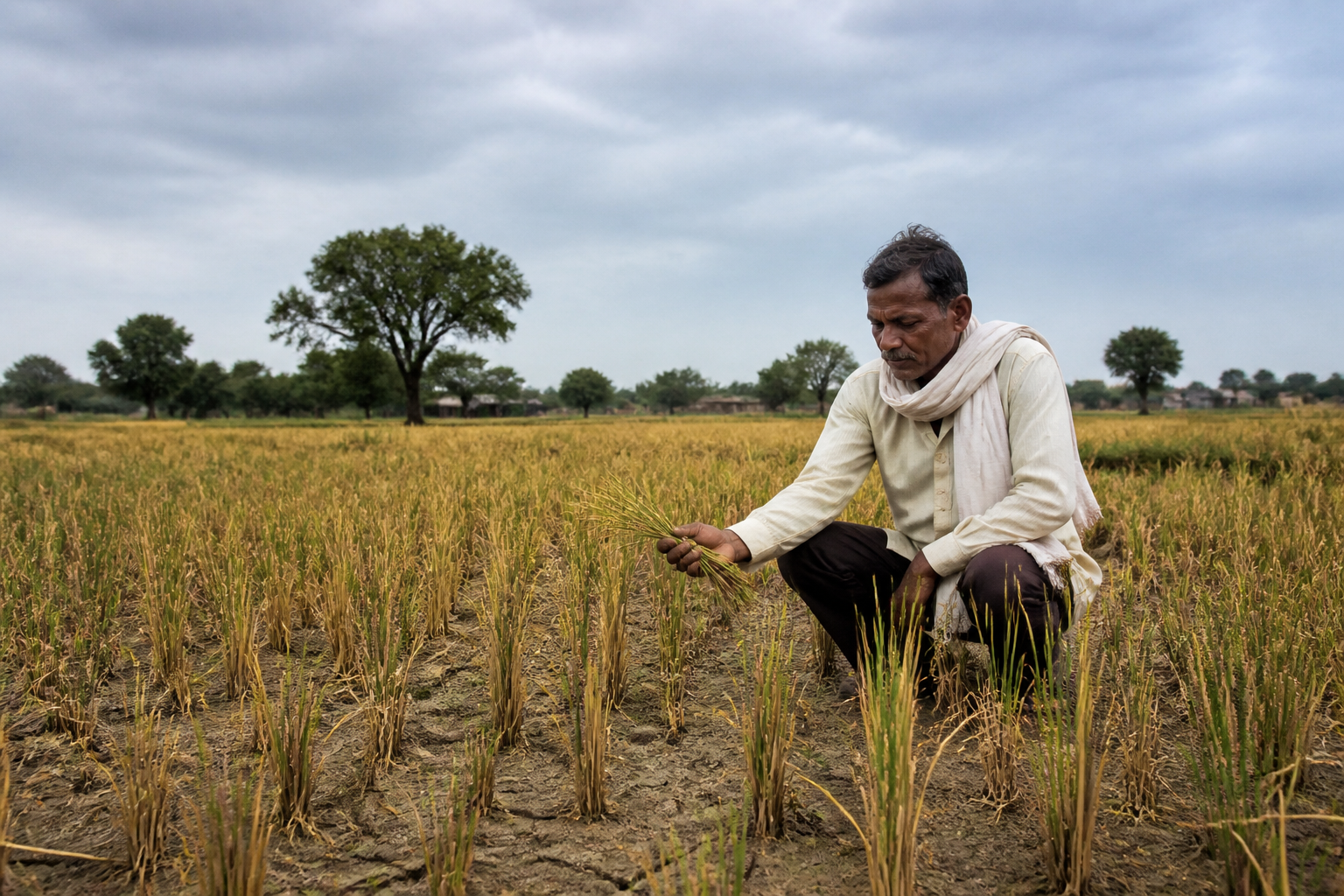
Bhandara’s rice crisis is no longer only an agricultural emergency. It is also a test of how drought-prone regions manage climate stress, protect rural livelihoods and move relief from government offices to individual fields. The district, known as Vidarbha’s rice bowl, is facing heavy paddy losses after a prolonged dry spell and pest infestation, while officials expand crop-damage assessments to determine whether more talukas qualify for drought-related support.
The immediate response has been administrative. Last week, the state government declared three talukas in Bhandara as drought-like. Assessments have now begun in Tumsar and Mohadi, where farmers told guardian minister Pankaj Bhoyar that their crops had been completely wiped out in some areas. Bhoyar visited farms in Palora, Dewala and Sukali in Tumsar and Salai Khurd, Dhop, Khairlanji and Kandri in Mohadi.
The significance of the assessment lies in what it determines next. A drought-like declaration is not simply a description of dry fields. It is part of the process through which the administration establishes the scale of damage and sends a report to the state government for relief decisions. That makes the speed, coverage and credibility of field surveys central to the outcome for affected cultivators.
In Bhandara, the consequences are concentrated because rice dominates the district’s crop economy. Sangita Mane, the district superintendent agriculture officer, said rice accounts for more than 90% of the crops grown in Bhandara. Rice cultivation covers 1.83 lakh hectares across the district, according to Mane, who said the crop-damage assessment was being conducted on a war footing.
Those figures show why the current disruption cannot be treated as a localised loss affecting only a few farms. When one crop occupies such a large share of cultivated land, a rainfall shock can affect a broad section of the rural economy at the same time. The impact extends from the cost of sowing and inputs to the expected income from the harvest. Bhoyar said farmers had already spent heavily on sowing, fertiliser, seeds and tilling before rainfall became deficient.
The district’s rice dependence also creates a structural vulnerability. Crop concentration can support a strong regional identity and established farming practices, but it can leave households more exposed when the dominant crop fails. The supplied report does not establish whether farmers have access to alternative crops, irrigation coverage, crop insurance or other forms of income protection. It does, however, show that the current crisis is affecting rice overwhelmingly and has also begun to damage cotton in some villages.
Mane said some farmers had started sowing cotton, but deficient rainfall had prevented plants from producing cotton bolls. This suggests that the stress is not confined to one stage of paddy cultivation. The same rainfall conditions are affecting other crop decisions and reducing the ability of farmers to shift quickly when the main crop is under pressure.
Rainfall failure has also intensified the biological risks facing farms. Bhoyar attributed the increase in pest infestation to dry weather, saying the absence of rain had enabled specific pests to grow and damage crops. The combination of water stress and pests matters because it can increase losses after farmers have already committed money and labour to cultivation. It also complicates the assessment process: visible crop failure may reflect deficient rainfall, pest damage or the interaction of both.
The minister said there had been no rain for almost 20 consecutive days in the previous month and linked the lower-than-expected rainfall to the El Nino effect. That statement is an official explanation for the weather conditions described in the report. The available material does not provide rainfall totals, comparisons with long-term averages or an independent assessment of the El Nino contribution. What it clearly establishes is the administrative consequence: officials are treating the situation as serious enough to extend surveys beyond the three talukas already declared drought-like.
This is where the Bhandara case connects to a broader governance problem. Relief depends not only on whether a field has suffered damage, but also on whether that damage is recorded through an official process. Bhoyar instructed the administration to visit every field, conduct surveys across all areas and send a ground report to the state government. His assurance that farmers would not be left alone reflects the political pressure created by visible crop losses, but the report does not specify the amount, form or delivery schedule of any relief.
The gap between visible damage and formal assistance has already become a point of contention. Sakoli MLA and former state Congress president Nana Patole criticised the government for waiting when crop damage was apparent and demanded immediate payment to farmers. His statement highlights the tension between two timelines: the administration’s need to complete assessments before processing support, and farmers’ need for assistance after losses have already occurred.
That tension is particularly important in a district where cultivators have paid for inputs before the harvest. A survey conducted slowly can delay relief at the moment when households may need money for food, debt payments, the next crop cycle or pest-control measures. At the same time, the supplied report does not provide enough information to assess how the state’s Trigger-1 process works in practice, what eligibility thresholds apply or how quickly payments follow a completed survey.
The use of the term Trigger-1 indicates that the response is being handled through an established drought-monitoring and administrative framework rather than as an isolated political announcement. However, the report does not detail the specific indicators being used in Bhandara or explain how the assessment will distinguish between talukas. The next stage will therefore be important: whether Tumsar and Mohadi are added to the drought-like list, what the final damage estimate records and what relief package follows.
The numbers available in the report provide a clear starting point for understanding the scale of exposure. Rice occupies more than 90% of Bhandara’s cropped area, with cultivation spread across 1.83 lakh hectares. Three talukas have already been declared drought-like, while two more are undergoing assessment. The report also records field-level visits across eight named locations in Tumsar and Mohadi and describes complete crop loss reported by farmers in some areas.
But the same numbers also reveal what remains unknown. There is no district-wide estimate of the area damaged, no value assigned to the losses, no count of affected cultivators and no rainfall dataset included in the supplied material. There is also no information on the proportion of farms dependent on irrigation, the status of reservoirs or groundwater, or the availability of crop insurance. These omissions do not reduce the seriousness of the reported losses; they define the information required before the full economic and administrative impact can be measured.
For urban readers, the Bhandara crisis is a reminder that the resilience of cities is connected to the stability of the regions that supply food and sustain linked economies. A disruption in a major rice-producing district is not only a rural matter. It raises questions about how public systems manage food-producing landscapes, how state relief reaches dispersed settlements and how climate variability affects areas whose economies depend heavily on one crop.
The evidence currently confirms a severe rainfall-related crop crisis, compounded by pests, in Bhandara’s rice-dominated agricultural system. It also confirms that the government has expanded damage assessments to Tumsar and Mohadi after declaring three other talukas drought-like. What remains unresolved is the final scale of damage and the nature and timing of relief. Those assessment reports, along with the state government’s decision on additional talukas and farmer assistance, are the next developments to watch.
