


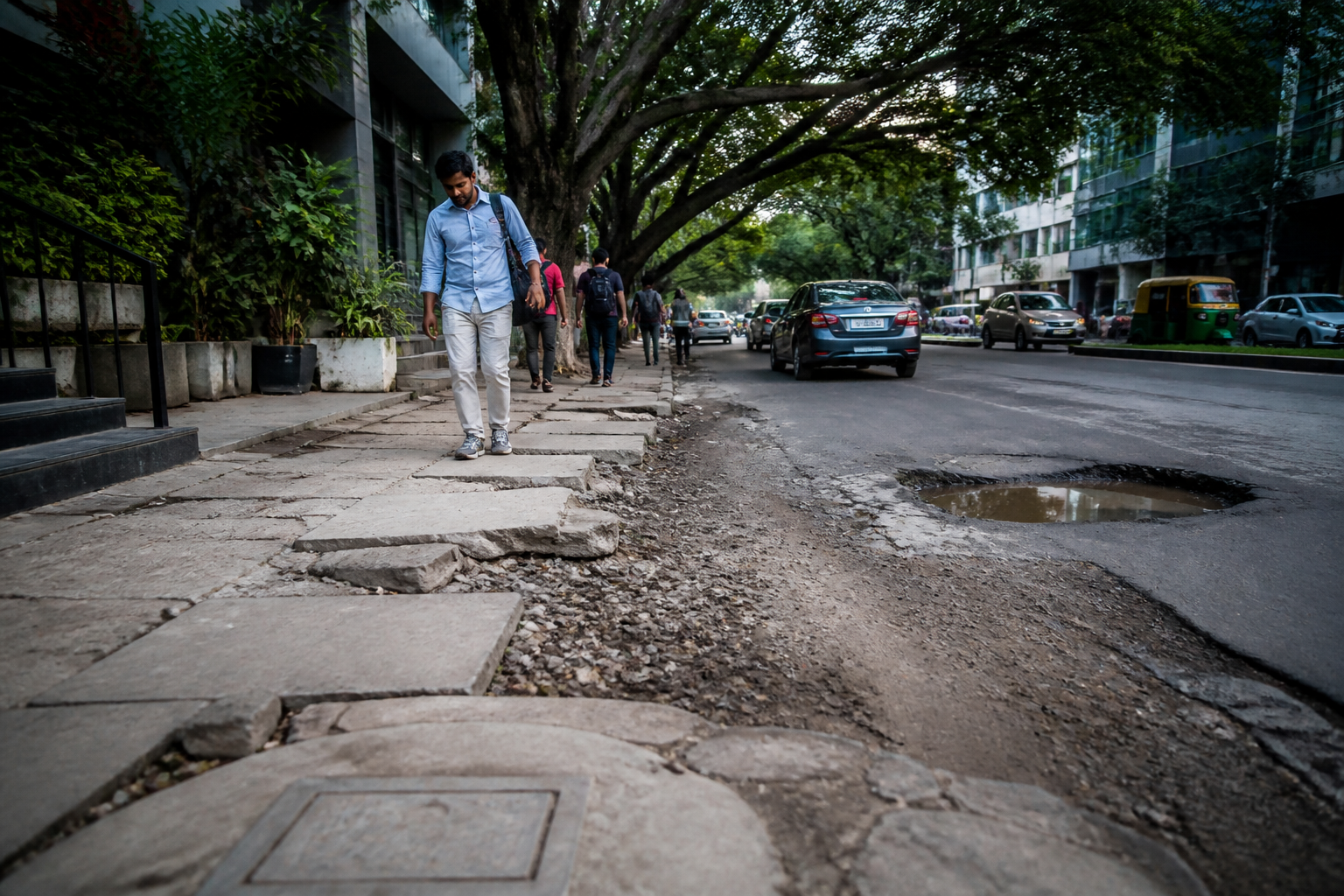
Bengaluru potholes have become more than a road-maintenance problem in Indiranagar. A viral video by Canadian influencer Caleb Friesen prompted the Greater Bengaluru Authority (GBA) to repair damaged portions of 12th Main within a day, but the speed of that response has raised a more consequential question: why did months of complaints from residents fail to produce the same result?
The incident offers a revealing view of how civic attention is allocated. The physical defects on 12th Main were visible before the video was posted. The stretch had broken and missing footpath slabs, large craters, rubble and trees being used as garbage bins. Yet the GBA’s intervention came only after the condition was presented to a much wider online audience by a foreign influencer.
That sequence has shifted public discussion away from the immediate repair and towards the accountability of the civic system. Residents are not disputing that the authority acted. They are questioning why the action required an external spotlight. Several citizens reportedly responded by inviting the influencer to their own neighbourhoods, implying that visibility through social media may now be seen as more effective than local complaints.
This is a significant distinction. A pothole or broken footpath is a maintenance failure, but the response to it is an administrative signal. If routine complaints do not move an issue through the civic system, while a viral post produces an immediate inspection or repair, residents receive a clear message about which forms of communication carry weight. The problem then becomes not only the condition of the street, but the credibility of the complaint and response process.
The 12th Main episode also shows how the city’s image and its everyday infrastructure can collide. Friesen described Indiranagar as a hub for start-ups and venture capital, while pointing out that its footpaths were in poor condition. His criticism was directed at a contradiction that is familiar in rapidly growing urban districts: areas associated with investment, innovation and economic activity can still lack basic pedestrian infrastructure.
In his video, Friesen said that visitors arriving to meet founders could instead encounter the condition of Bengaluru’s streets. He also described the infrastructure as “demoralising and frustrating”, while noting that he had made videos highlighting innovation and development in India. These remarks connected the local defects to the city’s broader public image, but the underlying issue remains practical. Footpaths are not primarily an image-making asset. They are basic public infrastructure used by residents, workers, visitors and people with limited mobility.
The GBA responded by publishing a video showing the same stretch after the repairs. Arun Pai of Walkaluru appeared in that video, walking along 12th Main and showing portions that had been fixed. The public response, however, suggested that the repair itself had not resolved the question of quality. Some citizens argued that damaged areas appeared to have been filled with concrete rather than properly restored as a walkable footpath.
That criticism matters because a footpath is not repaired simply when a visible gap is filled. The report does not establish the technical specifications, scope or durability of the work carried out on 12th Main. It does establish that citizens questioned whether the intervention amounted to restoration or a quick patch. This distinction is central to the experience of urban maintenance: a rapid response may remove the immediate visual problem without addressing the underlying condition of the pedestrian route.
The episode also exposes the weakness of treating roads and footpaths as separate or secondary concerns. The report describes both damaged road patches and broken footpaths, but the citizen backlash focused strongly on walkability. A footpath that is interrupted by missing slabs, rubble or large breaks is not a continuous public route. Its failure can push pedestrians onto the carriageway or force them to negotiate around obstructions, even when the road itself has received attention.
The reported location makes the contrast sharper. Indiranagar is presented as a commercially and economically prominent part of Bengaluru, yet the 12th Main stretch contained basic maintenance problems that residents had been raising for months. This suggests that economic visibility does not automatically translate into consistent public-realm maintenance. Nor does a neighbourhood’s reputation guarantee that complaints will be processed with urgency.
The GBA’s rapid action is not without value. It shows that the civic body can mobilise quickly when an issue receives sufficient attention. But that capacity creates a further administrative question: what prevented a similar response before the video? The supplied report does not identify the complaint mechanism, the responsible department, the number of complaints received, or the reason for the delay. Those missing details are precisely what would be needed to understand whether the failure lay in reporting, departmental responsibility, inspection, funding, contracting or follow-through.
The earlier episode involving Friesen makes the pattern more significant. In September 2025, he posted a video showing broken footpaths and poor civic conditions around Majestic. The following day, a team led by Walkaluru and then Central Corporation Commissioner P. Rajendra Cholan visited the area, cleaned it and ate on the footpath to draw attention to cleanliness. The recurrence of a similar sequence in Indiranagar indicates that the issue is not limited to one defective stretch.
It points instead to a recurring model of civic response: a visible external intervention creates momentum, officials demonstrate action, and citizens then question why ordinary reporting did not achieve the same result. The report does not provide enough evidence to determine whether this is a citywide pattern, but the two incidents establish that the dynamic has appeared more than once.
There is also an institutional context. The current response is attributed to the Greater Bengaluru Authority, while the earlier Majestic action involved the then Central Corporation Commissioner. The material supplied does not explain the division of responsibility between institutions, nor how footpath maintenance is assigned, monitored and funded. That absence is important because fragmented accountability can make it difficult for residents to know where a complaint should go and for officials to demonstrate who was responsible for resolving it.
For residents, the practical test is not whether a civic body can produce a before-and-after video. It is whether a complaint generates a documented inspection, an assigned responsibility, a defined repair scope and a durable outcome. None of those process details is included in the report. The public reaction indicates that citizens are looking for more than proof of immediate activity; they want evidence that the repair is substantive and that the complaint system can function without the intervention of a high-profile social media account.
The central lesson from Indiranagar is therefore not that viral videos are ineffective. On the contrary, this case shows their ability to accelerate official attention. The deeper concern is what happens to problems that remain visible but lack an audience large enough to create pressure. A city cannot depend on influencers to act as an informal inspection network for its footpaths.
The evidence confirms that a viral video was followed by swift civic action, and that residents had previously complained about the same conditions. It also confirms that questions remain about the quality of the repair and the institutional reasons for the earlier inaction. The next meaningful measure of accountability will be whether the repaired stretch remains walkable and whether Bengaluru’s complaint-response system can address similar failures before they become viral.
