


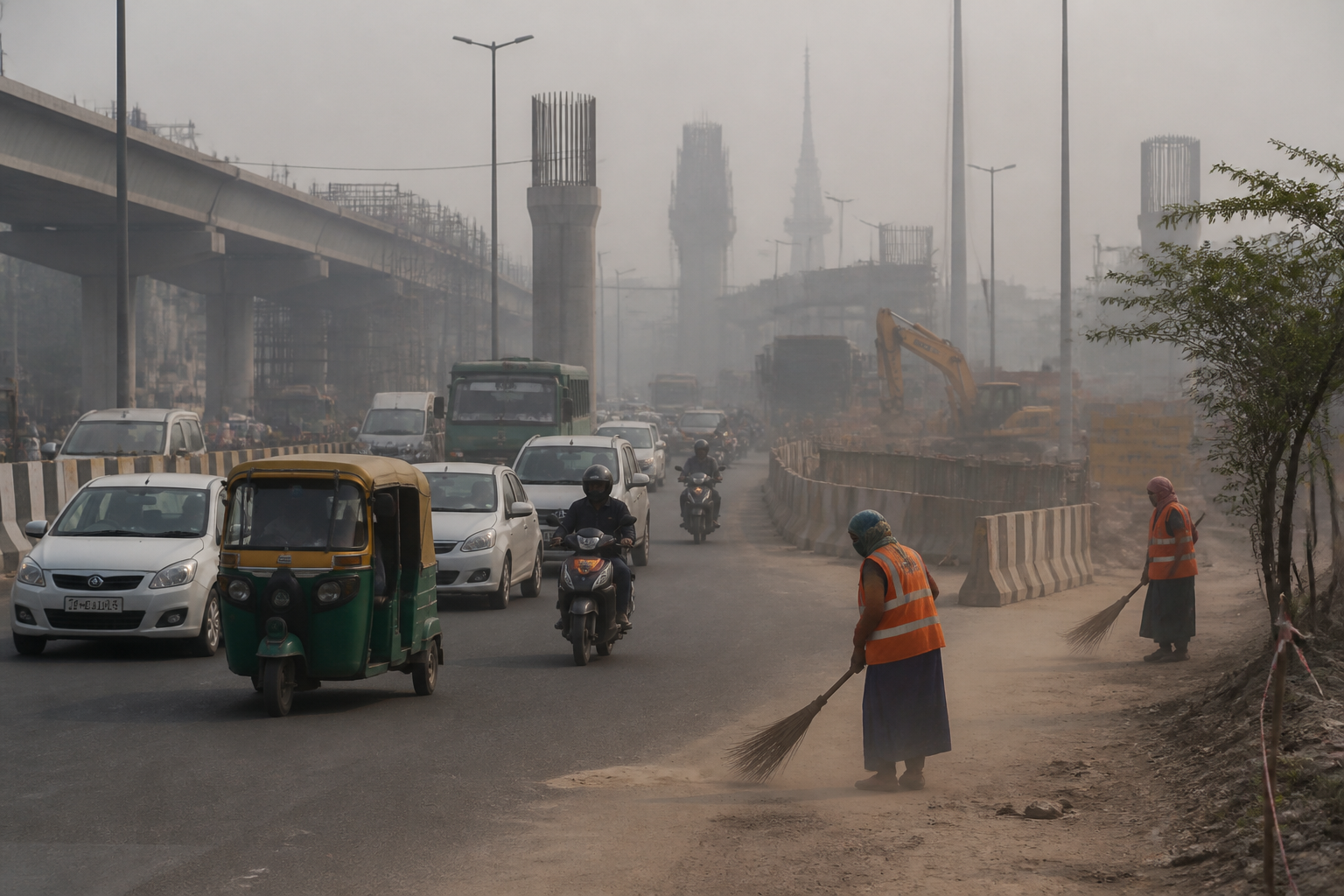
Delhi recorded its worst air quality of the season on Sunday, with the 24-hour average Air Quality Index reaching 187 and 19 monitoring stations registering readings in the poor category. Experts attributed the deterioration to low wind speeds that prevented emissions from dispersing and warned that winter conditions could bring more polluted days across the capital region.
The AQI stood at 187 at 4pm, after touching a peak of 196 at 10am, according to Central Pollution Control Board data. The city’s most polluted monitoring station was Mundka, where the AQI reached 273. CRRI Mathura Road and Narela followed with readings of 258 each.
Several neighbouring cities recorded worse air quality. Noida reported an AQI of 281, while Ghaziabad recorded 248. Greater Noida and Gurgaon registered readings of 171 and 166 respectively.
The previous higher reading in the region was an AQI of 246 on July 24, when transboundary dust from Iran, Afghanistan and Pakistan moved towards northwest India. Sunday’s deterioration was instead linked by experts to meteorological conditions and the inability of emissions to disperse effectively.
Dipankar Saha, former head of the CPCB’s air laboratory, said the total emission load in a defined area generally remains similar through the year, except during events such as large fires, crop-residue burning, major construction activity, dust storms and other exceptional episodes. He said air quality varies seasonally because wind speed and direction affect how pollutants disperse.
Delhi’s air quality typically deteriorates from mid-October as winter conditions coincide with a possible increase in farm fires. Gufran Beig, founder of the System of Air Quality and Weather Forecasting and Research and chair professor at the National Institute of Advanced Studies, said winter chill and north-westerly winds were gradually setting in and could facilitate the movement of pollutants. He also said satellite fire products might no longer reflect the timing of farm fires accurately if that timing has shifted.
The Air Quality Early Warning System indicated that Delhi’s air quality could remain in the moderate category for two days before turning poor over the following 10 days. Under CPCB classifications, AQI readings from 101 to 200 are moderate, while readings from 201 to 300 are poor.
The deterioration also coincided with enforcement action on urban dust sources. Four flying-squad teams constituted by the Commission for Air Quality Management inspected 25 road stretches covering 35 kilometres of the Inner and Outer Ring Roads under the Public Works Department. The teams reported 17 violations involving high visible road dust and the accumulation of construction and demolition waste.
CAQM said the inspection findings showed the need for stricter and more effective implementation of prescribed road-cleaning, sweeping and dust-mitigation measures by road-owning agencies. The next phase of air-quality management will therefore depend not only on changing weather conditions but also on the execution of dust-control measures on major roads and construction-affected stretches.
