


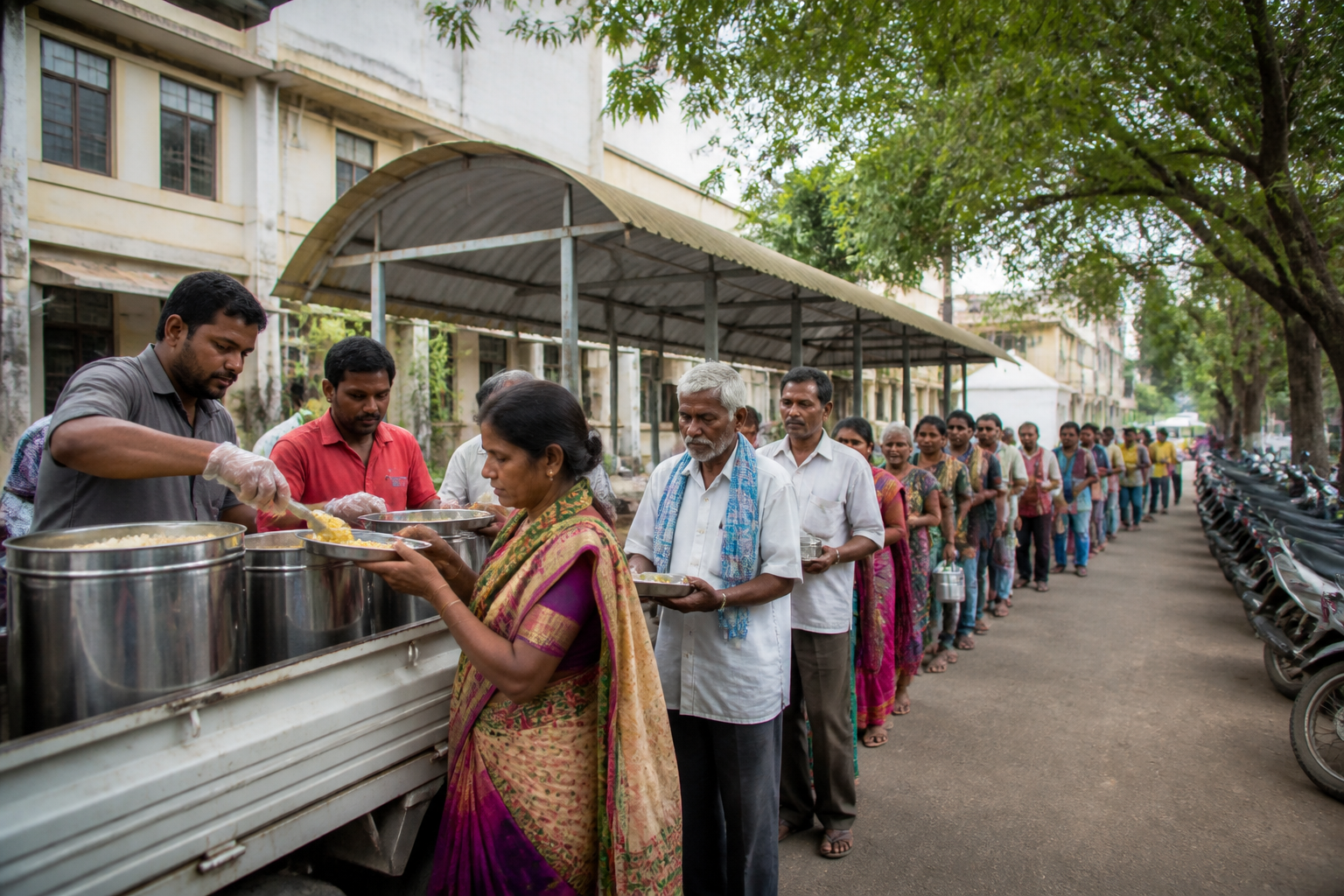
Every day, long queues form outside Cheluvamba Children’s Hospital and the Jayadeva Hospital Trauma Care Centre next to Mysuru’s K.R. Hospital. They are not queues of patients waiting for treatment. They are queues of patient attendants, workers and visitors waiting for hot food.
The meals are supplied free by rotating groups of residents, shopkeepers, youth organisations, religious groups and donors. Their work offers more than charity. It exposes an overlooked part of the public hospital system: the people who must remain beside a patient for days, often without a dependable place to eat, rest or spend money.
For families travelling from outside Mysuru, the hospital is not only a site of medical treatment. It becomes a temporary settlement. Relatives wait for doctors, tests and reports, arrange medicines and manage the uncertainty of a patient’s recovery. During that period, food can become an additional financial and logistical burden.
The queues outside the hospitals make this burden visible. Some people arrive carrying plates. Others wait for packed meals. Among them are elderly relatives, daily-wage workers, auto-rickshaw drivers and families who have travelled from neighbouring districts. Some share the food meant for the patient or survive on inexpensive snacks from nearby shops when money is limited.
One elderly woman interviewed in the report had been at the hospital for four days while caring for her daughter and grandson. She said that the free meals had helped her at a time when she did not know where to find food. Another visitor, Anand from Kirugavalu in Mandya district, said his child was admitted to the hospital and that a free meal would be a major relief for poor families arriving for treatment.
The accounts show why hospital access cannot be measured only by the availability of doctors, beds or medicines. A patient may be admitted, but the family member providing care must still eat, travel, sleep and find money for daily expenses. When those needs are not met, the cost of treatment extends beyond the hospital bill.
The food distribution outside the Mysuru hospitals is decentralised. There is no single organisation running it every day. Different groups take responsibility on different days, while others arrive occasionally to mark a wedding, birthday, religious occasion or community event. Some contribute money, others provide rice and pulses, and some come in person to cook or serve.
One of the more consistent groups is Santrupti Kutumba, formed under the leadership of Ashok Kumar and Yuvaraj, owners of Yuvraj Silk Cloth Store in Nazarbad. Around 30 people are associated with the group, which distributes food every Saturday and Sunday morning outside Cheluvamba Hospital and the Jayadeva Trauma Care Centre.
According to the report, the group completed its 635th week of food distribution in the first week of September. Its weekly cost has risen from about ₹2,000 when the initiative began to ₹35,000 for two days. Around 600 people receive food on Saturdays and approximately 750 on Sundays. The group also manages the queue so that distribution remains orderly and food is not wasted.
The increase in cost and volume is significant. It indicates both the continuity of the service and the scale of demand around the hospitals. The initiative has moved from a small act of assistance funded by friends to a regular operation requiring substantial donations, volunteers and logistics.
The group’s work began after its members visited the hospital and saw relatives sharing the patient’s bread, milk and meals because they could not afford food from home or a hotel. Some people were surviving on buns from nearby tea shops. The decision to provide meals was therefore based on direct observation of a gap around the hospital, rather than on an organised public programme described in the report.
Another group, Vishnu Samaj Yuva Mandal, has provided Friday morning meals since 2019. Its service completed 280 weeks in the first week of September. The group distributes food to around 250 to 300 people each Friday, funded by public donations. Its members also manage the queue and regulate portions according to need.
The report also describes a Muslim youth group that serves meals on Friday nights. Restaurants, event organisers and families sometimes bring surplus food, provided it is clean and suitable for distribution. This creates a loose network in which different groups occupy different days and roles.
Such a system can respond quickly because it is informal. A group can collect donations, prepare food and arrive at the hospital without waiting for a formal administrative process. It can also remain close to the people who need assistance. Volunteers see the queue, speak with families and adjust distribution on the basis of the day’s demand.
But informality also means that access depends on continuity, coordination and the willingness of donors to keep contributing. The report does not establish that every hospital visitor receives a meal, nor does it describe a formal arrangement with the hospitals or the municipal administration. The service documented is sustained by community initiative rather than presented as a guaranteed public entitlement.
This distinction matters. Food support outside a hospital is not the same as institutional provision within the healthcare system. Volunteers may reduce immediate hardship, but they do not remove the underlying expenses faced by families: transport, medicines, diagnostic tests, lost wages and accommodation. Nor does a free meal solve the problem of attendants who must remain in the city for several days.
The queues nevertheless reveal a form of urban support infrastructure. They connect hospitals with neighbourhood businesses, community organisations, donors and volunteers. The hospitals provide medical care, while the surrounding social network supplies an everyday service that allows some families to remain near the patient without spending on every meal.
The scale of the service also suggests that hospital precincts function as more than medical campuses. They are places where patients, attendants, vendors, workers, volunteers and visitors interact. Their needs include food, sanitation, shelter, transport and information. Planning for such precincts therefore requires attention to the wider ecosystem around treatment, not only to buildings and clinical facilities.
The volunteers’ attention to food waste adds another layer to the arrangement. Lakshmidevi, a member of Santrupti Kutumba, alternates between serving food and managing the queue. She asks recipients whether they need more and encourages them not to take more than they can eat. The practice links dignity of access with responsible distribution: people should receive enough, but food should not be wasted.
The ritual before distribution is similarly revealing. Volunteers gather around the vessel, fold their hands and pray that the food supply will remain inexhaustible and that the service will not stop. In an urban healthcare environment marked by urgency and uncertainty, the moment creates a brief pause. It also reflects the volunteers’ understanding that their work depends on continued collective support.
The Mysuru example raises a larger question about how cities account for the hidden costs of public healthcare. A hospital may be accessible in principle, but families can still be excluded by the cost of staying near it. When patient attendants skip meals or share the patient’s food, the problem is not merely individual hardship. It is a sign that the care system extends beyond the formal boundaries of the hospital.
The documented food services do not replace public responsibility. They show, however, how citizens fill an immediate gap when they recognise a need around a public institution. Their work has continued for years, with hundreds of people served on particular days each week. What remains unclear from the report is whether the hospitals or civic authorities formally monitor, coordinate or support these services.
For now, the long queues outside Cheluvamba Hospital and the Jayadeva Trauma Care Centre remain a record of both vulnerability and solidarity. They show that for families waiting beside a sick relative, one meal can become part of the infrastructure that makes treatment possible.
