


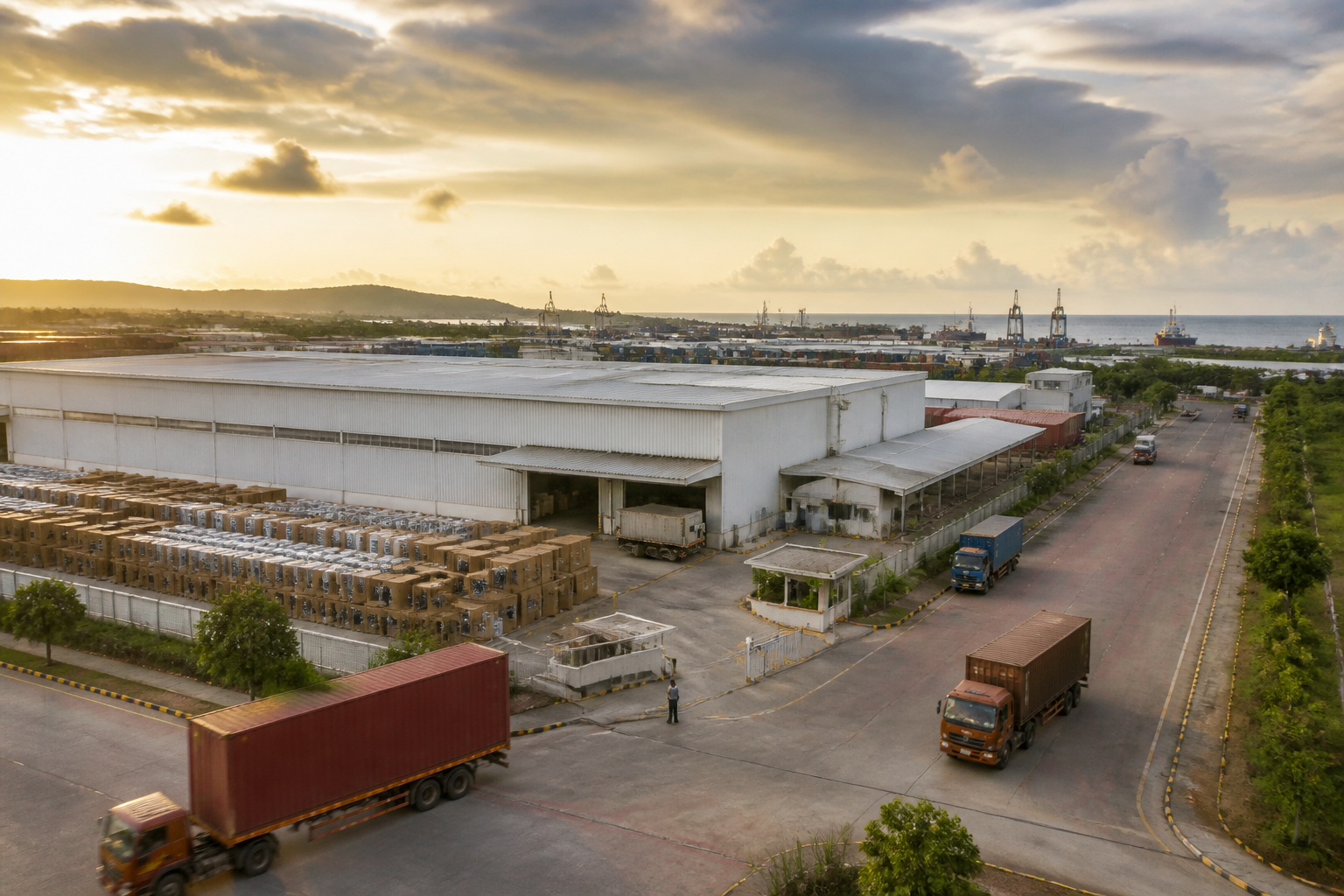
Air-conditioner manufacturing in South India is moving from a regional business decision to a significant reshaping of India’s industrial geography. New factories in Sri City, Andhra Pradesh, and Tamil Nadu are bringing production closer to southern consumers, imported components and ports, while a longer cooling season is creating a stronger case for locating capacity near the market.
The shift is centred on a roughly 100-km industrial corridor running from Sriperumbudur and Chennai to Sri City in Andhra Pradesh. Over the past five years, major manufacturers including Daikin, Blue Star, LG, Carrier and Havells Lloyd have opened factories in Sri City. Voltas and Mitsubishi Electric have established units in neighbouring Tamil Nadu, while Samsung India already operates a plant at Sriperumbudur.
The result is a manufacturing belt that links industrial land, supplier networks, port access and consumer demand across state boundaries. It also shows how production decisions are increasingly being shaped not only by incentives, but by the geography of delivery. For an appliance that is bulky to transport and increasingly sold across a geographically diverse market, the location of the factory can directly affect cost and availability.
Sri City’s emergence is particularly important because it combines a large industrial estate with proximity to Chennai. Ravindra Sannareddy, co-founder and managing director of Sri City, told the Economic Times that the 8,500-acre private industrial city has attracted 10 air-conditioner manufacturers and 34 component suppliers over the past five years. Their combined capacity is expected to reach eight million units next year.
Sannareddy said that by 2027, around 60% of the air-conditioners produced in India could come from Sri City alone. He added that the share would be considerably higher if factories operated by Samsung, Mitsubishi Electric and Voltas in nearby Tamil Nadu were included. These are projections attributed to Sri City’s leadership, rather than an independently verified industry-wide production estimate, but they indicate the scale of concentration taking shape in the corridor.
The industrial shift is not entirely new. Carrier established an early manufacturing presence in Gurugram in the 1980s, and Daikin opened a plant near Neemrana in Rajasthan in 2008. Until 2023, when Daikin and Blue Star began rolling out units from Sri City, Samsung’s Sriperumbudur factory was described as the only major southern AC manufacturing hub serving the regional market.
What has changed is the density of manufacturers and suppliers now gathering around the southern corridor. The emergence of multiple component suppliers alongside finished-product factories points to a more integrated production ecosystem. It may also reduce the need for manufacturers to move every component and finished unit across long distances, although the source does not provide a full breakdown of local versus imported sourcing.
The logistics arithmetic is central to the relocation. A plant manager at one of the Sri City manufacturers told the Economic Times that setting up production in Chennai or Sri City can save about ₹1,200 per air-conditioner. Sri City is approximately 65 km north of Chennai port, which matters because around 50-60% of the company’s components are imported, according to the manager.
The same manager said that transporting finished air-conditioners from North India to southern markets adds to the cost. Locating production closer to those customers, and near a major port, therefore delivers two benefits at once: it can reduce inbound movement for imported components and shorten outbound distribution to consumers in the South.
The reported impact is also visible in delivery time. The plant manager said the order-to-delivery cycle for southern customers can fall from around 12 days to three days. The claimed logistics benefit is roughly ₹1,200 per unit, apart from the shorter turnaround time. These figures come from an unnamed company plant manager and should be understood as an industry-level operational estimate, not a published regulatory benchmark.
That distinction matters because manufacturing location is not determined by freight cost alone. A factory corridor requires industrial land, reliable utilities, roads, labour, suppliers, warehousing and access to markets. The Sri City-Chennai geography brings these elements together within a relatively concentrated area, while its connection to the port supports a product category that remains partly dependent on imported components.
The corridor also demonstrates the administrative importance of industrial areas that operate across conventional city boundaries. Sri City is located in Andhra Pradesh’s Tirupati district and borders Tamil Nadu, while Chennai provides the nearest major port and a large metropolitan market. The manufacturing network therefore depends on coordination between industrial planning, state boundaries, port logistics and regional distribution.
The Centre’s production-linked incentive scheme is another part of the picture. The Economic Times report identifies the PLI scheme as a major factor encouraging AC manufacturers to expand in the South. The source does not specify the incentive amounts received by individual companies or provide a comparison of the fiscal benefits available across locations. It does, however, show how industrial policy can reinforce existing geographical advantages rather than operate separately from them.
This is particularly relevant to the government’s wider manufacturing ambitions. Incentives may encourage companies to add capacity, but long-term industrial clustering depends on whether factories can obtain inputs, move goods and reach customers efficiently. In the southern AC corridor, the policy push appears to be working alongside port access, supplier concentration and local demand rather than replacing those fundamentals.
Demand is the other major reason for the shift. An engineer with another AC manufacturer in Sri City told the Economic Times that South India has a longer cooling season, with limited winter conditions in many areas. The engineer argued that the region is not merely a growing market but one in which households may use air-conditioners for more months of the year.
That seasonal pattern changes the economics of capacity planning. A market with a longer cooling period can offer manufacturers a more extended sales window and reduce the risk that production and distribution systems are built around a short annual peak. The source does not provide regional sales figures or a comparison of cooling demand across Indian states, but the reported manufacturer comments establish why companies view the South as strategically important.
The development also raises a broader question about how India’s manufacturing map will respond to climate and consumption patterns. Air-conditioners are becoming more important in regions where heat lasts longer, while manufacturers must also manage the cost of importing components and distributing finished products. The location of production consequently reflects both industrial policy and the physical geography of demand.
For cities, the consequences extend beyond factory gates. Industrial concentration brings demand for freight links, worker housing, utilities, roads and supporting services. It can strengthen a corridor, but it also places pressure on the infrastructure connecting industrial estates to ports and metropolitan markets. The supplied report confirms the emergence of the manufacturing cluster, but it does not establish how local authorities are planning for these wider urban requirements.
The immediate evidence points to a clear transition. Northern India remains part of the AC manufacturing story, with established facilities in Gurugram and Neemrana, but the strongest new concentration is forming in and around Sri City, Chennai and Sriperumbudur. Production capacity, component suppliers, port proximity and a longer cooling season are aligning in the South.
The next milestones are the expected expansion of combined Sri City capacity to eight million units next year and the projection that the city could account for around 60% of India’s AC production by 2027. Whether those targets are achieved will determine how far this industrial corridor changes the balance between northern manufacturing centres and the emerging southern belt.
