


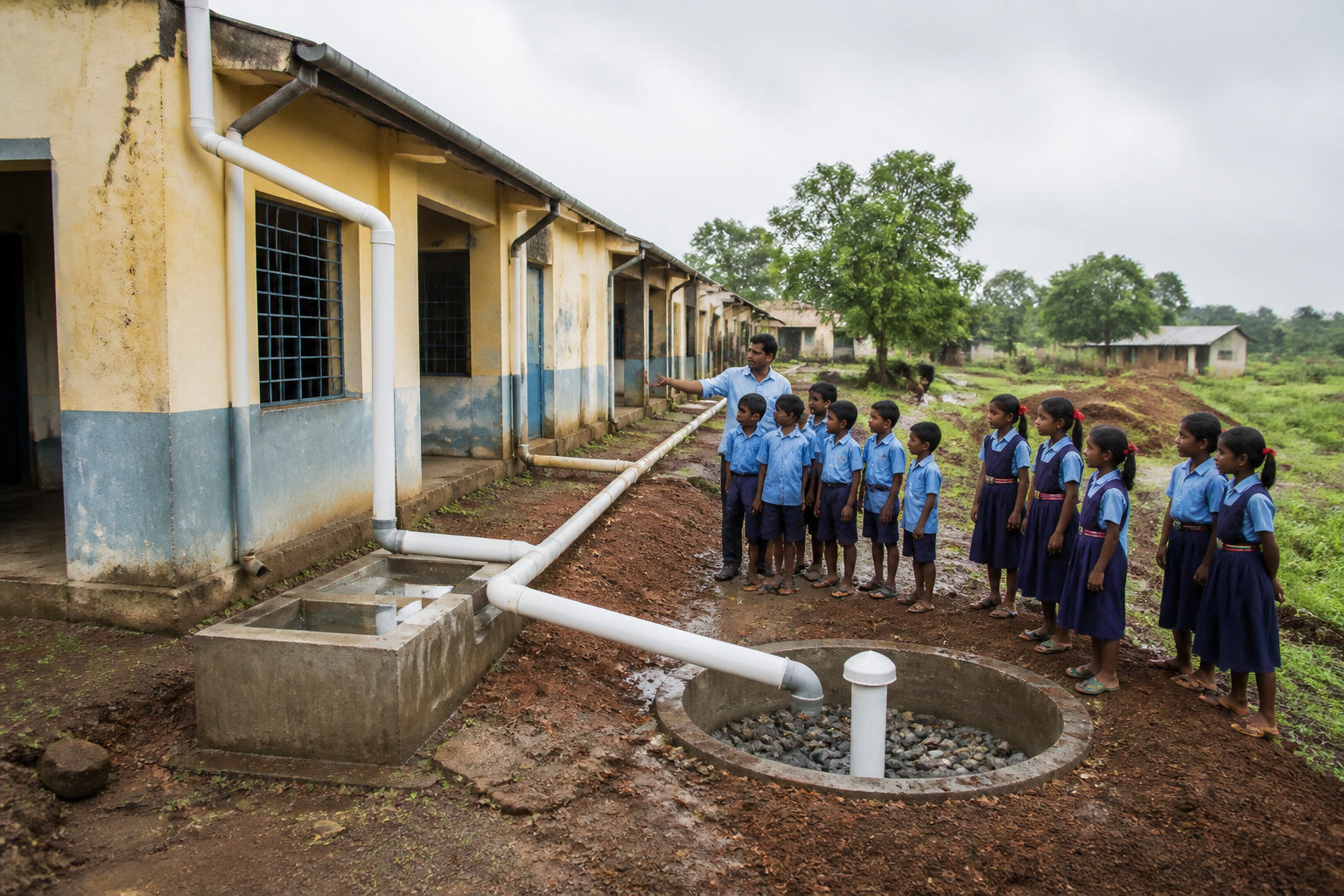
The completion of a rooftop rainwater harvesting project at a Zilla Parishad school in Junewani, Nagpur district, is a small intervention with a much larger urban and rural water lesson: water security depends not only on finding new sources, but also on retaining the rain that already falls. The project, completed on October 2 by the Olava Foundation with corporate social responsibility support and coordination with the GST department, is designed to collect, filter and store rooftop rainwater or divert it for groundwater recharge.
The foundation says the school system will also function as a practical demonstration for students. Rainwater collected from the roof can be used for gardening and sanitation, while the process is intended to explain how runoff becomes a local water resource. That educational component is significant because the infrastructure is being presented not as an isolated facility, but as a way to connect water use in an institution with the condition of the wider groundwater system.
The Junewani project comes against a backdrop of drought conditions in parts of Maharashtra and growing concern over water security. The foundation’s work, as described by its representatives, is based on slowing runoff, allowing water to infiltrate soil and strengthening local sources rather than relying only on larger supply schemes or deeper extraction. Its interventions have included rooftop harvesting, trenches, pits and recharge structures, with the form of the project determined by local terrain.
That approach challenges a common assumption in water planning: that a village or settlement facing scarcity must look outward for a new source. The experience cited by the foundation in Pardi village in Amravati district illustrates the distinction between water availability and water access. Around 2001, villagers reportedly walked 1.5 to 2 kilometres to fetch water despite living alongside the Upper Wardha project, one of the region’s major reservoirs. The presence of a large reservoir did not ensure that water was available where residents needed it.
Following water-conservation and groundwater-recharge interventions, Pardi became tanker-free in 2002-03, according to the foundation. The account does not establish that the intervention can be replicated identically in every location, but it does point to a central administrative problem: a regional water asset and a dependable local water source are not the same thing. Distribution systems, recharge conditions, local geology, storage and community management determine whether water remains available at the point of use.
The same logic was applied in Jiwti Pahad in Chandrapur, where villagers reportedly travelled nearly a kilometre downhill to collect water. Similar interventions were undertaken in Akola, Khamgaon, Shegaon, Nandura and Malkapur, as well as in Melghat, Latur, Jalgaon and Aurangabad. The projects varied according to local conditions, but the reported methods shared an emphasis on intercepting runoff and replenishing groundwater.
This is where the distinction between infrastructure and water governance becomes important. A tank, pit or recharge structure is visible and relatively easy to count. The less visible work involves understanding how water moves through a settlement, where runoff is generated, how quickly it leaves the area, how much groundwater is extracted and whether communities have the knowledge to maintain the system. The foundation’s stated position is that construction alone cannot provide a lasting solution.
Its representatives argue that groundwater extraction must be balanced with recharge, wastewater should be treated and reused, and soil should be treated as part of the water system. Soil with better structure, organic matter and biological activity can improve infiltration, allowing more rainwater to move underground rather than becoming surface runoff. The supplied report does not provide site-wise measurements of recharge volumes or groundwater-level changes, so the scale of the hydrological impact cannot be independently assessed from the available evidence. But the operating principle is clear: water conservation is being framed as a landscape and management task, not merely a storage project.
The foundation also places considerable emphasis on training. Its vice-president, Uday Dighe, said around 500 people in the Amravati division were trained through three-day programmes to assess local water conditions, harvest rainwater and convert runoff into a groundwater resource. The organisation says training for Jalduts, water volunteers and water workers has facilitated more than 5,000 projects, while more than 2,000 lectures have been conducted in schools, colleges and among farmers across India.
These figures are claims made by the organisation and are not accompanied in the supplied report by an independent evaluation. Even so, they identify an institutional question that is often overlooked in infrastructure reporting: who is responsible for operating and maintaining decentralised water systems after construction? Training local volunteers and students is one answer, but long-term performance would also depend on maintenance, monitoring, land conditions, water quality and coordination with public agencies.
The Junewani school project makes that question visible in an everyday setting. A school roof is a defined catchment area. The building provides an identifiable location for filtration, storage and recharge. Students can observe the system and potentially carry the practice into their homes. Foundation volunteers Prabhakar Walke, Kirti Bokare and Mandar Nazar said the objective was to create water ambassadors who could take the message from the school to their families and communities.
That model also reveals the limits of treating water conservation as an awareness campaign alone. Students may understand the value of capturing rain, but the wider settlement still needs functioning drainage, suitable recharge locations, safe storage and rules for groundwater use. The school can become a demonstration site, but it cannot by itself resolve the institutional fragmentation that commonly separates education buildings, local government, groundwater management, stormwater drainage and rural water supply.
The reported road-runoff experiment in Amravati extends the argument from villages and public buildings to urban infrastructure. The foundation demonstrated how rainwater flowing along roads could be diverted towards groundwater recharge instead of being sent directly into drains. The idea has particular relevance to rapidly urbanising cities such as Nagpur, where roads, rooftops and other paved surfaces generate runoff during intense showers.
Urban drainage systems are designed primarily to remove water quickly from roads and built-up areas. That function is essential for reducing local flooding, but it can also mean that rainfall leaves the catchment before it has a chance to infiltrate. The available report does not provide figures for Nagpur’s runoff volumes, recharge potential or the performance of the Amravati experiment. It therefore cannot establish how much water could be captured through road-based systems. It does, however, identify a planning choice: stormwater can be viewed only as a hazard to be evacuated, or also as a resource that must be managed within the city.
This choice becomes more important as urban surfaces expand. Paved roads and rooftops reduce exposed soil, while intense rainfall can produce rapid runoff. If recharge is not integrated into road design, open spaces, institutional campuses and drainage planning, cities may experience the paradox of water arriving in excess during short periods while groundwater remains stressed outside the monsoon.
The foundation’s work also highlights the difference between supply augmentation and demand-side resilience. Larger water-supply projects can move water across distances, but they do not automatically improve local recharge or reduce dependence on tankers and borewells. The Pardi example, as reported, suggests that local retention can alter the need for external supply. At the same time, the available evidence does not show that decentralised harvesting can replace regional water infrastructure. The two systems address different parts of the water chain and would need to operate together.
The policy and administrative challenge is therefore one of coordination. A recharge pit may involve local land management; a school installation may require education authorities; road runoff belongs to public works or municipal agencies; groundwater extraction affects households and farms; and wastewater reuse requires treatment and quality oversight. Without coordination, individual projects can remain isolated demonstrations rather than becoming part of a functioning water-management system.
The Junewani project offers a useful institutional entry point because schools are public assets with regular community visibility. A school can demonstrate water collection, filtration, storage and reuse while creating a local site for monitoring. However, the source material does not specify the project’s storage capacity, estimated annual collection, maintenance arrangements, cost or monitoring framework. Those details will determine whether the installation remains an educational exhibit or becomes reliable water infrastructure.
What the evidence supports is a narrower but important conclusion. Vidarbha’s water challenge is not simply a shortage of rainfall or the absence of major reservoirs. It is also a problem of where water is retained, how groundwater is replenished, how runoff is managed and whether local institutions can maintain the systems built for them. The reported examples from Pardi, Jiwti Pahad and Junewani show different ways of placing that question at village, school and landscape level.
For Nagpur and other growing cities, the road-runoff experiment raises the next question: whether stormwater planning can move beyond rapid disposal and incorporate recharge wherever soil, safety and water-quality conditions permit. For rural settlements, the immediate issue is whether decentralised systems can reduce dependence on tankers and distant sources without creating new maintenance or extraction problems. The available report confirms the direction of the interventions, but not their measured long-term performance. Future assessment will depend on documented recharge outcomes, groundwater levels, water quality, system upkeep and the responsibilities assigned to local institutions.
