


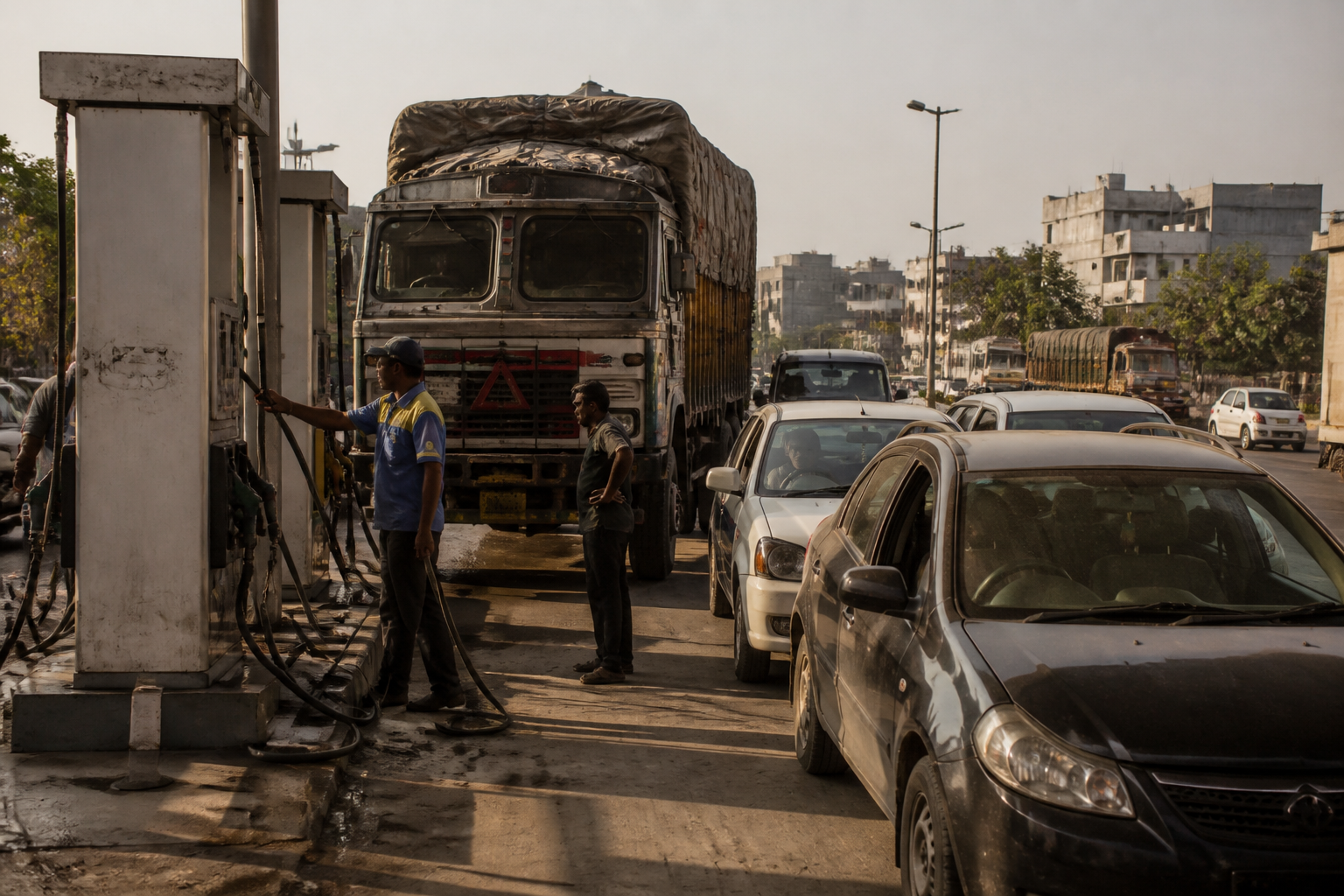
The sharp increase in bulk diesel prices has exposed a widening fault line in India’s fuel market: commercial and industrial users are being charged close to market-linked rates, while retail diesel remains frozen at a lower regulated price. That gap is already redirecting demand towards petrol pumps, creating pressure on oil companies and raising questions about how urban transport, construction and institutional operations will absorb the difference.
Oil marketing companies have increased the price of bulk diesel by Rs 14.6 per litre to Rs 153.57, from Rs 138.97 in September, according to a report by The Times of India. Bulk diesel is sold to commercial, industrial and institutional customers, and its price is aligned directly with international product benchmarks rather than being kept at the regulated retail level.
At the same time, diesel sold at public-sector oil company retail outlets remains priced at Rs 95.64 per litre in the capital, while petrol is priced at Rs 102.12. This has created a difference of Rs 57.93 per litre between bulk diesel and retail diesel. The gap is large enough to change the purchasing behaviour of businesses that would normally source fuel through bulk arrangements.
The immediate urban consequence is not confined to fuel stations. Diesel is a basic operating input for goods vehicles, construction equipment, generators, industrial machinery and several institutional services. When businesses move from bulk supply to retail pumps, the impact is transferred from a controlled procurement system to a public-facing network designed primarily for individual motorists.
## Bulk diesel prices and the shift to retail pumps
The price divergence is rooted in the different ways the two markets are managed. Bulk diesel reflects the actual market price of the fuel and is linked to international product benchmarks. Retail petrol and diesel sold by public-sector oil marketing companies, by contrast, remain regulated by the government and are currently frozen at the stated capital-city prices.
That distinction becomes commercially significant when international crude and refined-fuel prices rise. Brent crude was trading at $102.25 a barrel for December contracts on Friday, while the Indian basket of crude was last reported at $117.28 per barrel on September 30. The Times of India report said elevated crude prices had begun to hurt oil companies’ margins.
The result is a two-tier market in which the same broad fuel category carries substantially different prices depending on the customer and point of sale. Commercial and industrial buyers paying the bulk rate face the full effect of higher international prices. Buyers able to obtain diesel through retail outlets encounter a much lower price, although that channel was not designed to serve their full requirements.
Petroleum dealers have reported that the difference has already prompted some commercial and industrial customers to purchase supplies from retail outlets. Monty Sehgal, spokesperson for the Federation of All India Petroleum Association, said there had been a spike in diesel sales and that dealers had no means to distinguish commercial and industrial buyers from retail customers.
That observation points to an administrative problem as much as a pricing problem. The retail network can identify the product being sold, but not necessarily the end use of every customer. A truck operator, contractor, factory representative and private motorist may all arrive at the same dispensing station. Without a separate mechanism for identifying commercial demand, the price difference can encourage users to shift channels without changing their underlying consumption.
## Why the price gap matters to cities
Urban economies depend on the continuous movement of fuel-intensive services. Goods vehicles bring food, construction materials and manufactured products into cities. Contractors use diesel-powered machinery at project sites. Institutions and commercial facilities may rely on diesel for backup generation or other operational needs. The source report does not quantify the share of each activity affected, but the customer categories for bulk diesel show that the exposure extends beyond individual vehicle owners.
The shift towards retail pumps can also affect how fuel is distributed across a city. Bulk procurement generally allows a commercial customer to arrange supplies for a defined operation, location or fleet. Retail purchasing requires repeated visits to public outlets and makes businesses more dependent on the availability of fuel at those locations. That can increase competition for dispensing capacity, particularly when several commercial users respond to the same price signal.
The dealer association’s warning is focused on losses for oil companies. If retail sales rise because bulk customers are buying at the lower regulated price, public-sector retailers may have to sell more fuel at a price that does not reflect current market conditions. The report says private retailers have been reported to ration diesel sales following increased buying by commercial users, while public-sector retailers said they could not take such decisions.
This creates an uneven operating environment among retailers. Private companies may limit sales to protect their margins, while state-run outlets remain subject to government directions and continue serving customers at the regulated price. Consumers and businesses therefore experience different levels of access depending on the outlet they use, even when the underlying product is similar.
## The earlier diesel cap shows the governance challenge
The current situation is not without precedent. During the West Asia war, when crude supplies were disrupted and prices rose, state-run oil retailers introduced a cap of 200 litres per customer. The measure followed government directions after commercial and industrial customers began buying from retail outlets because of the price difference.
That cap was later removed. Its earlier use nevertheless shows how a pricing distortion can become an operational and governance issue at the pump. Once retail outlets begin serving substantial commercial demand, authorities may have to consider whether access should be limited, whether certain customers should be identified separately, or whether the pricing structure itself needs adjustment.
The source material does not establish that a new cap has been imposed or that one will necessarily return. It does show that the earlier measure was temporary and linked to a specific period of supply disruption. Any future restriction would therefore have to be distinguished from the existing price change and supported by a separate official direction.
The lack of customer classification is central to the problem. As Sehgal noted, dealers do not have a means to differentiate commercial and industrial buyers from retail customers. This means that the retail network is being asked to absorb a demand shift for which its transaction systems and pricing rules were not designed.
An executive of an oil marketing company cited in the report said the impact of increased retail sales would become clear only after a week or 10 days. That delay matters because fuel companies and authorities may not immediately know whether the rise in sales represents ordinary consumer demand, stockpiling, temporary commercial substitution or a broader movement away from bulk procurement.
## The limits of a frozen retail price
Keeping retail fuel prices unchanged can cushion motorists from immediate increases, but it does not remove the underlying cost pressure. Instead, the pressure appears in different parts of the fuel system. Bulk customers pay more directly, oil companies face margin stress when retail volumes rise, and dealers confront uncertainty over how to manage customer demand.
The current figures make the transfer visible. Bulk diesel has risen to Rs 153.57 per litre, while retail diesel in the capital remains at Rs 95.64. The gap is not a marginal discount that affects purchasing convenience; it is a substantial price difference that can influence the procurement decisions of businesses with significant fuel requirements.
For urban infrastructure and construction activity, the key issue is not simply whether diesel is expensive. It is whether the price is predictable and whether the supply channel can reliably serve the users who depend on it. A contractor may budget for bulk diesel but shift to retail purchasing when the differential becomes too large. A logistics operator may face a different cost depending on whether it can access a retail outlet without restrictions. A public or private institution may have to reassess how it sources fuel for equipment and backup systems.
The report does not provide evidence of project cancellations, transport fare changes or shortages. Those outcomes should not be assumed from the price increase alone. What is established is that the difference has already encouraged some commercial and industrial buyers to use retail outlets and that dealers have observed higher diesel sales.
## What the next 10 days may reveal
The most important near-term indicator will be the pattern of retail diesel sales. Oil marketing companies expect to know within a week or 10 days whether the increase is significant enough to alter the balance between retail and bulk channels. That information will help establish whether the current shift is temporary or whether the two-tier pricing structure is producing sustained substitution.
The other issue is whether private retailers continue to ration diesel sales and whether public-sector outlets face similar pressure. The source report does not identify a uniform national restriction. It says that private retailers have reportedly limited sales in some cases, while public-sector retailers have said they cannot make such decisions.
This leaves the system dependent on a combination of market behaviour and government direction. The underlying international price exposure remains visible in bulk diesel, while retail prices remain frozen at the levels cited for Delhi. Until either demand patterns or official policy changes, the fuel market will continue to operate with a sharp divide between commercial procurement and retail access.
The evidence currently confirms a significant price distortion, a reported shift by commercial and industrial users towards retail pumps, and growing concern over oil-company margins. It does not yet establish the scale of the impact on urban freight, construction costs or public services. The next sales data and any further government direction on retail access will determine whether the present gap remains a market anomaly or becomes a wider operational challenge for India’s cities.
