


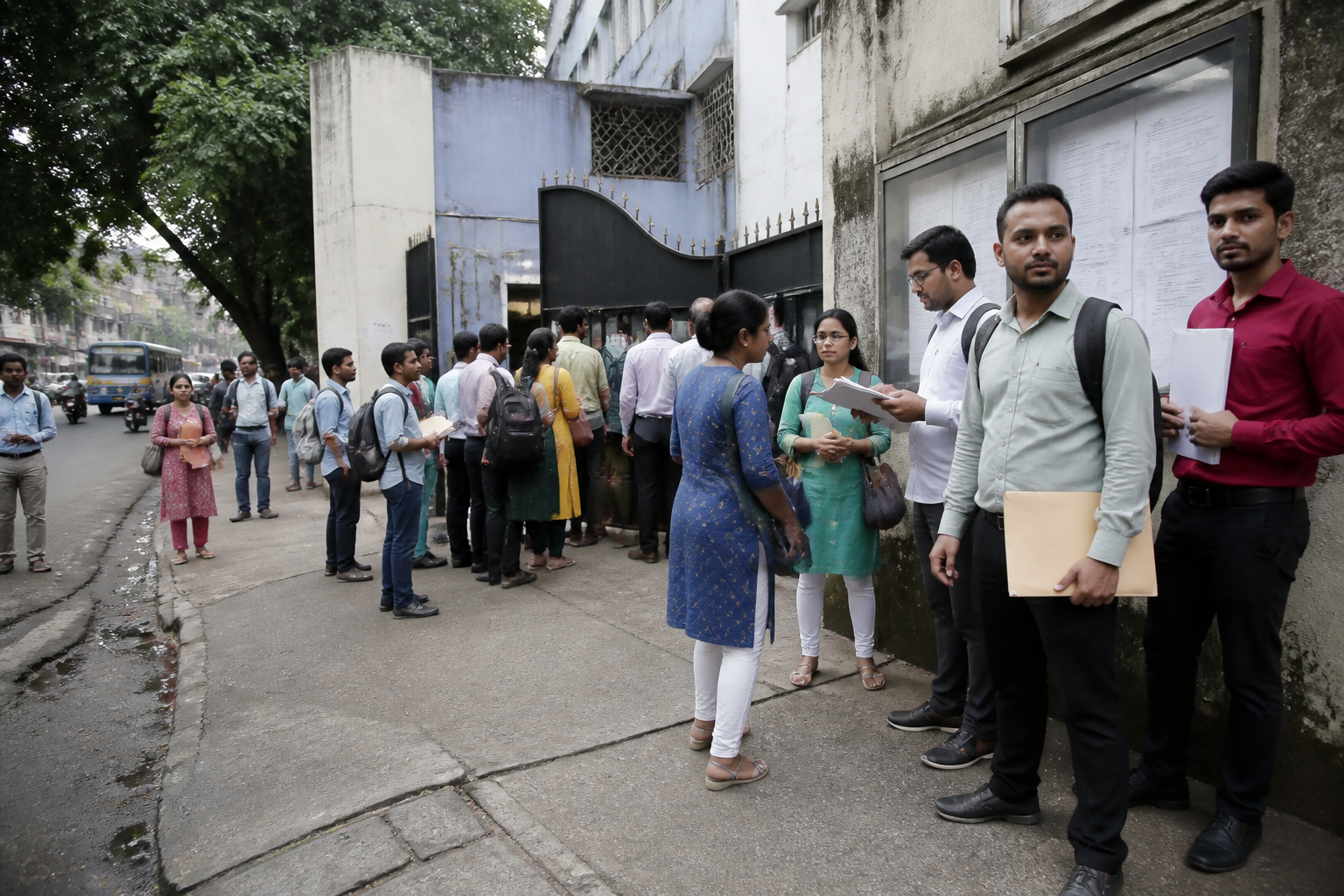
The West Bengal School Service Commission’s revised interview schedule has reopened uncertainty over teacher recruitment in government-aided schools, after a new preliminary list was prepared using a 7% OBC reservation quota instead of the 17% quota applied under the previous government. The immediate issue is a series of interviews and lecture demonstrations beginning on October 8. The larger problem is that the change has been introduced midway through a recruitment process already shaped by cancelled appointments, court deadlines and thousands of candidates whose employment prospects remain unsettled.
The SSC said in a notice issued on October 1 that verification and oral interviews combined with lecture demonstrations for candidates in the revised preliminary interview list would begin on October 8. Candidates have been asked to follow the commission’s website for the detailed interview schedule. After the latest round, the commission is expected to prepare a fresh list of empanelled candidates for selection through counselling.
The notice followed the publication of a revised preliminary list of interviewees after the government reduced OBC reservation from 17% to 7%. The change has direct consequences for the composition of the merit list. Candidates who were considered under the earlier reservation framework may now face a different outcome even where their written examination, academic record and interview performance remain unchanged.
The distinction is important because the selection process is not beginning from a clean slate. Several candidates had already appeared for interviews and lecture demonstrations, while an earlier preliminary interview list was published in November last year and a final panel and waiting list followed in January. The revised list effectively interrupts that sequence and requires the commission to recalculate the field under a new reservation arrangement.
The SSC has said candidates who have already completed interviews and lecture demonstrations do not need to appear again. Their written examination marks, academic scores, interview marks and lecture-demonstration marks will be considered while preparing the revised merit list. That assurance limits the immediate procedural burden on candidates, but it does not remove the uncertainty created by the change in the reservation basis.
Rupa Karmakar, an in-service Sanskrit teacher at a government-aided school and one of the candidates taking part in the fresh selection process, told The Telegraph that the revised notice cancelled the preliminary list issued earlier, along with the panel and waiting list published in January. She said that although earlier marks would be retained, the new merit list would be based on 7% OBC reservation rather than the 17% quota used for the earlier list. As a result, she said, many candidates from the earlier panel may not qualify for the revised list.
This makes the dispute more than a question of scheduling. The reservation percentage determines how the available posts are distributed across categories and therefore influences who reaches the panel, who remains on the waiting list and who is excluded. In a recruitment process with a large number of candidates and a fixed number of vacancies, even a change that appears administrative can alter the practical value of marks already earned.
The scale of the vacancy also raises the stakes. As many as 12,445 teaching posts are vacant at the Plus-II level in Bengal’s government-aided schools, according to the report. The SSC’s recruitment exercise is therefore linked to the staffing capacity of the state’s higher-secondary school system, not only to the employment claims of individual applicants. Delays leave schools waiting for appointments while candidates remain uncertain about whether a process they entered under one framework will conclude under another.
The recruitment process is also connected to the Supreme Court’s intervention in the earlier selection exercise. In April last year, the court revoked the appointments of 17,209 teachers recruited through what the report describes as a tainted SSC process carried out in 2016. Of those, 15,403 candidates were identified as untainted and were allowed to participate in a fresh selection process to retain their jobs.
Karmakar is among those 15,403 candidates. She had qualified in the written examination held last September and appeared for an interview in December. Her case illustrates the overlapping pressures within the current process: candidates are not simply seeking first-time appointments but, in some cases, attempting to retain employment after the earlier recruitment system was invalidated.
That history explains why procedural changes have produced such a strong reaction. A candidate who has already lost a job, completed another examination and interview, and been included in an earlier panel faces a different level of risk from an applicant entering a new recruitment exercise. For the former group, a revised list can affect both future employment and the prospect of restoring a position previously held.
The legal timetable adds another layer. The Supreme Court had earlier set deadlines of December 31, 2025, and August 31, 2026, before setting May 31, 2027, as the final deadline after the state government sought more time, according to the report. The recruitment process must therefore move within a court-monitored schedule while the commission revises its lists and conducts interviews under the changed reservation framework.
Candidates have questioned whether the revised preliminary list can legally be introduced midway through the process. Karmakar said the change was already facing legal challenges and expressed doubt that recruitment would be completed by May 2027. The report does not establish the outcome of those challenges, but the existence of litigation means that the SSC’s administrative steps are taking place alongside continuing legal scrutiny.
The sequence also reveals the institutional difficulty of repairing a recruitment process after a court finds that the original exercise was compromised. The commission must simultaneously identify candidates eligible for a fresh selection, preserve marks from earlier stages, apply the current reservation framework, prepare a new merit list and meet the court’s deadline. Each step can affect the next. A change in one rule can require the publication of a new list, which can then trigger objections or litigation and further delay counselling and appointments.
The dispute over the OBC quota shows how recruitment rules operate as part of the administrative infrastructure of public education. Reservation is not an additional decision made after merit is calculated; it shapes the structure within which merit lists are prepared. When the quota changes after candidates have completed earlier stages, the commission must reconcile continuity for candidates with the government’s revised policy position.
The report attributes the reduction from 17% to 7% to the BJP government and says that the earlier 17% reservation was implemented by the previous government. The supplied material does not provide the notification, legal reasoning or administrative order behind the revised percentage. It also does not establish whether the change will apply beyond this recruitment exercise. What is clear is that the SSC has used the reduced quota in preparing the revised preliminary interview list.
The government’s public commitment to completing the recruitment process by May next year has also become part of the institutional context. The SSC published the revised list and schedule days after chief minister Suvendu Adhikari said the process would be completed by May next year. The commission’s next steps will determine whether the interview schedule can be converted into a final panel and counselling process within the court-approved timeline.
For schools, the central issue is not only the eventual appointment of candidates but the timing and reliability of the process. The reported 12,445 vacancies represent a staffing gap at the Plus-II level. Until appointments are completed, the recruitment dispute remains connected to the functioning of government-aided schools and the ability of those institutions to fill sanctioned teaching positions.
For candidates, the most consequential uncertainty is whether marks and prior participation will carry the same practical value under the revised quota. The SSC has stated that candidates who have already completed the interview and lecture demonstration need not repeat them, and that their scores will be retained. However, the commission will prepare a new merit list, and the change in reservation may alter the ranking and category-wise selection outcome.
The immediate milestone is the start of verification, interviews and lecture demonstrations on October 8. The next significant step will be the preparation of the fresh empanelled list and the counselling process that follows it. Until those stages are completed, the effect of the revised reservation framework on the earlier panel, waiting list and participating candidates will remain unresolved.
The evidence currently confirms a revised list, a new interview schedule, a changed OBC reservation basis and a recruitment process operating under a May 31, 2027, court deadline. It does not establish how courts will decide the legal challenges or how many candidates from the earlier lists will remain eligible for appointment. Those outcomes will determine whether the latest administrative reset becomes a step towards completing recruitment or another source of delay in West Bengal’s prolonged teacher-selection process.
