


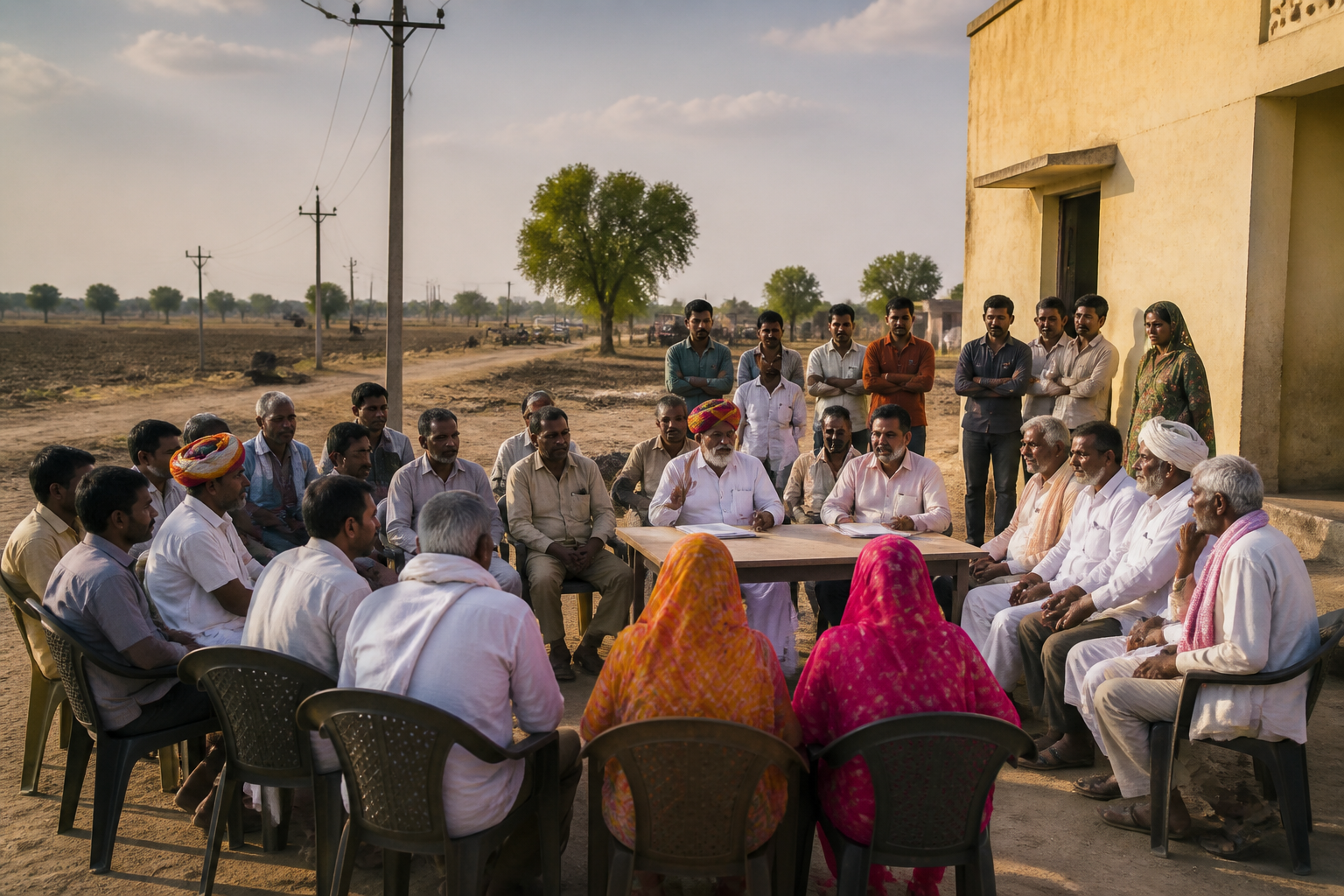
Congress’s preparations for Rajasthan’s Panchayati Raj elections are revealing less about campaign messaging than about the institutional difficulty of converting electoral support into functioning local governments. The party is planning early ticket distribution, tighter coordination and a stronger grassroots network after encountering problems in forming boards following the recent urban local body polls.
The elections are expected to cover all 41 districts, 14,403 gram panchayats and every panchayat samiti. That scale makes candidate selection more than an internal party exercise. It will determine who enters the formal structure of rural governance, how local representatives are linked to political organisations and whether elected bodies can maintain cohesion after polling.
The Times of India reported that the election notification was expected shortly. Congress is therefore trying to move before the formal campaign window becomes compressed. Its stated concerns include delays in distributing tickets, dissatisfaction among aspirants and inadequate time for campaign management. These are organisational issues, but they can directly affect the quality and continuity of local administration once representatives take office.
The party’s approach is shaped by its experience in the recent urban local body elections. According to the report, Congress won a substantial share of seats but faced difficulties in forming boards. The party has also pointed to a vote-share gap of only 0.92 percentage points between Congress and the BJP in those polls. The narrow gap is being used internally to argue that electoral performance cannot be assessed only by seat totals: the ability to coordinate elected members after the results is equally important.
That distinction is particularly significant in the Panchayati Raj system because some positions are filled through indirect elections. Zila Parishad members will elect Zila Pramukhs through secret ballot, creating a second stage in which party strength on paper may not automatically translate into control of the district-level body. Congress is consequently factoring the possibility of cross-voting into its rural strategy and seeking closer coordination between elected members and the organisational network.
The party source cited by the report said preference would be given to long-serving workers, people who had held organisational or elected positions, former panchayat representatives and those with a record of grassroots work. This is an attempt to address the trust and loyalty problem exposed by secret-ballot elections. It also shows how political parties view local representatives: not only as candidates for a single election, but as part of a continuing organisational chain extending from the gram panchayat to the district level.
Congress is forming 21-member executive committees in every gram panchayat and plans to create more than 3.23 lakh rural office-bearers. The scale of that exercise is notable, although the report does not establish how these committees will function, how frequently they will meet or what formal relationship they will have with elected panchayats. Those unanswered questions matter because party organisation and statutory local government are not the same institution. The former manages political mobilisation; the latter is responsible for public administration within the powers assigned to it.
The election strategy is also being built around agrarian issues. Rajasthan Pradesh Congress Committee president Govind Singh Dotasra has raised concerns about fertiliser availability, alleged fake seeds, the absence of a milk bonus and inadequate electricity and irrigation water. He questioned why farmers had to wait in queues for DAP fertiliser and alleged that some were subjected to lathi-charge. He also said the government had failed to fulfil its promise of doubling farmers’ income.
These issues connect electoral competition to the everyday functioning of rural infrastructure and public services. Irrigation power and water are not simply campaign subjects; they influence agricultural production, household incomes and the viability of rural settlements. Fertiliser distribution and seed quality involve supply chains and regulatory oversight beyond the panchayat, while local representatives may still be the first political point of contact for residents seeking redress.
The report does not provide independent data on fertiliser shortages, seed complaints, electricity supply or irrigation availability. It records Dotasra’s allegations and the issues Congress expects to emphasise. That distinction is important. The political salience of a problem can be established by the campaign’s focus, but the scale, causes and administrative responsibility for each problem require separate evidence.
The same caution applies to the party’s reading of the urban local body results. A 0.92 percentage-point vote-share difference indicates a close contest as described in the report, but it does not by itself explain why Congress struggled to form boards. The party has identified cross-voting and coordination as key concerns, yet the supplied account does not provide ward-level results, the number of boards affected or evidence showing how individual defections altered outcomes.
Still, the link Congress is drawing between urban and rural elections highlights a recurring governance problem: elections are often treated as the end point of political competition, while the formation and operation of local bodies determine whether mandates become administrative action. In municipalities, board formation can affect standing committees, local priorities and control over civic decisions. In the Panchayati Raj system, indirect elections and multiple tiers create their own coordination challenges.
The forthcoming polls will operate across gram panchayats, panchayat samitis and district-level institutions. The report provides no details on the election schedule, reservation arrangements, expenditure limits or the powers available to the bodies being contested. It also does not say whether the government’s response to the agrarian concerns raised by Congress has included specific measures. Those gaps limit what can be concluded about the likely administrative consequences of the campaign.
What is clear is that Congress is trying to solve two separate problems at once. The first is electoral access: selecting candidates early enough to prevent dissatisfaction and organising workers across a very large rural geography. The second is post-election cohesion: ensuring that elected members remain aligned during leadership elections and board formation. The party’s proposed network of rural office-bearers is intended to address the first problem and, potentially, the second, although its effectiveness has not yet been demonstrated.
The formation of a nine-member committee to examine complaints from Bhilwara, Pali, Bharatpur and other urban local bodies adds another institutional layer to the strategy. The committee, headed by former Assembly Speaker C P Joshi, has been asked to submit recommendations within seven days. The report does not specify the complaints under examination or the committee’s terms of reference. Its findings could clarify whether the party’s urban difficulties were primarily related to candidate selection, cross-voting, local coordination or other factors.
For Rajasthan’s rural local governance system, the key issue is therefore not only which party wins seats. It is whether the elected structure can operate with sufficient coordination to make decisions, represent local demands and connect public grievances with the departments responsible for delivery. The available account shows that political parties recognise this challenge, but it does not yet establish how their proposed organisational mechanisms will perform.
The next concrete milestones are the election notification, Congress’s ticket distribution and the seven-day report of the committee examining urban local body complaints. Together, they will indicate whether the party’s response remains a campaign strategy or develops into a more defined approach to managing elected local institutions.

