


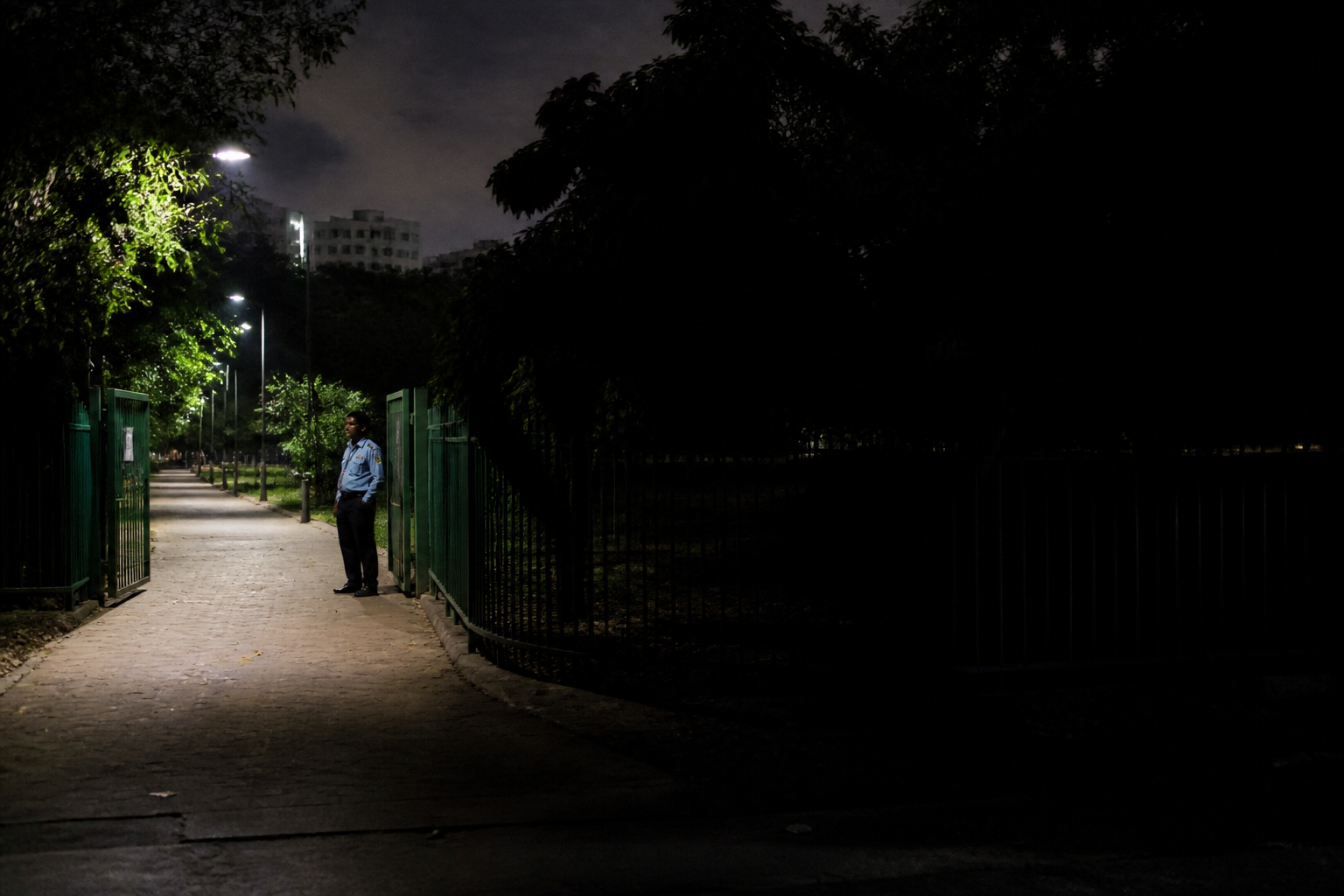
Delhi’s response to dark spots has come under scrutiny after a ground inspection by Jagran reported that parts of Asola’s Aastha Kunj Park remained poorly lit and exposed despite increased police patrolling and municipal assurances following a reported sexual assault. The report also identified lighting and boundary-security gaps at Jahapanah City Forest and Sanjay Jheel Park.
The findings point to a gap between the announcement of safety measures and their delivery at the locations where women and other park users are expected to depend on public lighting, guards and secure boundaries. At Aastha Kunj Park, the inspection found a security guard posted near the nursery-side gate, but also reported that the area beside the gate remained in darkness. The report said the park had not been fully illuminated even after the incident that prompted renewed attention to women’s safety in public spaces.
The supplied report identifies the incident as a gang rape of a minor near Kalkaji Temple. It says the event led to pressure on Delhi Police to strengthen safety measures and prompted public discussion about the condition of dark spots across the capital. Police officials were reported to have increased patrolling and conducted inspections, while the Municipal Corporation of Delhi began identifying locations where inadequate lighting or other physical conditions could affect safety.
The Delhi Government also announced a plan to convert about 96,000 street lights to smart LED systems. According to the report, the plan included real-time monitoring of dark spots, improved illumination and stronger arrangements for women’s safety. However, the inspection described the condition at Aastha Kunj Park as evidence that announcements and implementation were not yet aligned at every location.
The report’s observations at other parks show that lighting is only one part of the safety problem. At Gate 5 of Jahapanah City Forest, lights were present along the access routes, but broken fencing and dense vegetation were reported to leave adjoining areas inadequately illuminated. The condition of the boundary and the surrounding vegetation can affect visibility even where lighting fixtures have been installed. This makes the difference between having lights on a site and creating a consistently visible, secure public environment important for assessing the effectiveness of the intervention.
At Sanjay Jheel Park in Trilokpuri, the inspection reported areas of darkness caused by insufficient lighting. It also found sections of the boundary wall where grills were missing. The report said security personnel were not visible during the inspection. These conditions create multiple points of concern: limited illumination, openings in the perimeter and an absence of visible guarding. The account does not establish whether these conditions were temporary or whether they reflected the park’s regular operating arrangements.
The three locations raise a wider administrative question about how Delhi’s dark spots are identified, prioritised and closed. A list of locations is not, by itself, evidence that the safety problem has been resolved. For residents, the relevant test is whether a park entrance, pathway, boundary and surrounding area remain visible and accessible without exposed pockets of darkness. It is also whether lighting repairs are accompanied by maintenance of fencing, trimming of vegetation and deployment of guards where required.
Responsibility is divided across institutions. Delhi Police is responsible for patrolling and responding to threats, while municipal agencies are responsible for public infrastructure and, in relevant locations, park maintenance and lighting. The reported plan to replace street lights with smart LED systems adds a technology and monitoring layer, but the inspection suggests that physical conditions such as broken grills, dense vegetation and unlit spaces remain part of the same safety system. A lighting upgrade cannot independently address every risk within a large park or forested public space.
The report also illustrates the difficulty of measuring public-safety commitments through photographs, announcements or lists of proposed works alone. Police patrols may be increased while dark areas remain. Lights may be installed along one route while adjoining spaces remain obscured. A guard may be posted at a gate while the area beside the gate remains unlit. Each of these conditions can produce a different experience from the one described in an official update.
The available material does not provide a completion schedule for the proposed LED conversion, the number of lights repaired at each park, the agency responsible for each location or a formal response from the Municipal Corporation of Delhi to the inspection findings. It also does not establish whether the reported security conditions have since changed. Those details are necessary to assess the status of the government’s dark-spot programme and to distinguish temporary deficiencies from persistent failures.
The chronology in the supplied report also requires clarification before publication. The article describes the incident as having taken place on 21 December and refers to an inspection 12 days later, while the accompanying publication metadata dates the report to 2 October 2026. These dates cannot be reconciled from the supplied material. The incident date, inspection date and timeline for the municipal and police actions should therefore be confirmed against the original police, municipal or government records.
What the report does establish is that the safety of public parks depends on more than a formal assurance that patrolling has increased or that dark spots have been listed for action. At the three locations examined by Jagran, the reported conditions included darkness near a guarded gate, broken fencing, dense vegetation, missing boundary grills and an absence of visible security personnel. The next verifiable milestone is confirmation from the concerned authorities of the repair status, lighting coverage, monitoring arrangements and implementation timeline for the announced smart LED programme.
