


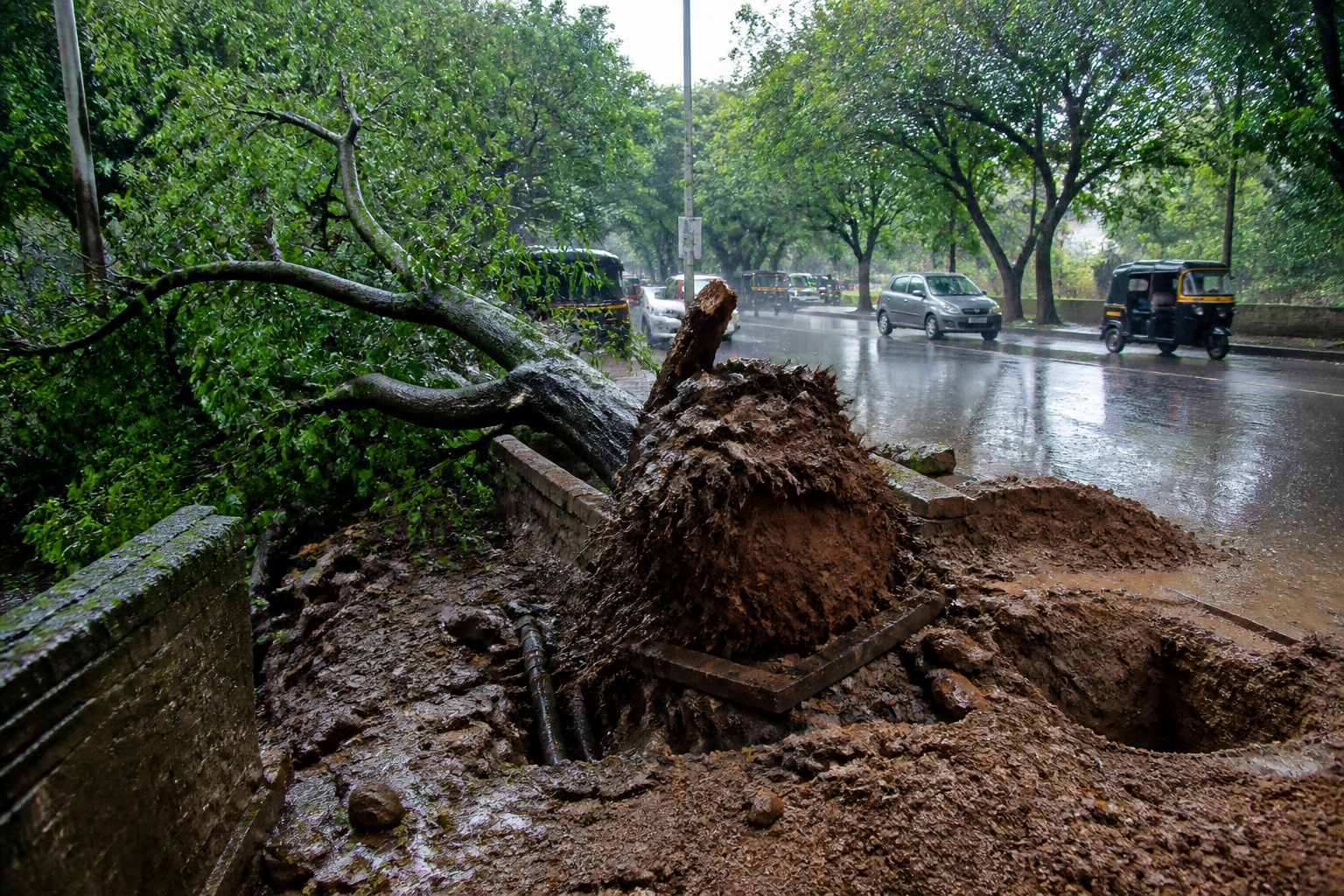
The Aarey tree falls reported after heavy rain and strong winds on September 29 have raised a question that extends beyond a single weather event: whether underground utility work is weakening roadside trees before extreme weather exposes the damage. Mid-Day reported that around 25 to 30 large trees collapsed along Aarey main road, while activist Godfrey Pimenta of the Watchdog Foundation sought an investigation into possible root damage caused by cable-laying and other excavation work.
The available account does not establish that utility work caused the collapses. It records an allegation that earlier trenching near existing trees may have damaged their root systems, leaving some trees more vulnerable when heavy rain and strong winds affected the area. That distinction is important. In cities, tree failures can result from several interacting factors, including saturated soil, wind loading, structural weakness, poor drainage and damage to roots. Establishing the cause requires an inspection of each location rather than an assumption based only on timing.
What the Aarey incident does establish is the administrative question surrounding work carried out near mature roadside trees. Pimenta wrote to the BMC Commissioner and the Secretary of the Ministry of Environment, Forest and Climate Change seeking an inspection of the locations where the trees fell. He also asked authorities to identify other trees whose roots may have been damaged during utility work and to assess their structural and safety condition.
That request points to a weakness in the way urban infrastructure is often experienced on the ground. A cable trench may be temporary, but the damage caused by excavation can remain below the surface long after the road is restored. Roots provide stability as well as access to water and nutrients. If excavation cuts through or severs important roots, the visible road surface may show little evidence of the risk until a storm or period of saturated soil places additional pressure on the tree.
The Mid-Day report attributes the concern to utility works undertaken earlier this year by various agencies. It does not identify the individual companies, contractors, work packages or specific permissions involved. It also does not provide an independent arboricultural assessment linking any particular tree collapse to a particular excavation. Those gaps are precisely why a location-level inquiry would matter: the question is not simply whether trenches existed, but whether they were dug within root zones, what safeguards were prescribed, and whether those safeguards were followed.
## The permission chain behind a roadside trench
Work on public roads typically involves more than one institutional responsibility. The agency seeking to install or maintain a cable must coordinate with the road-owning or road-managing authority and comply with conditions attached to excavation and restoration. Where trees are present, additional protections may apply through municipal tree authorities, environmental regulations or project-specific permissions. The supplied report does not specify which permissions were issued in Aarey or which agency was responsible for monitoring compliance.
Pimenta has asked the BMC to investigate whether prescribed permissions, safety conditions and tree-protection measures were followed. He has also requested that details of permissions issued for such work be made publicly available. That demand shifts the issue from a one-time inspection to a question of administrative transparency. If permissions, alignment plans and restoration conditions are accessible, residents and independent experts can better understand who authorised the work and what safeguards were required.
The accountability chain also matters because utility corridors are rarely controlled by a single actor. Different agencies may undertake cable-laying or other underground works at different times, sometimes along the same road. Without a consolidated record, it can be difficult to determine which excavation affected a tree, whether the work was permitted, or whether a contractor restored the site in accordance with the conditions imposed.
## Why weather alone may not explain every failure
Heavy rain and strong winds were reported before the trees fell, and those conditions may have contributed to the incidents. However, the presence of severe weather does not by itself answer whether earlier infrastructure work increased the vulnerability of individual trees. A healthy tree can fail during a storm, but a tree with compromised roots may fail at lower wind speeds or after prolonged soil saturation. The distinction can only be assessed through site inspection, examination of the root zone and review of the work history.
The reported number—approximately 25 to 30 large trees—makes the event significant for Aarey’s roadside safety and for the movement of people along the main road. The report does not provide a tree-by-tree record, the exact locations of the collapses, the species or age of the trees, the extent of road disruption, or information on injuries and property damage. These details would be necessary to assess whether the falls were concentrated near particular excavation stretches or distributed across the road.
Pimenta has therefore sought a structural and safety assessment of vulnerable trees in Aarey Milk Colony, particularly along roads where underground utility work has taken place. Such an assessment would have two functions. It could identify immediate risks to road users, and it could create evidence about whether excavation corridors correspond with weakened trees. Without that exercise, authorities may remove fallen trees while leaving other potentially unstable trees in place, or attribute the entire event to weather without examining the infrastructure history of the affected locations.
## A test of coordination, not only tree protection
The Aarey case also exposes the difficulty of managing infrastructure in a landscape where roads, utilities and mature vegetation occupy the same narrow corridor. Underground services are necessary for a growing city, but their installation can create conflicts with existing trees when alignments are selected without sufficient attention to root zones. The conflict is not automatically between development and conservation. It is often a problem of sequencing, mapping, supervision and enforcement.
Before excavation begins, agencies need accurate information about the location and condition of existing trees. During the work, contractors need clearly defined limits and methods for avoiding major roots. Afterward, the authority responsible for the road and the tree assets needs a record of what was excavated, what was damaged and what remedial measures were taken. The report indicates that Pimenta wants future cable-laying to minimise damage to existing trees, but it does not state whether Aarey currently has a publicly available asset map linking trees with underground utility corridors.
That missing information is important for governance. A public record of permissions could show whether tree-protection conditions were imposed. Inspection reports could show whether conditions were monitored. Contractor records could establish who carried out the work. A structural assessment could indicate whether other trees are at risk. Together, these documents would allow the public to distinguish an unavoidable weather-related failure from a preventable infrastructure-related risk.
The case also highlights the limits of post-incident action. Investigating a collapse after heavy rain is necessary, but prevention depends on inspections before the monsoon and before new utility works begin. The source report does not say whether such pre-work or pre-monsoon assessments were conducted in the affected stretches. It also does not record any response from the BMC, which had not replied to Mid-Day’s queries at the time of publication.
For now, the evidence supports a narrower conclusion than the allegation being examined. Around 25 to 30 large trees reportedly fell along Aarey main road after heavy rain and strong winds. An activist has alleged that earlier cable-laying and underground excavation may have damaged roots and asked for an inquiry. Whether that work contributed to the collapses remains unestablished in the supplied material. The next meaningful step is an official, location-specific inspection that identifies the fallen trees, examines nearby vulnerable trees, reviews permissions and determines whether prescribed protection measures were followed.
