


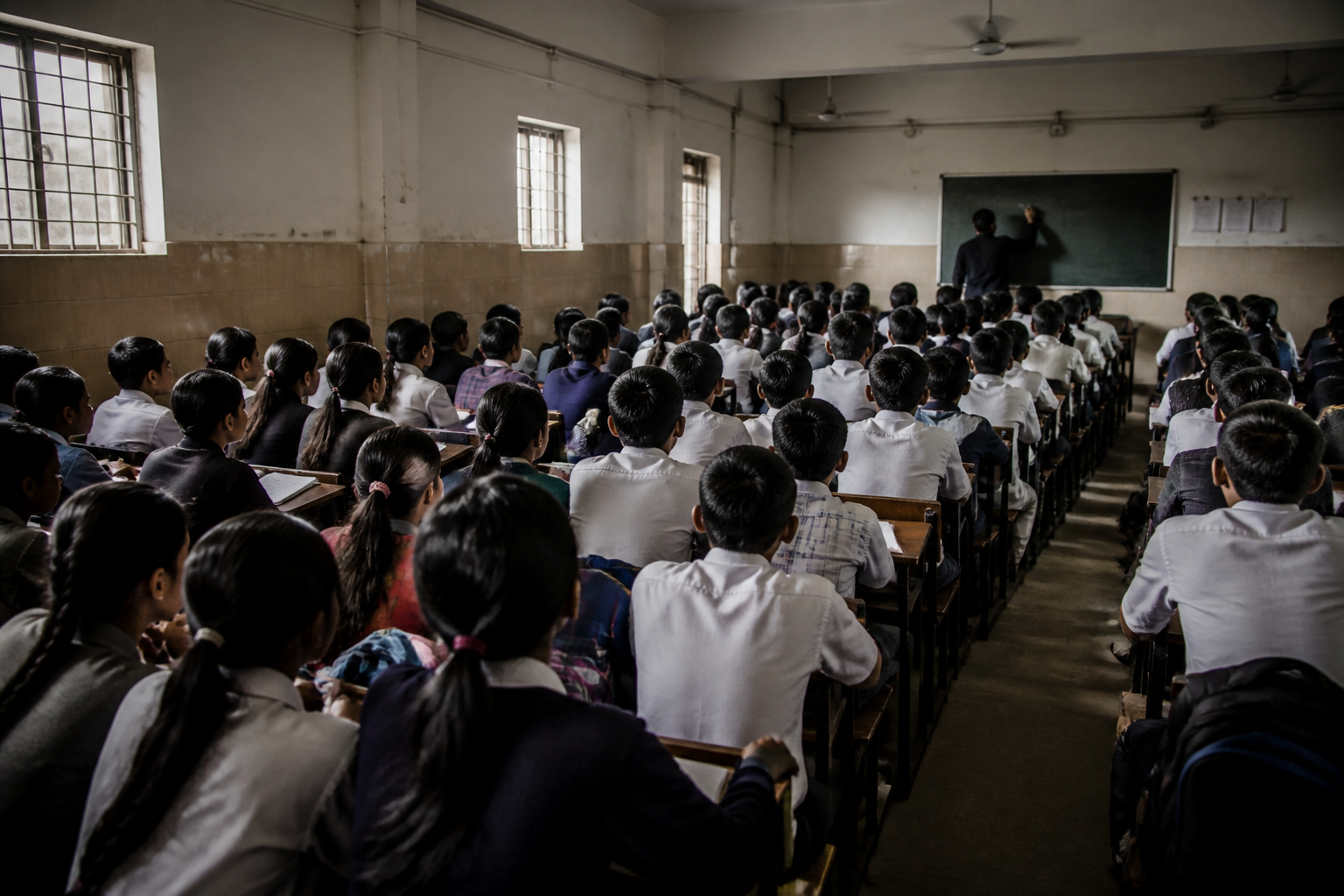
Delhi government schools are facing severe overcrowding, with some sections holding 70 to 80 students and certain classes accommodating close to 90, according to a representation submitted to the education department by education activist and lawyer Ashok Agarwal.
The letter seeks urgent intervention to reduce what it describes as an excessively high student-classroom ratio, particularly in schools in east Delhi. Agarwal said the pressure was especially serious in senior secondary classes, including physics, chemistry and biology sections, where shortages of subject teachers and inadequate classroom capacity were affecting students.
The concern extends beyond east Delhi. In northeast Delhi, schools have previously responded to high enrolment and limited space by operating double shifts, using libraries and other spaces as classrooms, and staggering attendance. A Times of India ground report in September 2024 found that the pressure was affecting how often some children could attend school.
Figures submitted by the Directorate of Education to the Delhi High Court in 2023 showed that 14 schools examined in northeast Delhi had 31,251 students and 374 classrooms, producing an average student-classroom ratio of 83.5:1. The ratios varied sharply. Government Co-ed Middle School in Johripur recorded 190 students per classroom, while two schools in Sabhapur recorded ratios of 102:1 and 109:1, according to officials cited in the report.
Students have described the direct impact of the shortage of space. A student at a government school in Tukhmirpur said they were told on joining Class XI that attendance would be limited to Tuesdays, Thursdays and Saturdays. Another student from a Khajuri Khas school said that students sometimes had to sit in the library because the school had so many enrolled children.
The overcrowding has also intersected with shortages of subject teachers. In August, students at a Khajuri Khas government school alleged that more than 200 students in Classes XI and XII had been affected by the absence of a regular chemistry teacher. Each of the four sections had around 50 to 55 students. A teacher was subsequently assigned to the school for three days a week.
An education department official said infrastructure expansion was under way in some affected areas. The government is planning permanent school buildings on vacant plots in Nand Nagri, Mandoli, New Usmanpur, Johripur and Geeta Colony. The five projects are estimated to cost around Rs 165 crore, while additional school buildings are also in the pipeline, the official said.
Agarwal’s representation has called for immediate measures to reduce the student-classroom ratio, arguing that inadequate seating and space were preventing some students from attending school regularly. The education department’s planned buildings are intended to address capacity constraints in the affected areas.
