


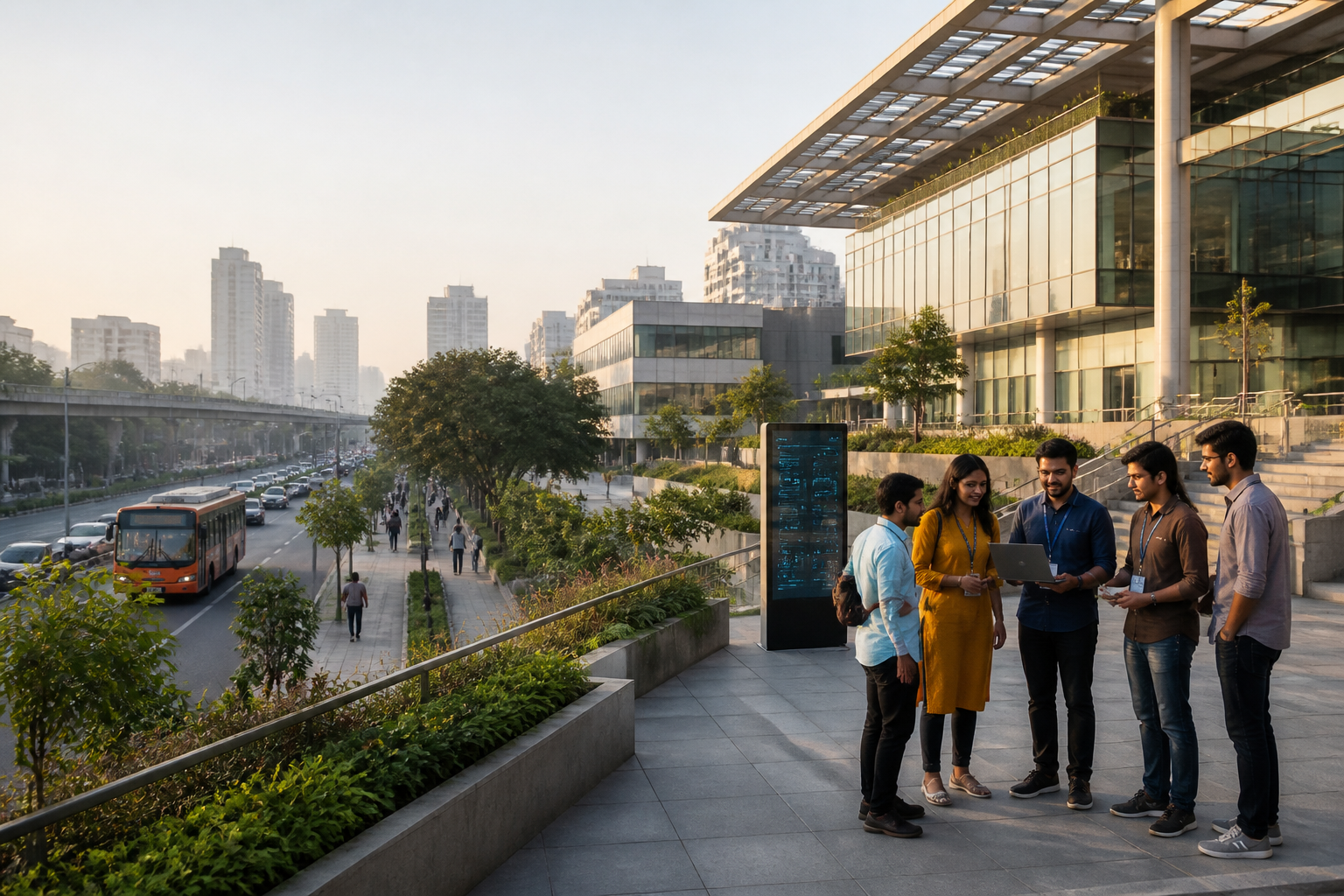
Maharashtra’s ambition to become a global innovation hub is being framed not only as a technology goal but as a test of how the state governs, funds and deploys new ideas. Chief Minister Devendra Fadnavis said on October 1 that the state has the capacity to build this position through new technology, research and youth-led innovation. But his own remarks also identified the central challenge: ideas emerging from competitions, hackathons and research programmes must reach administration, markets and citizens rather than end with certificates or announcements.
Speaking at the fourth edition of The Governance Challenge at the National Centre for the Performing Arts in Mumbai, Fadnavis said around 18 per cent of the country’s startups are being launched in Maharashtra and that the state has more than 30,000 startups. The event, organised in coordination with the Gates Foundation and Samagra, recognised winners of the governance-focused initiative. This year’s theme was the use of innovation to strengthen Maharashtra’s research capacity by 2035.
The figures and plans presented at the event place Maharashtra’s innovation policy within a larger administrative question. A sizeable startup base can provide companies, researchers and entrepreneurs. It does not, by itself, establish that public institutions can identify useful solutions, procure them, integrate them into existing systems or measure their results. The emphasis in the chief minister’s speech on implementation therefore matters as much as the ambition to create an innovation ecosystem.
Fadnavis said research, industry and markets would need to be connected so that innovation produces practical results. He described The Governance Challenge as more than a competition, saying it was intended to identify talent and ideas that could shape the future structure of administration. The distinction is important for a state that wants to use innovation in areas where public systems are complex, data-heavy and spread across multiple departments.
The areas listed in the speech include artificial intelligence, data analysis, digital governance, urbanisation, agriculture, health, education, climate change and innovation. Several of these are directly linked to how cities function. Digital governance affects how residents access services and how departments process information. Data analysis can influence planning and allocation. Urbanisation creates demand for coordinated decisions on infrastructure, housing, mobility, utilities and public health. Climate change adds pressure to make these systems more resilient.
The announcement, however, does not establish that specific applications have already been adopted across these sectors. The supplied report records the government’s stated intention to bring young people’s perspectives into administration, not a completed list of projects, departments or service improvements. That distinction is essential. A policy can create a pathway for experimentation without yet demonstrating that the pathway works.
The state’s proposed geographical approach is also significant. Fadnavis said young researchers from Nagpur, Nashik, Kolhapur, Nanded, Amravati and every part of Maharashtra would be provided access to mentoring, technology, incubation and markets. This suggests an attempt to present innovation as a state-wide project rather than one concentrated only in Mumbai or a small number of established technology centres.
Whether that distribution becomes real will depend on the institutional mechanisms behind it. The speech refers to mentoring, incubation and market access, but the supplied material does not specify the agencies responsible, the selection criteria for beneficiaries, the funding structure or the timelines for delivery. It also does not identify how smaller cities will be connected to research institutions, investors, public procurement systems or state departments. These details will determine whether the proposed geography is an operating model or an outreach promise.
The proposed 300-acre Innovation City is the most visible physical component of the plan. According to the chief minister, the project is being planned around artificial intelligence and advanced technologies. A large, technology-oriented development can provide space for laboratories, companies, incubators and training institutions. Yet its urban value will depend on what functions it performs and how it connects to the city around it.
The announcement does not provide the proposed location, land-acquisition model, development authority, investment requirement, construction timeline or governance structure for the Innovation City. Without those details, it is not possible to assess whether the project is intended as a research district, a business park, an education cluster or a broader mixed-use urban development. Each model would carry different implications for transport, housing, utilities, public access and local economic participation.
The physical scale also raises a question about the relationship between innovation infrastructure and existing urban systems. A technology district cannot operate independently of transport networks, reliable power and communications, affordable accommodation, public services and institutional links. The source material does not state how these requirements will be addressed. For now, the 300-acre figure establishes the proposed scale, but not the project’s urban form or implementation status.
The state’s artificial intelligence policy is expected to train two lakh young people and professionals, the chief minister said. The government is also preparing to establish AI incubators and is seeking to make government data available to young innovators for research. Together, these proposals indicate three different policy functions: building skills, supporting enterprises and enabling public-interest experimentation.
Each function has a separate administrative requirement. Training needs a defined curriculum, delivery network and method for assessing outcomes. Incubation needs facilities, technical support, financing and access to users or markets. Government data requires rules for access, privacy, security, quality and accountability. The report records the intention to use government data for research but does not provide details of the proposed safeguards or the categories of data that could be made available.
This is particularly relevant to urban governance. City administrations generate and use data on transport, land, construction, water, waste, public health and service delivery. Making such information useful to researchers can improve understanding of urban problems, but data alone does not produce better decisions. It must be accurate, interoperable and connected to departments that have the authority and capacity to act. The announcement does not yet indicate how proposed AI incubators or young researchers would work with municipal bodies and state agencies.
The Governance Challenge provides the immediate institutional setting for the announcement. Its stated purpose, as described by Fadnavis, is to find ideas and talent that can influence the future design of administration. That framing moves the discussion away from innovation as a purely commercial activity. It presents young researchers as potential contributors to the public system, including in fields such as climate change and urbanisation.
But the transition from a winning idea to a public project is usually more demanding than the competition stage. A proposal must be tested against legal responsibilities, departmental budgets, procurement rules, existing technology systems and the needs of residents. It must also have an accountable institution that can own the project after the event ends. Fadnavis’s statement that hackathons and competitions should not conclude with certificates directly acknowledges this gap, although the supplied report does not describe a formal implementation framework.
The proposed 2035 horizon adds a long-term dimension to the plan. The state wants to strengthen its research capacity by that year, while the immediate proposals involve an Innovation City, AI training for two lakh people, incubators and the use of government data. These elements operate on different timelines. Training can begin through programmes, incubator development requires institutions and facilities, and a 300-acre city would require planning and execution over a longer period. The report does not specify milestones linking these components.
The startup figures cited at the event are intended to show Maharashtra’s existing strength. More than 30,000 startups and approximately 18 per cent of the country’s startups provide a base on which the state can build. They do not explain how many of these firms work in public services, urban technology, climate resilience or infrastructure. Nor does the report state how many have moved from early-stage ideas to sustainable operations. The numbers therefore establish the size of the ecosystem cited by the government, but not its direct contribution to public administration.
That distinction is important for the state’s urban agenda. A startup ecosystem can create jobs and products, while a public innovation system must also solve problems that may not offer immediate commercial returns. A digital tool for a municipal service, a climate-risk model or a data platform may require government adoption before it can achieve scale. The policy challenge is not only to produce more ideas, but to create a credible route through which public institutions can test and use them.
The announcement also places responsibility on institutions beyond the chief minister’s office. The event was attended by Chief Secretary Rajesh Agrawal and MITRA member Deepak Karanjikar, according to the report. Their presence points to the need for coordination between political leadership, the state bureaucracy and organisations responsible for investment or development. The source does not set out the respective roles of these institutions, so the administrative chain for the proposed initiatives remains to be clarified.
For citizens, the eventual measure of the innovation hub will not be its branding or physical scale. It will be whether research and technology improve the reliability, accessibility and accountability of public services. The government’s own emphasis on implementation provides that standard. At present, the evidence supplied confirms an ambition, a set of proposed interventions and a broad list of sectors. It does not yet confirm completed projects, measurable service improvements or an operating model for the Innovation City.
Maharashtra’s plan is therefore best understood as an attempt to connect three systems that often operate separately: the startup economy, the research community and government administration. The state has cited a large startup base and announced training, incubation, data access and a major technology-oriented development. The next evidence will need to come from the institutional details—locations, budgets, responsible agencies, implementation milestones, data safeguards and the first public problems selected for testing. Those details will show whether the innovation hub becomes an administrative capability or remains primarily an announcement of intent.
