


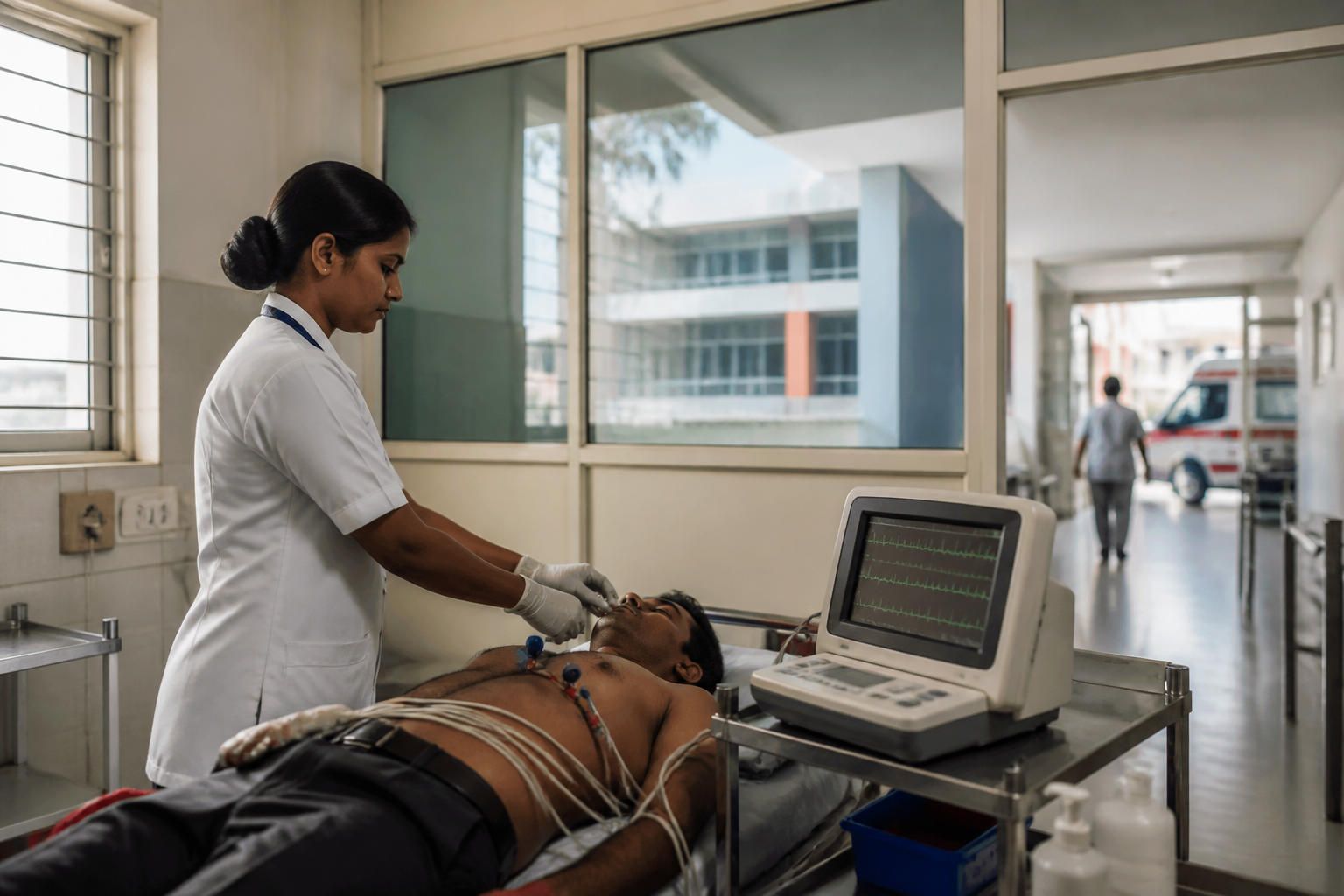
Maharashtra’s STEMI programme has conducted nearly 58 lakh ECGs and flagged more than 34,000 critical heart-attack cases in seven years. The numbers show the scale of the state’s cardiac disease burden, but they also reveal a more important institutional shift: emergency cardiac care is no longer being designed only around major city hospitals. It is being organised as a network linking primary health centres, remote specialists, referral hospitals and publicly funded treatment.
That network now covers 34 districts through 2,415 spoke facilities and 134 hubs. The model is intended to shorten the distance between the onset of a heart attack and the treatment that can prevent serious damage. It also raises a central question for public health infrastructure: whether a system can deliver advanced emergency care quickly when the first point of contact is a small government facility far from a cardiac catheterisation laboratory.
The programme, launched in 2020, uses a hub-and-spoke structure. Government health facilities function as spokes where ECGs are performed. These ECGs can be analysed remotely by specialists within about four minutes, according to a state health department official quoted in the report. When a heart attack is diagnosed, patients receive clot-busting treatment at the spoke facility before being referred to a hub for angiography and angioplasty.
The arrangement is significant because it separates diagnosis from specialist treatment without treating them as unrelated services. A primary health centre may not have a catheterisation laboratory or a cardiologist, but it can become the first link in the emergency chain if it has ECG equipment, trained staff, reliable connectivity and a functioning referral pathway. The effectiveness of the model therefore depends not only on the number of facilities listed, but on whether each link works under emergency conditions.
Maharashtra initially introduced the programme in 12 districts. It was expanded to another 22 districts in March 2024, taking the total to 34. State health minister Prakash Abitkar said the expansion was intended to take faster diagnosis and treatment closer to patients, particularly those outside major cities. The stated objective places geography at the centre of the programme. In cardiac emergencies, the location of the first test and the speed of the referral can influence whether a patient reaches definitive treatment in time.
The network also combines public facilities with private and charitable hospitals. Medical colleges, private hospitals and charitable hospitals with cardiac catheterisation laboratories have been empanelled as hubs under the Mahatma Jyotirao Phule Jan Arogya Yojana. Eligible patients can receive treatment under the scheme free of cost. This creates a public-private delivery system in which the state expands access by using existing specialist capacity beyond government hospitals alone.
That arrangement can increase coverage, but it also makes administration more complex. The system must coordinate diagnosis at a spoke, remote interpretation, initial treatment, ambulance or other referral arrangements, admission at a hub and payment under the public insurance scheme. The supplied report does not provide data on referral times, ambulance availability, treatment completion rates or outcomes. Those measures would be necessary to establish how consistently the network converts an ECG alert into timely angioplasty or other definitive care.
The programme’s 34,000 flagged STEMI cases provide an important measure of detection, but the figure should not be read as a complete measure of treatment success. A flagged case shows that the system identified a critical condition. It does not, by itself, establish how quickly the patient reached a hub, whether the referral was completed, or what clinical outcome followed. The distinction matters because emergency health infrastructure is judged not only by its ability to detect a problem, but also by its ability to move a patient through the system.
The urban dimension is visible in the contrast between statewide access infrastructure and the burden recorded in Mumbai. BMC data show that an average of 27 people died of heart attacks every day in the city. The report does not specify the period or methodology behind that average, but the figure indicates that the challenge is not limited to rural access or long distances. A dense metropolitan region can have major hospitals and specialist services while still facing delays linked to traffic, affordability, late recognition of symptoms and uneven access to first-contact testing.
The findings from Seven Hills Reliance Foundation Hospital add another layer to the question of who requires cardiac care. An analysis of 2,657 cardiac procedures over three years found that nearly one in four patients was below 50. Patients aged 50 to 69 accounted for 60% of procedures, while the 50-to-59 age group alone represented 31%. About 6% of procedures involved people aged 20 to 40, and men accounted for 67% of all procedures.
These figures come from one hospital and concern procedures rather than the entire population. They cannot be used to estimate the prevalence of heart disease across Maharashtra. They do, however, challenge the assumption that serious coronary disease is primarily a condition of the elderly. Cardiologist Dr Ganesh Manudhane said coronary disease requiring investigation or treatment was increasingly being seen among people in their 40s and even younger.
The reported risk factors include diabetes, hypertension, smoking, high cholesterol, obesity and family history. The presence of these risks also connects emergency care to routine primary healthcare. A system that identifies a heart attack only after symptoms become severe is operating at the most expensive and time-sensitive end of the care pathway. The report’s reference to lipid-profile evaluation by age 18, as recommended by the Cardiological Society of India, points to the role of earlier risk identification, although the supplied material does not provide data on how widely such screening is being conducted.
This is where the STEMI programme and the wider health system meet. The programme is designed for an acute event: an ECG, a remote interpretation, clot-busting treatment and referral for angiography and angioplasty. The age profile from the Seven Hills analysis points towards a longer-term prevention and monitoring challenge. Emergency networks can reduce treatment delays, but they cannot by themselves address undiagnosed hypertension, diabetes, high cholesterol or smoking-related risk.
The institutional architecture is therefore spread across several levels. The state health department oversees the programme’s expansion. Government health facilities provide the spoke network. Specialists interpret ECGs remotely. Empanelled medical colleges, private hospitals and charitable hospitals operate as hubs. The BMC contributes data on deaths in Mumbai, while the Seven Hills facility, operating through a public-private partnership with the civic body, provides a hospital-level view of procedures. The Mahatma Jyotirao Phule Jan Arogya Yojana provides the funding route for eligible patients.
Such a structure can bring specialist care closer to residents without requiring every primary facility to replicate a tertiary hospital. But it also means that performance depends on coordination across institutions with different ownership, staffing arrangements and operational capacities. The report confirms the scale of the network, but not whether all 2,415 spokes have the same equipment, staffing, connectivity or emergency transport support. It also does not establish whether access is evenly distributed across the 34 districts.
The available data point to two parallel pressures. One is the need to expand the emergency chain so that a patient outside a major city can be diagnosed and transferred rapidly. The other is the need to recognise cardiovascular risk earlier, including among people below 50. The first pressure is being addressed through the hub-and-spoke network. The second is reflected in the hospital age profile and the risk factors identified by the cardiologist.
For cities, the issue extends beyond the walls of hospitals. A cardiac emergency is shaped by the location of health facilities, the reliability of communications, the availability of transport, the design of referral networks and the affordability of specialist treatment. Mumbai’s mortality figure shows that large urban populations remain exposed even when specialist hospitals are present. Maharashtra’s statewide programme shows an attempt to connect different levels of the health system rather than concentrate all emergency capacity in a few urban centres.
The evidence confirms that Maharashtra has built a substantial detection and referral network, expanded it from 12 to 34 districts and linked it to publicly financed treatment at designated hubs. It also shows that cardiac procedures are affecting a sizeable share of patients below 50 in the reported hospital sample. What remains unclear is how the network performs after a case is flagged: the time taken to reach a hub, the proportion completing treatment, geographic variation and patient outcomes. Those measures will determine whether the programme is only identifying the state’s cardiac burden or successfully reducing the consequences of delayed care.
