


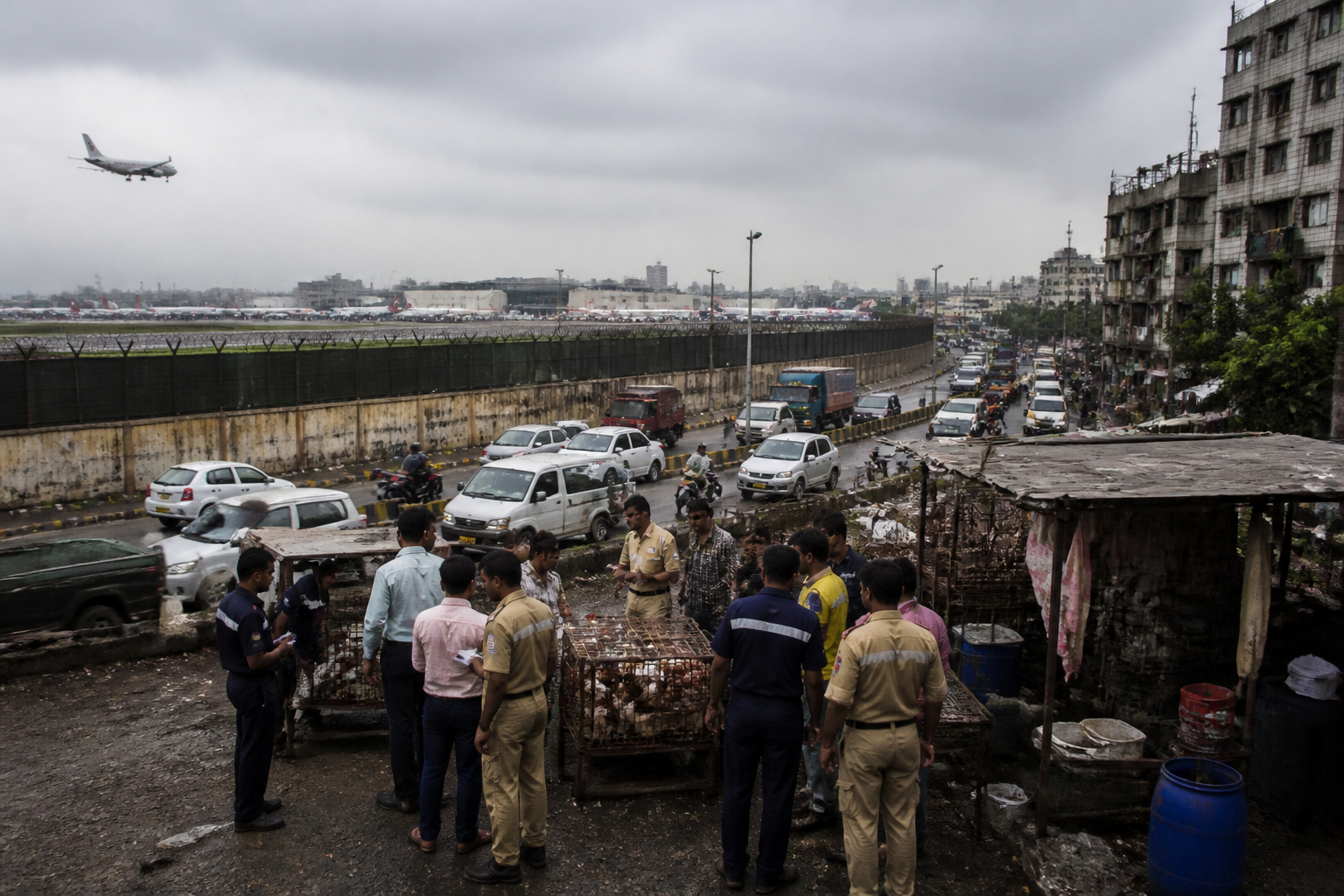
The Bombay High Court’s direction to the Brihanmumbai Municipal Corporation (BMC) to prepare a permanent scheme against unauthorised meat, poultry and fish shops within 10 kilometres of Chhatrapati Shivaji Maharaj International Airport is more than another enforcement order. It exposes a recurring urban governance problem: a civic action can be recorded, goods can be seized and shops can be closed during a drive, yet the underlying activity can continue when enforcement teams leave.
The court’s intervention came while hearing an interim application filed by Mumbai International Airport Limited (MIAL), which sought compliance with earlier directions concerning the bird-hit hazard associated with illegal slaughtering and the implementation of the Aircraft Rules. The bench of Justices Ajey S Gadkari and Kamal R Khata described the issue as serious and asked the BMC to place before it a comprehensive scheme to permanently prevent such shops from operating in the airport’s surrounding area.
The facts placed before the court show why the matter has persisted. The BMC submitted an action-taken report covering 323 unauthorised meat shops across 13 municipal wards between January and August this year. Yet the civic body also acknowledged that several establishments closed during enforcement drives conducted by the BMC and the Airports Authority of India, while continuing to operate on other days. Its affidavit described the activity as continuing despite ongoing enforcement efforts.
That admission shifts the issue from the number of raids to the design of enforcement. A drive is a time-bound operation. A permanent scheme, by contrast, would have to identify which shops are licensed, establish how unauthorised premises are removed or prevented from reopening, and specify which authority is responsible for monitoring compliance between drives. The court’s request for a list of licensed shops alongside the proposed scheme points to the importance of that administrative baseline.
The case also highlights the complicated geography of regulating activity around a major airport. The BMC told the court that enforcement was difficult in areas including Kurla surrounding the airport, where dense slums are present. That detail matters because the challenge is not limited to identifying an unauthorised shop. Civic officers must enter dense and heavily occupied urban areas, conduct seizures or removals, and return repeatedly if operators resume activity. Each step involves questions of access, staffing, safety and coordination.
The court indicated that it could direct senior police authorities to provide personnel permanently to protect civic officers carrying out lawful enforcement. It also said police protection could be provided during drives if officers faced intimidation or threats. This makes clear that enforcement is not being treated only as a licensing dispute. The court is examining whether municipal action can be carried out effectively when the civic agency does not have sufficient operational protection on the ground.
The institutional structure is therefore central to the story. MIAL brought the application because the airport operator is seeking compliance with earlier court directions related to aviation safety. The BMC is responsible for municipal enforcement and has reported action across 13 wards. The Airports Authority of India has also participated in enforcement drives, according to the civic body’s affidavit. Police authorities may be required to protect civic staff. The court is acting as the forum demanding that these responsibilities produce a durable result rather than a series of disconnected operations.
The aviation concern gives the dispute a wider public dimension. The court was told that illegal slaughtering can attract predatory birds, creating a bird-hit hazard around the airport. The supplied report does not establish a specific recent bird strike or quantify the risk. It does establish that MIAL has linked the continued operation of such shops with an aviation-safety concern and has sought implementation of the Aircraft Rules. That distinction is important: the current proceedings concern prevention and compliance, not a finding that a particular incident was caused by a particular shop.
The BMC’s own account provides the clearest evidence of the enforcement gap. Shops remained closed when enforcement teams were present but were known to operate regularly on non-drive days. The seizure of livestock and goods therefore did not end the activity. The court responded by asking whether totally unauthorised establishments could be demolished or removed in the same manner as encroachments on roads. The question suggests that the court is testing whether the existing response is proportionate to the stated objective and capable of preventing immediate reopening.
At the same time, the report does not establish that demolition has been legally authorised for every premises covered by the proceedings, nor does it set out the ownership, tenancy or construction status of each shop. The distinction between an unlicensed commercial activity and an unauthorised structure can affect the action available to a civic authority. The court’s direction for a comprehensive scheme may therefore require the BMC to clarify not only where the shops are located, but also what legal route it proposes to use against different categories of premises.
The number of establishments involved adds to the administrative challenge. Three hundred and twenty-three unauthorised meat shops were covered in the BMC’s action-taken report across 13 wards over eight months. That is a dispersed enforcement problem rather than a single-site operation. A programme that depends only on periodic raids would require sustained personnel and coordination across multiple municipal jurisdictions. The continued reopening described in the affidavit indicates that the gap lies between action taken on a particular day and compliance maintained over time.
The court’s request for a list of licensed shops is significant in this context. Without a clear distinction between licensed and unlicensed vendors, enforcement can become episodic and difficult to audit. With such a list, the civic body could identify the establishments that are permitted to operate, locate those allegedly operating without authorisation, and present a clearer account of action taken. The supplied material does not say that such a complete list already exists; the BMC sought time to place it before the court along with its proposed scheme.
The airport’s 10-kilometre radius also makes the matter a question of coordinated urban regulation. The area cuts across 13 municipal wards and includes neighbourhoods with dense settlements. The relevant administrative boundary is therefore not a single street or municipal office. It requires the airport operator, civic authorities, enforcement teams and police to work against the same map and the same compliance standard. The proceedings show that a safety-sensitive zone can be difficult to govern when operational responsibilities are distributed across institutions.
The case also demonstrates the limits of measuring enforcement through activity rather than outcomes. The BMC can report drives, seizures and closures, but the court is asking what happens afterwards. If establishments resume operating on non-drive days, the existence of enforcement activity does not by itself demonstrate compliance. The more meaningful test is whether the activity has been stopped permanently, whether lawful businesses can be identified, and whether officers can safely return when violations recur.
The court has not yet finalised the remedy. It granted the BMC time to submit a comprehensive scheme and a list of licensed shops, and posted the matter for further hearing after two weeks. It also left open the possibility of directing police protection for civic officers. These are the next institutional milestones in a case that has already continued for more than a decade, according to MIAL’s submission that earlier directions had not been sufficiently complied with.
What the proceedings currently confirm is a persistent mismatch between enforcement drives and lasting control around Mumbai’s airport. What remains to be established is the form of the BMC’s proposed scheme, the completeness of its licensing list, the legal action it will recommend against different premises, and the role of the police in making that action possible. Those details will determine whether the next response is another temporary closure or a workable system for maintaining compliance across the airport’s surrounding wards.
