


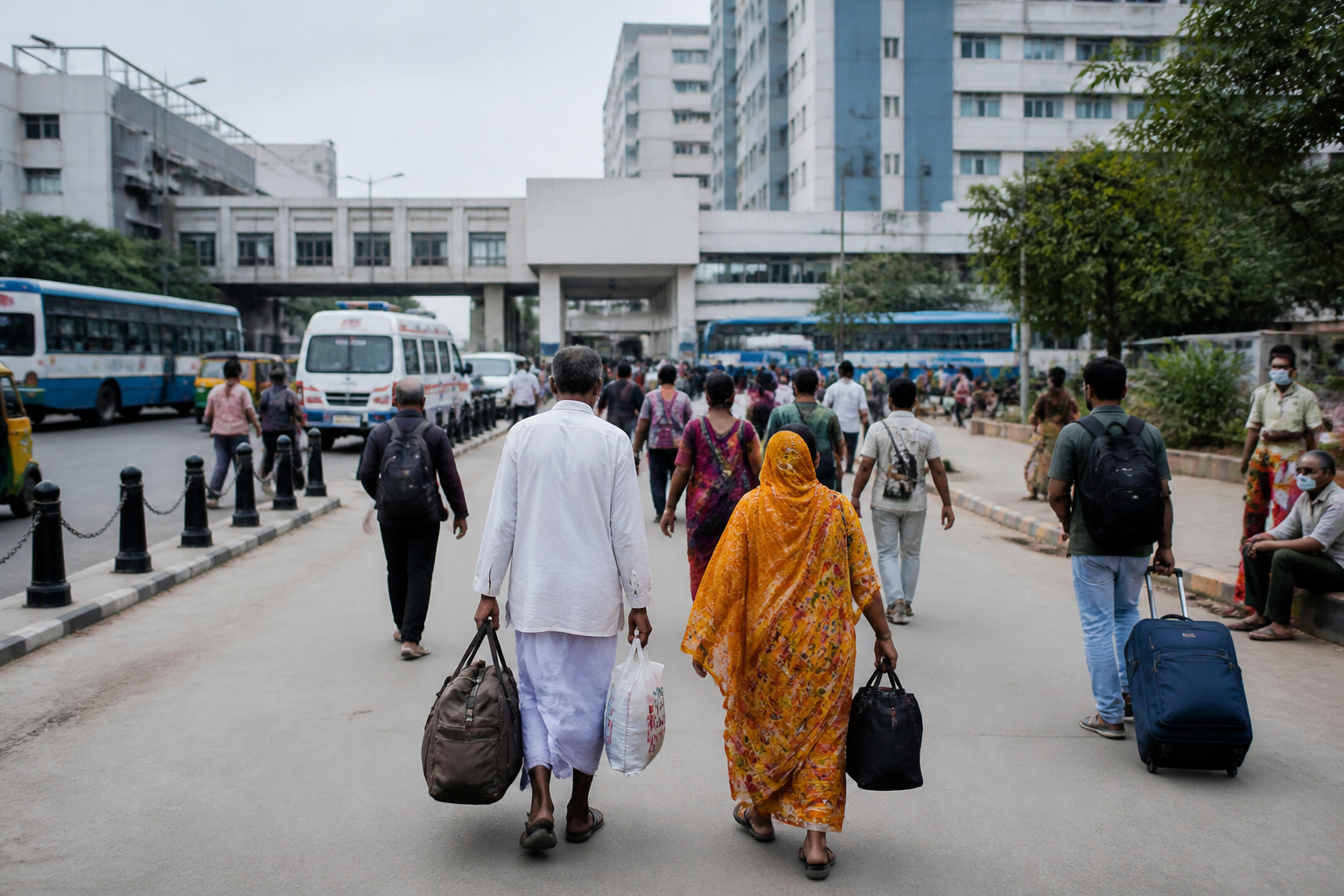
The financial burden of healthcare in Telangana does not end when a patient reaches a hospital. For families travelling from districts to Hyderabad for specialised treatment, the cost of hospitalisation is joined by transport, accommodation, food and attendant expenses. Data cited from the National Statistics Office’s 80th Round survey places the average medical expenditure per hospitalisation case in Telangana, excluding childbirth, at Rs 52,743 across public and private facilities. Separately, the NSO’s Domestic Tourism Expenditure Survey identifies medical travel as the most expensive category of domestic overnight travel in India, with an average expenditure of Rs 32,167 per trip.
Taken together, the figures show how access to healthcare is shaped not only by the price charged inside a hospital but also by the geography of the health system. Hyderabad functions as a major destination for secondary, tertiary and quaternary care, according to the report. That concentration allows specialised institutions to serve a large population, but it also means that households outside the capital must absorb the cost of physically reaching those services.
This makes the healthcare burden particularly visible in the relationship between rural districts and the city. The report identifies Adilabad, Khammam, Mahabubnagar and Nalgonda among the districts where daily-wage earners, tenant farmers and low-income households can face severe financial pressure after a single inpatient episode. For such families, the hospital bill may consume savings or lead them to borrow through informal ‘hand loans’. The added cost of travel and staying in the city extends the financial exposure beyond the treatment itself.
The NSO data cited in the report records a national average of Rs 32,167 for an overnight medical trip. Rural households spend an average of Rs 29,454 per trip, while urban households spend Rs 41,649. The difference does not mean that urban households face a lower burden in absolute terms. Rather, it shows that medical travel costs vary by household location, travel pattern and the nature of care being accessed. The data also establishes that medical travel is not a marginal form of movement: health and medical trips account for 29.6 per cent of all overnight trips completed in a year.
The frequency of these journeys is also uneven. Rural households undertake 49 overnight medical trips per 100 tourist households, compared with 22 per 100 among urban households, according to the figures cited. This distinction is important because a household may face the cost of travel even before a procedure or hospital admission begins. A consultation, diagnostic visit or referral can require transport and overnight accommodation, particularly when the distance to a specialised facility makes same-day travel impractical.
For Hyderabad, the figures point to a form of urban dependence that is often missed in discussions about healthcare infrastructure. The city is not only a place where hospitals are located; it is also the point at which patients from other parts of the state must arrange temporary living, transport and support systems. Families may use private vehicles, make multiple bus journeys, rent inexpensive rooms or sleep in and around hospital premises. Meals and accommodation for attendants become part of the cost of treatment, even when they do not appear on a hospital bill.
This places pressure on the city’s surrounding urban systems. Transport access determines how quickly a patient can reach a hospital and how much a family spends to do so. The availability and price of short-term accommodation affect whether attendants can remain near a patient. Public spaces and hospital campuses become informal waiting and sleeping areas when families cannot afford private lodging. These are not separate issues from healthcare access; they are part of the practical infrastructure required to use healthcare services.
The report’s evidence also highlights the difference between nominal availability and effective access. A specialised hospital may technically be available to a rural household in Hyderabad, but access remains constrained if reaching it requires several fares, lost workdays, overnight accommodation and food for multiple people. The distance between a patient and a hospital therefore has an economic value. That value is paid by households, particularly when care is concentrated in one urban centre.
The hospitalisation figure of Rs 52,743 provides another measure of the pressure. The report states that the average consists largely of out-of-pocket spending on diagnostics, specialised drugs and dependence on private facilities. The figure combines public and private hospitalisation cases and excludes childbirth. It does not, by itself, establish the precise cost faced by every household or explain the distribution between different treatments. It does, however, indicate the scale of the financial exposure associated with an average hospitalisation episode in the state.
The travel figure must be read alongside that limitation. The Rs 32,167 average for medical travel is a household expenditure estimate for an overnight trip and excludes treatment costs themselves. It should not be added mechanically to the Rs 52,743 hospitalisation average to produce a single bill for every patient. The two figures describe different components of the healthcare burden and come from separate NSO datasets. Their significance lies in showing that medical care can generate costs both within the health facility and across the journey to it.
The data also reveals why rural families can be more exposed even when the average urban medical traveller spends more per trip. Rural households travel more frequently for overnight medical purposes, at 49 trips per 100 households compared with 22 among urban households. A lower average spending figure per trip does not remove the impact of repeated journeys. Transport choices, distance, household income and the number of accompanying family members can all affect the cumulative burden, although the supplied data does not provide a district-level total for Telangana.
This is fundamentally an institutional question as well as a household finance question. The report describes specialised care as centralised in Hyderabad, while patients from remote areas continue to depend on the city. The data supplied does not specify which departments, hospitals or government programmes are responsible for reducing this dependence, nor does it identify a state-level funding plan for medical travel. What it does show is the consequence of a system in which the location of advanced care and the location of patients are often far apart.
That separation has implications for how urban infrastructure is evaluated. Hospitals are usually assessed through beds, equipment, staffing and clinical capacity. For patients arriving from outside the city, the wider access chain includes roads and public transport, affordable places to stay, food arrangements and clear referral pathways. When those links are weak, the effective cost of a hospital bed increases for the household using it. The burden is transferred from the institution to the patient’s family.
Hyderabad’s role as a healthcare destination also means that the city absorbs demand generated beyond its municipal boundaries. Patients arriving from districts may require longer stays, repeat visits or attendants who remain nearby. The supplied report does not quantify the number of patients travelling to Hyderabad or the capacity of hospitals to accommodate them. It nevertheless establishes a clear pattern: rural households travel more frequently for overnight medical purposes, while advanced and specialised care remains concentrated in the urban centre.
The larger urban question is whether a city can be considered an accessible healthcare destination when the cost of reaching it is excluded from the assessment of care. The NSO figures suggest that medical access cannot be understood only through hospital charges. For Telangana households, the financial burden can include admission, diagnostics and medicines, followed by transport, lodging, meals and the loss of time associated with travelling to the place where treatment is available.
The evidence confirms two distinct pressures: the average hospitalisation expenditure in Telangana is Rs 52,743 excluding childbirth, and medical travel is the costliest category of overnight domestic travel nationally at an average of Rs 32,167 per trip. The report also establishes that rural households undertake more overnight medical trips than urban households. What remains unclear from the supplied data is the district-wise cost of these journeys, the share borne by public and private facilities, and the extent to which existing transport or welfare measures reduce the burden. Those are the next gaps to watch as Telangana’s healthcare network continues to rely on Hyderabad as its principal specialised-care destination.
