


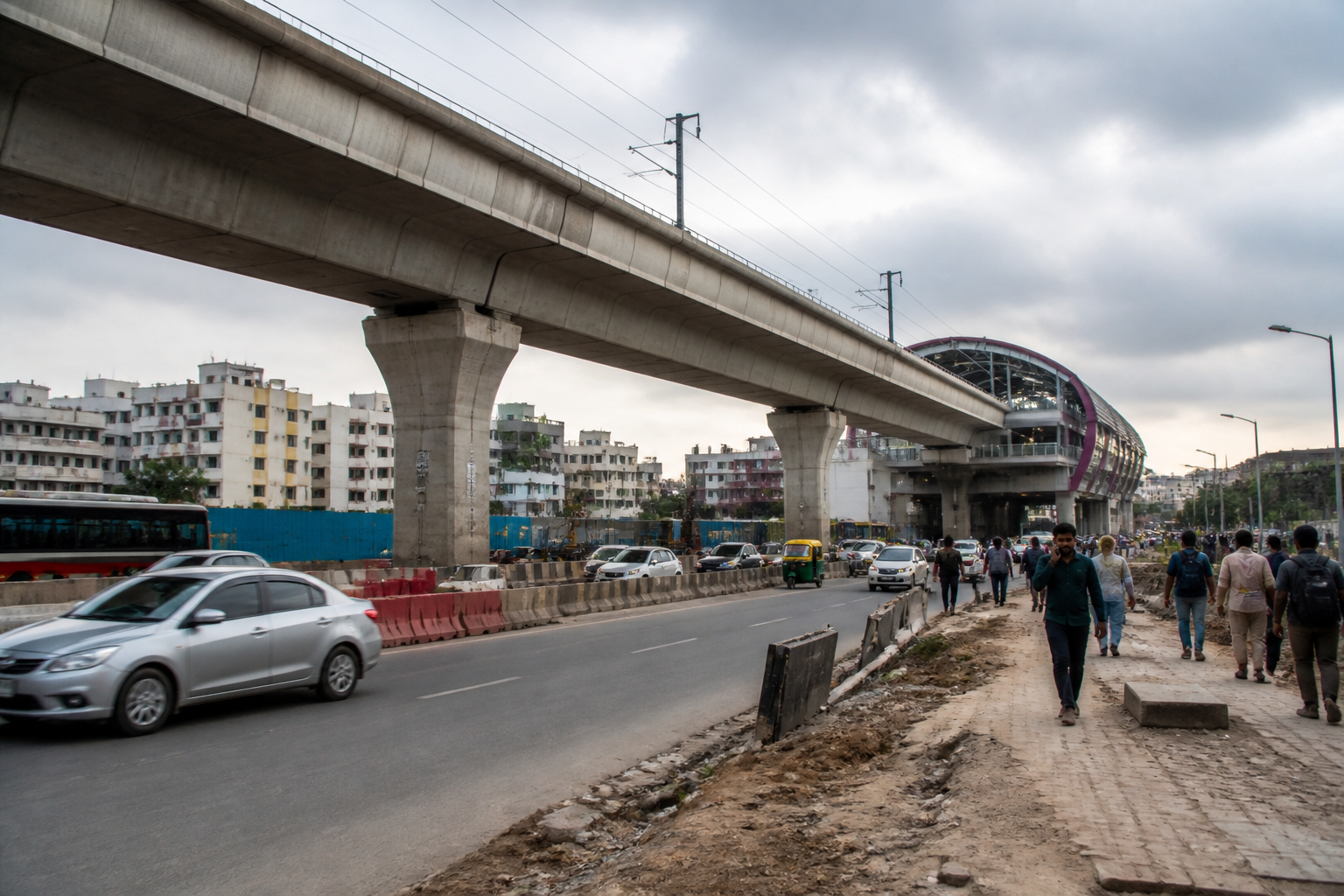
Bengaluru residents staging a mock inauguration of the Pink Line at Kalena Agrahara is more than a protest against a delayed Metro opening. It captures a wider urban problem: a transport project can be physically close to completion and still fail to deliver meaningful relief when construction delays, incomplete connectivity and neglected street infrastructure remain unresolved.
The residents cut a pink ribbon and released pink balloons at Kalena Agrahara station, according to the Times of India report, in a symbolic attempt to open a line they say has been delayed for years. Their action followed repeated delays in the opening of the Pink Line and growing frustration among people living along Bannerghatta Road.
The immediate issue is the proposed phased opening of the corridor. Bangalore Metro Rail Corporation Ltd (BMRCL) plans to open the 7.5-kilometre elevated section between Kalena Agrahara and Tavarekere first. The remaining 13-kilometre underground section, running from Dairy Circle to Nagawara, is slated to open next year, according to the report. Together, the two sections form a 21-kilometre corridor.
That division is administratively understandable but operationally significant. Residents quoted in the report argue that opening only the elevated section will provide limited relief because the entire line is needed to connect a larger section of commuters. The dispute is therefore not simply about whether a station can open. It is about whether a partial transport network can produce the mobility benefits that justified the project in the first place.
The Pink Line’s construction history explains why the public response has become so sharp. The contract for the elevated section was issued in 2017, with completion expected by 2020. BMRCL later terminated the contract after Simplex Infrastructure failed to deliver the work according to the contractual terms. A new contractor was selected in August 2021 to complete the pending construction, but the work continued for years because of various issues, the report said.
The sequence shows how a project’s formal deadline can lose meaning when contract failure is followed by re-tendering, mobilisation and execution problems. The original 2020 completion target was not merely missed once; it was overtaken by a chain of institutional decisions and implementation difficulties. Each stage extended the period during which residents had neither the promised Metro connection nor a replacement improvement in the road environment.
BMRCL set multiple deadlines for opening the line, with September 2026 identified as the most recent one in the report. Repeated deadlines create a credibility problem even when the underlying construction work progresses. For commuters, the practical question is not when a project was sanctioned or when a revised target was announced, but when a reliable service will begin and which destinations it will actually connect.
The Bannerghatta Road experience makes that gap visible at street level. Residents have complained that the road is in poor condition and that footpaths along the elevated section are inadequate. This means that the Metro project is being judged not only through its viaducts and stations, but through the last stretch of every passenger’s journey: reaching the station, crossing the road, walking beside construction and continuing safely after leaving the train.
A Metro corridor cannot function as an isolated engineering object. Its public value depends on access to stations, interchange with other modes, walkability and the condition of the surrounding road network. The concerns raised by Bannerghatta Road residents suggest that the elevated structure and the public realm below it have not advanced as a single mobility system. Even if trains begin operating, poor footpaths and damaged roads could limit who can use the service conveniently.
This is especially important in a corridor where residents say traffic density has increased manifold during the delay. The report does not provide traffic counts or travel-time data, so the scale of the increase cannot be independently quantified from the supplied material. But the reported complaint establishes the central mismatch: demand for better public transport has grown while the promised alternative has remained unavailable.
The project’s planned phasing also raises a question about how transport benefits are measured. A 7.5-kilometre elevated section may provide a usable service to some passengers, but the remaining 13-kilometre underground section is not a minor addition. It represents the larger part of the corridor by length and is intended to extend the line between Dairy Circle and Nagawara. Until that section opens, the system will not operate as the complete 21-kilometre connection described in the project plan.
For BMRCL, the challenge is consequently twofold. It must complete and open the elevated section while also communicating clearly what passengers can expect from a partial operation. It must then complete the underground section without allowing the interim opening to become another substitute for a firm end-to-end delivery plan. The source material does not establish the precise commissioning requirements, safety clearances or operational timetable for either phase, so those details remain outside the evidence available here.
The contract history points to a broader governance issue in urban infrastructure: the gap between awarding a project and delivering a functioning public service. The 2017 contract and 2020 deadline show the original intent. The termination of the Simplex Infrastructure contract shows the consequences when delivery fails. The appointment of another contractor in August 2021 shows an attempt to recover the schedule. The later delays show that replacing a contractor does not automatically restore the lost time.
This pattern matters because large urban projects are often evaluated through their headline infrastructure—viaducts, tunnels, stations and kilometres completed. Residents experience them differently. They encounter barricades, disrupted roads, dust, unsafe walking conditions and uncertain opening dates. When construction takes years longer than planned, the costs are distributed across daily journeys rather than appearing in one visible project figure.
The mock inauguration also exposes the symbolic distance between official project delivery and citizen expectations. Srikanth Narasimhan, founder of the Bengaluru Navanirmana Party, said that if BMRCL had received clearance to open the line, it should not wait for the prime minister, chief minister, MPs, VIPs or politicians to inaugurate it. He argued that common citizens are the real VIPs and should be able to put the line to use.
That statement is a political comment and does not establish whether the line has received all required clearances. Its significance lies in what it reveals about public frustration with ceremonial milestones when operational delivery is still pending. For residents, the meaningful inauguration is not the ribbon-cutting event but the first dependable passenger journey.
Another resident quoted by the report said BMRCL had taken more than eight years to construct the line and was still buying time to open it. The resident linked the delay to the absence of both a good road and an operational Metro. This combines two infrastructure failures that are often administered separately: the corridor intended to improve mobility and the road environment through which residents must reach it.
The Pink Line’s current situation therefore cannot be reduced to a question of whether the elevated section should open first. The deeper issue is whether phased delivery can be matched by phased urban access. If stations open without adequate footpaths, road improvements and clear passenger information, the project may be technically operational but only partially accessible. If the underground section remains delayed, the public will continue to judge the corridor against the complete connection that was originally expected.
The available evidence confirms a six-year delay to the elevated section against its 2020 deadline, a terminated contract, a replacement contractor appointed in August 2021, a planned first phase of 7.5 kilometres and a remaining underground phase of 13 kilometres. It does not establish the final opening date, the status of all clearances or the exact reasons for every later delay. Those are the facts that require close monitoring as BMRCL moves towards the latest announced timeline and the proposed opening of the underground section next year.
