


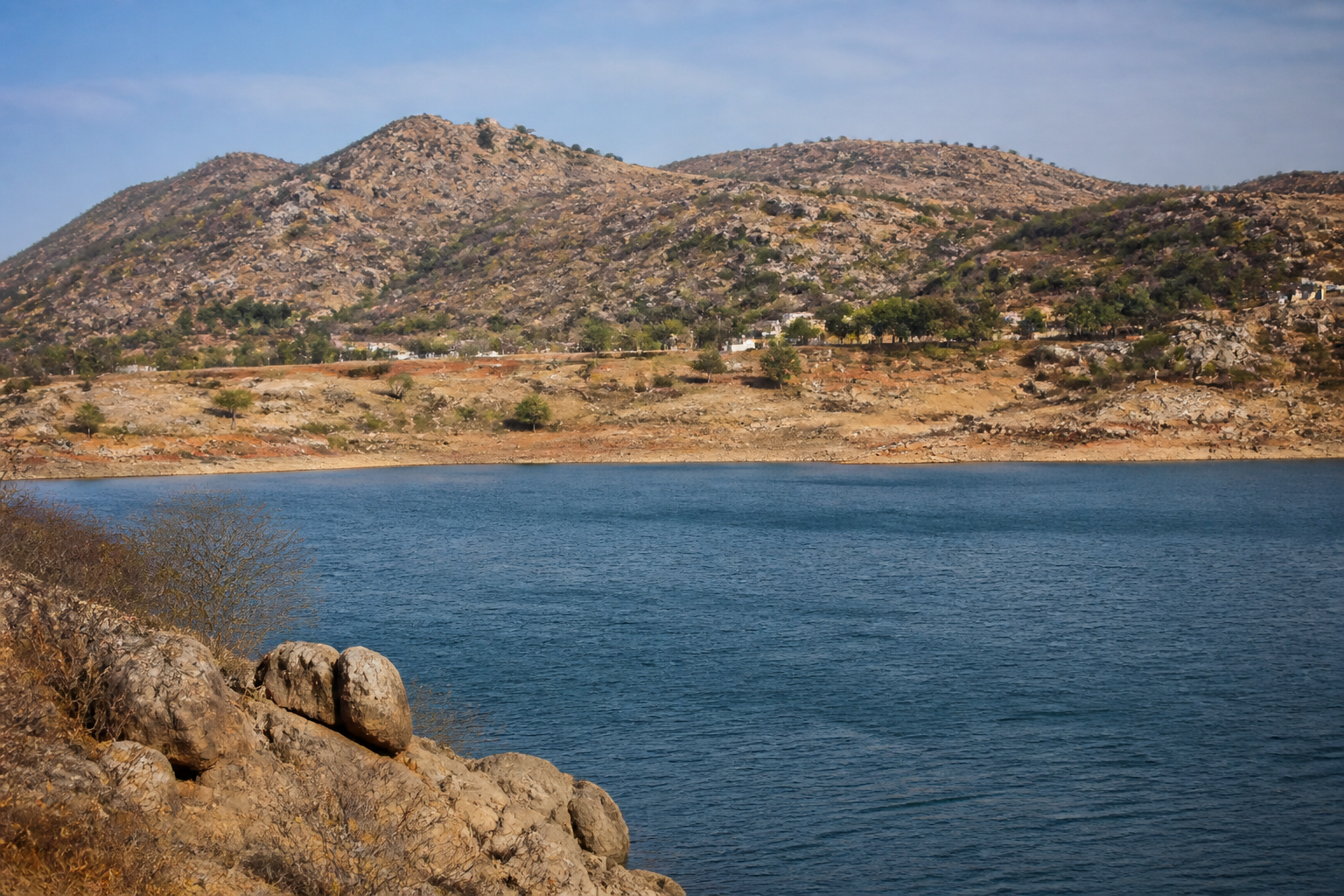
The proposed 300 MW Narihalla pumped storage project in Ballari has received conditional first-stage approval from the Expert Appraisal Committee of the Ministry of Environment, Forest and Climate Change. The approval advances a major energy infrastructure proposal, but the conditions attached to it place water availability, forest diversion and the protection of existing users at the centre of the project’s next stage.
The project is proposed near Taranagar and Shankarapura villages in Sandur taluk by JSW Energy PSP Three Limited. It is estimated to cost ₹2,215 crore and will require 111.10 hectares of land. The land package includes 39.255 hectares of forest land, 10.47 hectares of government land, 31.754 hectares classified as NHP land and 29.622 hectares of private land.
The proposal is built around the existing Narihalla reservoir, which would serve as the lower reservoir. A new upper reservoir is planned near Taranagar, connected to an underground power house containing two 150 MW turbines. The project’s estimated annual generation is 832.20 million units.
That configuration matters because the project is not simply an additional generating station. It depends on moving and storing water between two reservoirs. The Narihalla reservoir would therefore become part of an electricity storage system while continuing to serve the people and institutions that already depend on it. The project documents cited by Prajavani identify farmers in Sandur taluk, residents of the town and the military camp near Lingadahalli among the existing users of the reservoir.
The approval followed a meeting held on September 15, where the committee agreed to recommend permission subject to conditions. The decision is a first-stage approval and does not remove the need to comply with the environmental and forest-related requirements specified by the committee. One of the conditions is obtaining first-stage approval from the Union forest ministry for the diversion of forest land.
The project’s land requirement is one of the clearest indicators of the institutional complexity ahead. Forest land accounts for more than a third of the total area identified for the project, while private land accounts for nearly another quarter. The records cited in the report state that no families will be displaced and that rehabilitation and resettlement will therefore not be required. That does not eliminate the need to address land ownership, access, ecological effects and the concerns of users who depend on the reservoir.
The water requirement is more consequential still. During construction, the project is expected to need 500 kilolitres of water every day, with the Narihalla reservoir identified as the source. During operations, the initial filling of the reservoir system is estimated to require 8 million cubic metres of water, followed by annual consumption of about 0.46 million cubic metres.
The figures do not have the same meaning at every stage. Construction demand is a daily requirement, while the operational estimates refer to the initial filling and annual use of the system. Together, however, they show why the committee required the submission of 10 years of water availability data. A pumped storage facility can only function as planned if water is available not just for commissioning but across the operating cycle, particularly in a region where the reservoir already has established users.
The proposal includes a contingency arrangement for severe drought or water scarcity. Under this plan, an intake and pump house could be built near Kampli, with water conveyed from the Tungabhadra river through a 48-kilometre pipeline. The committee has called for a comprehensive study of the effects of this proposed withdrawal from the Tungabhadra.
This alternative is not a minor engineering detail. It would extend the project’s footprint beyond the Narihalla reservoir and bring another river system into its water planning. It also raises a governance question: when a project designed around one reservoir requires a second source during scarcity, how will competing claims on that water be prioritised and monitored?
The committee has specifically stressed that water reserved for irrigation must not be used for power generation under any circumstances. It has also called for a robust monitoring system to ensure that this condition is enforced. The requirement places accountability, rather than only engineering design, at the heart of the approval process. The project’s operation will need to be assessed against the actual availability of water and the rights of existing users, not only against its installed capacity.
The project’s history shows how its scale and corporate structure have changed. On November 28, 2022, the Karnataka government granted in-principle approval to JSW Neo Energy Limited for a 557 MW Narihalla pumped storage project. On July 4, 2025, the capacity was reduced to 300 MW and the approval was transferred to JSW Energy PSP Three Limited.
That change means that the current proposal should be understood as a revised project rather than a simple continuation of the earlier 557 MW plan. The available report does not establish why the capacity was reduced or how the revised configuration changes the project’s land and water impacts. Those details will be important as the proposal moves through further permissions and compliance stages.
The approval conditions also cover the project’s ecological footprint. They include a plantation plan using local species, a management plan for excavated material and an assessment of impacts on fisheries and aquatic ecosystems. These conditions are directly linked to the project’s physical design: the upper reservoir, underground power house, excavation and water movement could affect land, soil, drainage and the ecological functioning of the existing reservoir system.
The requirement to use local plant species indicates that compensatory planting is expected to be linked to the site’s ecological context, rather than treated only as a numerical replacement exercise. Similarly, a muck-management plan is significant for an underground power house and associated construction because excavated material must be handled without creating additional impacts on water bodies, land or access routes. The source material does not specify the proposed disposal locations or the scale of excavation, so those details remain to be established through the project’s subsequent documentation.
The fisheries and aquatic ecosystem study is another important part of the approval framework. Narihalla is already a working water system for local users, and the proposal would add a power-generation function to it. The study will need to clarify how changes in water movement, reservoir levels and construction activity may affect aquatic conditions. The supplied report does not provide the study’s findings, which means the ecological impacts cannot yet be treated as settled.
The project also illustrates the layered nature of infrastructure approvals. The energy proposal has moved through state-level in-principle approval and a central environmental appraisal process, while forest diversion and water-related conditions remain material to its progression. Different institutions are therefore responsible for different parts of the project: the state government for the earlier in-principle approval, the environment ministry’s appraisal system for environmental conditions and the forest authorities for diversion of forest land.
This division can make accountability difficult unless conditions are measurable and publicly tracked. In this case, the committee has identified several measurable areas: 10 years of water availability data, protection of irrigation allocations, the impact study for the proposed Tungabhadra withdrawal, local-species plantation, excavated-waste management and aquatic ecosystem assessment. The strength of the safeguards will depend on whether these requirements are completed before construction and whether compliance continues during operation.
The project’s energy numbers also need to be read alongside its resource requirements. The proposed capacity is 300 MW, with estimated annual generation of 832.20 million units. The project would use the existing Narihalla reservoir as its lower storage component and build a new upper reservoir near Taranagar. The source material provides these figures but does not establish the project’s operating schedule, expected hours of generation, tariff structure or electricity buyers. Those details would determine how the facility fits into Karnataka’s wider power system, but they are not yet available in the supplied report.
For residents, the immediate issue is not only whether the project can generate electricity. It is whether the existing functions of the reservoir will remain protected when energy storage is added to the system. Farmers, Sandur residents and the military camp near Lingadahalli are identified as dependent on Narihalla. In a period of water scarcity, the committee’s direction on irrigation water is therefore central to the project’s social acceptability and administrative credibility.
The Narihalla proposal now enters a stage where the approval conditions are as important as the headline approval itself. The project has received a conditional first-stage clearance, but it still has to satisfy requirements related to forest land, water data, irrigation protection, the possible Tungabhadra intake, ecological studies and construction waste. The evidence currently confirms a significant energy-storage proposal and a detailed list of safeguards; it does not yet confirm that those safeguards have been completed or that the project has received all permissions required for construction.
The next developments to watch are the submission of the 10-year water availability data, the forest diversion approval, the study of the proposed Tungabhadra withdrawal and the assessments of fisheries and aquatic ecosystems. These steps will determine whether the project’s promised power-storage benefits can proceed without weakening the water and ecological systems on which Sandur’s existing users depend.
