


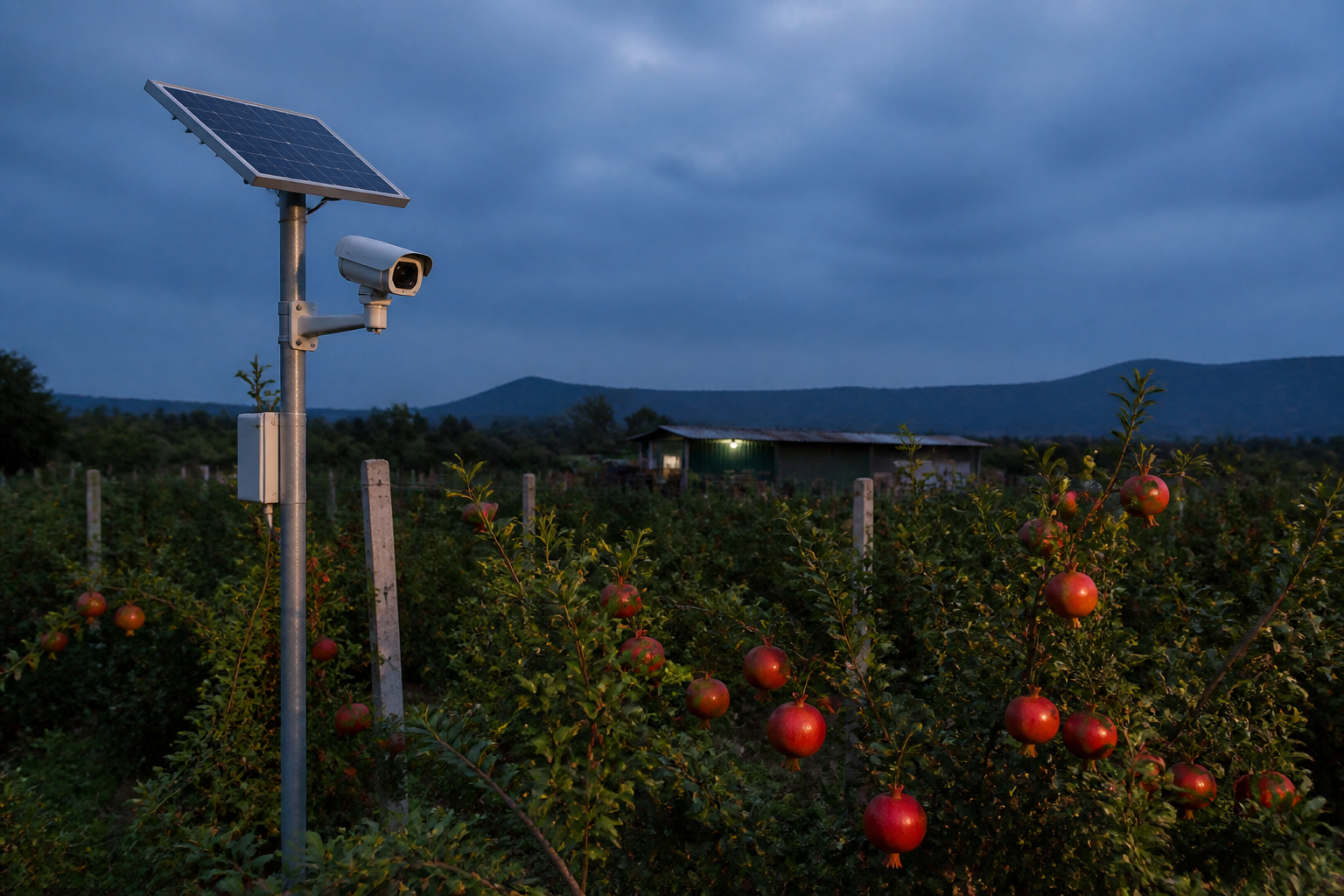
Farmers in Maharashtra’s pomegranate-growing districts are turning to solar-powered CCTV cameras and night vision equipment after thefts targeted ripe Bhagwa fruit, revealing how technology is entering an overlooked part of the rural production system: protecting crops between maturity and sale. The change is not simply about installing cameras. It reflects the rising value concentrated in orchards, the limits of traditional night patrols and the additional danger faced by growers in leopard-prone areas.
The shift has been reported in parts of Pune, Solapur, Ahilyanagar and Nashik, where farmers have historically relied on “rakhan” — a system in which farmers and villagers take turns guarding orchards after dark. That arrangement becomes particularly important during the short harvest window, when the fruit is ready to be picked and its value is most visible. This year, several growers have installed cameras specifically for those weeks rather than keeping surveillance equipment active throughout the year.
The immediate trigger was a series of thefts reported during the previous harvest season. The Indian Express reported coordinated thefts of large, high-value pomegranates from areas including Shirur taluka in Pune, Sangola in Solapur, Shrirampur in Ahilyanagar and Deola in Nashik. The Bhagwa variety was reportedly targeted because it commands a high market value and is also exported. Some local accomplices were arrested, but the report said there were no major arrests of alleged masterminds.
That pattern changes the economics of farm security. A pomegranate orchard may require months of irrigation, labour and crop management before the produce can be harvested. Yet the period of greatest vulnerability can be concentrated in only a few weeks. A security system that is activated during that window allows farmers to respond to a specific risk without necessarily making permanent surveillance infrastructure part of their annual operating costs.
For Sandeep Yelbhar, who experienced theft at his farm and saw similar incidents nearby, two cameras now provide surveillance during the harvest period. The cameras are connected to his mobile phone and use motion detection to send an alarm when movement is detected. Yelbhar told The Indian Express that he or a family member checks the feed every two or three hours.
This arrangement does not remove the need for human intervention. It changes when and how that intervention occurs. Instead of someone remaining in the orchard throughout the night, a farmer can monitor activity remotely and decide whether a physical response is needed. The camera therefore functions less as a replacement for security staff than as an early-warning system connecting the field to the household.
The technology is particularly relevant in areas where night patrols carry a second risk. Shirur farmer and former sarpanch Suresh Kolhe said he installed three cameras to monitor both pomegranates and grapes. The cameras are solar powered, and one has night vision. His account places crop protection within a wider rural safety problem: the same darkness that provides cover for thieves can expose farmers and watchmen to encounters with leopards.
In that context, remote monitoring has a practical advantage. It reduces the need for people to move through orchards after dark, while still providing visual information about what is happening on the farm. The supplied report does not establish how often cameras prevent theft or whether they lead to arrests, but it does show that farmers are treating them as a response to a recurring security problem rather than as a novelty.
The market response is already visible. Ashok Magar, who owns an electronic appliances store in Shirur, said sales of CCTV cameras had increased over the previous eight to nine months, with particular demand for solar-powered models and night vision equipment. He said the solar systems commonly include a panel, built-in storage, mobile-feed capability and an alarm function.
These features matter because many farms are not positioned like urban properties with reliable grid connections, fixed broadband and a security room. A solar-powered camera can operate in a more dispersed setting and send alerts to a farmer’s phone. The technology’s usefulness therefore depends not only on the camera itself but also on power availability, mobile connectivity, storage capacity and the farmer’s ability to respond to alerts.
Maharashtra’s scale in pomegranate production gives the trend wider significance. Production estimates for 2024-25 cited in the report place the state’s output at about 1.25 million tonnes. A crop of that scale creates a substantial rural economy, but it also concentrates value across thousands of orchards and multiple market routes. When prices rise, the security exposure of the crop rises with them. The report identifies the soaring price of pomegranates as the reason the fruit became a target.
The Bhagwa variety is central to that exposure. Known for its saffron-red rind and deep ruby-coloured arils, it is described as the premium variety among Indian pomegranates and earns the highest market value. Its export orientation adds another layer to the chain linking orchard-level decisions with wider trade demand. At farm level, however, that value is experienced as a short period in which a crop can be lost just before it is converted into income.
The move to CCTV also shows the limits of informal rural institutions when the nature of risk changes. Rakhan is built on collective presence: people share the responsibility of guarding the fields. It can work when farms are close to one another and the threat is manageable. But repeated, coordinated thefts place pressure on that system. Families must give up sleep, labour must be diverted from other work and, in leopard-prone areas, the act of guarding itself can become hazardous.
The cameras do not resolve the institutional questions behind the thefts. They can record movement, issue alerts and potentially provide evidence, but they cannot replace policing, investigation or prosecution. The report’s reference to arrests of local accomplices but no major arrests of masterminds points to a gap between detecting an incident and dismantling the network responsible for it. Farm-level technology can improve visibility without guaranteeing accountability.
There is also a governance dimension to the spread of such equipment. Crop security is often treated as an individual farmer’s responsibility, even when losses are organised across several villages and districts. The reported incidents span different parts of Maharashtra’s pomegranate belt, suggesting that security risks do not stop at the boundary of one farm or one local police jurisdiction. The evidence supplied does not establish whether there is a coordinated district-level response, but the geography of the reported thefts raises that question.
The technology is also being adopted in response to a specific seasonal cycle. Farmers are not necessarily installing cameras for the entire year. They are deploying them when the crop becomes most valuable and vulnerable. This seasonal model may make the equipment more affordable and easier to justify, but it also means that surveillance depends on advance preparation. Rajaram Ovhal of Shindodi village, who lost 800 kilograms of ready-to-harvest pomegranates in July, told The Indian Express that he planned to install cameras before the next season.
His experience illustrates the difference between the cost of prevention and the cost of learning after a loss. The report does not provide equipment prices or calculate the value of the stolen produce, so the financial comparison cannot be measured from the available evidence. It does establish that farmers who suffered losses are changing their behaviour ahead of the next harvest rather than returning to the previous security arrangement unchanged.
The larger urban and built-environment question is how rural production systems are being reshaped by low-cost digital infrastructure. Solar panels, mobile networks, remote alerts and compact storage devices are extending forms of surveillance beyond homes, roads and commercial premises into agricultural landscapes. This is a built-environment transition even though the setting is an orchard: the field is becoming a connected, monitored space because its economic value requires protection.
That transition is uneven. A camera is useful only where it receives enough power, can transmit or store usable footage and is monitored by someone able to act. It may also produce false alarms or create expectations that a device can substitute for physical security. None of these limitations is quantified in the supplied report. What is clear is that the technology is being selected because it fits the practical conditions of farms better than a fixed, grid-dependent system might.
The evidence confirms a specific chain of change: high-value Bhagwa pomegranates became targets during the harvest window; traditional night patrols placed burdens on farmers and exposed some to leopard risk; and the availability of solar-powered, mobile-connected cameras has offered a new method of monitoring. What remains uncertain is whether the devices will reduce theft across the region, improve conviction rates or simply shift security costs from collective patrols to individual growers.
For now, the next stage is seasonal and precautionary. Farmers who have suffered losses are installing cameras before the fruit ripens, while growers in affected areas are combining night vision, motion detection and solar power with mobile monitoring. The development deserves attention not as a standalone technology purchase, but as evidence of how vulnerable agricultural economies adapt when production value, rural safety and weak enforcement meet in the same landscape.
