


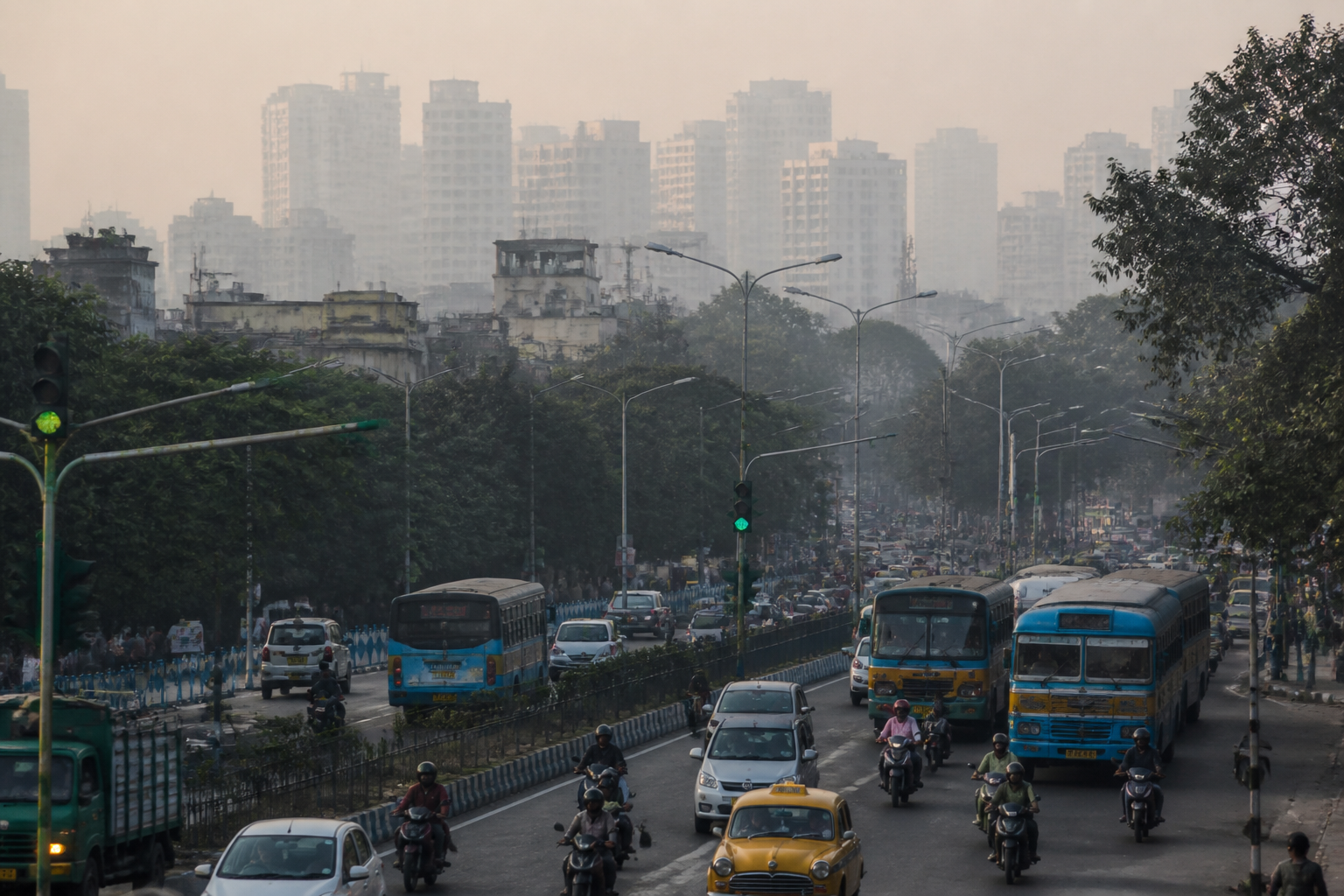
The Calcutta High Court’s direction to the West Bengal Pollution Control Board (WBPCB) to prepare a time-bound roadmap for controlling air pollution is significant because it shifts the immediate focus from recording poor air quality to deciding who must act, under which policies and by what deadline. The order places the statutory pollution-control authority at the centre of a coordinated response covering Kolkata, Howrah and the wider state.
The court issued the direction on September 21 while hearing a public interest litigation filed by advocate Akash Sharma, along with the court’s own motion. A division bench comprising Chief Justice Ravindra Vithalrao Ghuge and Justice Om Narayan Rai asked the WBPCB to submit a comprehensive roadmap containing specific policies and time-bound measures for controlling air pollution and improving the air quality index, or AQI, across West Bengal.
The board has also been directed to consult experts while developing the proposed policies. Its report is due on October 13, and the matter will next be heard on November 19. These dates turn the proceedings into a defined administrative exercise rather than an open-ended request for improvement.
## What the Kolkata air pollution order changes
The central issue in the case is not simply whether pollution levels are high. The PIL raised concerns about deterioration in air quality in Kolkata and Howrah, particularly during winter, and sought a coordinated institutional mechanism for monitoring and responding to episodes of poor air quality. The court’s direction addresses that institutional gap by asking the pollution-control board to set out policies and implementation measures in advance.
This distinction matters for urban governance. AQI readings describe the condition of the air at a particular time. They do not, by themselves, establish which agency is responsible for reducing emissions, what intervention should be triggered, or how quickly it must be implemented. The order, as described in the supplied report, asks the WBPCB to move beyond measurement and prepare a framework that connects monitoring with action.
The direction also gives expert consultation a formal place in the process. The court has not specified in the supplied material which experts must be consulted or what sectors the roadmap must cover. It has, however, required the board to work on the proposed policies in consultation with experts, making technical input part of the preparation process rather than an optional addition.
The order therefore creates three immediate administrative requirements: the identification of specific policies, the preparation of a time-bound implementation roadmap and the involvement of technical experts. The effectiveness of the eventual framework will depend on the detail contained in the report and on how responsibilities are distributed between the pollution-control authority and the state government.
## From winter episodes to a year-round institutional question
The PIL’s focus on Kolkata and Howrah during winter places seasonal deterioration at the heart of the proceedings. The supplied report does not provide pollution readings, emissions inventories or a breakdown of sources. It also does not identify the relative contribution of transport, construction, industry, dust, waste burning or other activities. Those questions remain outside the evidence available in the report.
What is established is that the court has been asked to consider poor air quality as a recurring urban governance problem rather than as a series of isolated episodes. The distinction is important because an episodic response can begin only after air quality has deteriorated. A coordinated mechanism, by contrast, is intended to establish how authorities monitor conditions and respond when poor air quality occurs.
The state’s response, as reported, was also framed around cooperation. The state counsel indicated that if the WBPCB formulates policies and makes recommendations to the state, the government would respond positively. The counsel described the proceedings as “not an adversarial litigation”. That position suggests that the immediate legal process is being presented as a route to policy coordination between the court, the board and the state rather than only as a dispute over past administrative action.
However, a positive response to future recommendations is not the same as an implementation plan. The court’s deadlines will require the board to convert that broad assurance into specific proposals. The report does not establish the funding, staffing, enforcement powers or inter-agency arrangements that would support the roadmap. Those details will be important when the October filing is submitted.
## Why the next report is the key document
The October 13 report is likely to be the first concrete test of whether the proceedings produce an operational framework. Based on the direction reported by the Times of India, the document will need to address policies and measures that are specific enough to be implemented and time-bound enough to be monitored.
Several elements will determine its usefulness. The roadmap will need to make clear which authority is responsible for each action, what deadlines apply and how progress will be assessed. It will also need to explain how expert advice has been incorporated and how monitoring will lead to a response when air quality worsens. The supplied material does not say whether the court has prescribed this level of detail, so these remain questions for the filing and subsequent hearing rather than established features of the current order.
The order also directly addresses pollution from firecrackers during the upcoming festivals. The board and the state have been directed to ensure that appropriate measures are taken to curb such pollution. This is the most immediate measure mentioned in the report and gives the authorities a near-term responsibility while the broader roadmap is being prepared.
That festival-related direction illustrates the two time scales operating in the case. One is immediate: measures to reduce pollution from firecrackers during the ensuing festivals. The other is structural: the preparation of policies and a state-wide, time-bound roadmap for improving air quality. The court’s intervention links the two without treating the short-term measure as a substitute for the larger institutional response.
## The governance test behind the case
Air pollution in a metropolitan area rarely fits within the boundaries of one neighbourhood or one municipal agency. Yet the supplied report does not identify a single existing mechanism that coordinates responses across Kolkata and Howrah. The PIL specifically sought such a coordinated and institutional mechanism, while the court has directed the WBPCB to formulate policies and make recommendations to the state.
This places the WBPCB in a central coordinating role. The board is expected to prepare the policy framework, consult experts and submit the roadmap. The state, meanwhile, is expected to consider the board’s recommendations and ensure that appropriate festival-related measures are taken. The court will review the progress through the scheduled report and hearing.
The arrangement raises an administrative question that the next stages of the case will have to clarify: how will policy responsibility be connected to implementation responsibility? A pollution-control board can formulate standards, monitor air quality and make recommendations, but the report supplied for this story does not set out the precise division of work among the board, the state and other authorities. It is therefore not yet possible to assess whether the proposed framework will have a clear chain of accountability.
The same limitation applies to public reporting. The court has ordered a report, but the supplied material does not state whether the roadmap will include publicly accessible targets, regular progress updates or a system for evaluating whether AQI conditions improve. These are not findings from the current proceeding; they are details that remain to be established through the board’s filing and the court’s further directions.
## What the evidence confirms—and what it does not
The evidence currently available confirms a judicial direction, a defined reporting deadline, expert consultation, concern over winter air quality in Kolkata and Howrah, and a specific instruction concerning firecracker pollution during upcoming festivals. It also confirms that the case combines a PIL filed by an advocate with the court’s own motion and that the next hearing is scheduled for November 19.
It does not provide AQI data, a list of proposed policies, a financial estimate, an enforcement schedule or a source-by-source assessment of pollution. Nor does it establish that air quality has already improved or that the state has adopted any new pollution-control policy. Those distinctions matter because the court has initiated a policy process, but the policy itself has not yet been presented.
The significance of the case will therefore be measured less by the existence of another direction to curb pollution and more by the quality of the roadmap that follows. If the October report identifies measurable actions, responsible authorities and deadlines, it could give the air-quality response a clearer administrative structure. If it remains a general statement of intent, the central concern raised by the PIL—how to coordinate action during recurring poor-air episodes—will remain unresolved.
For now, the Calcutta High Court has established a timetable and placed the responsibility for preparing the framework on the WBPCB, with expert input and state participation. The October 13 report and the November 19 hearing are the next formal milestones in determining whether Kolkata’s air-pollution response moves from monitoring episodes to managing them through an accountable institutional plan.
