


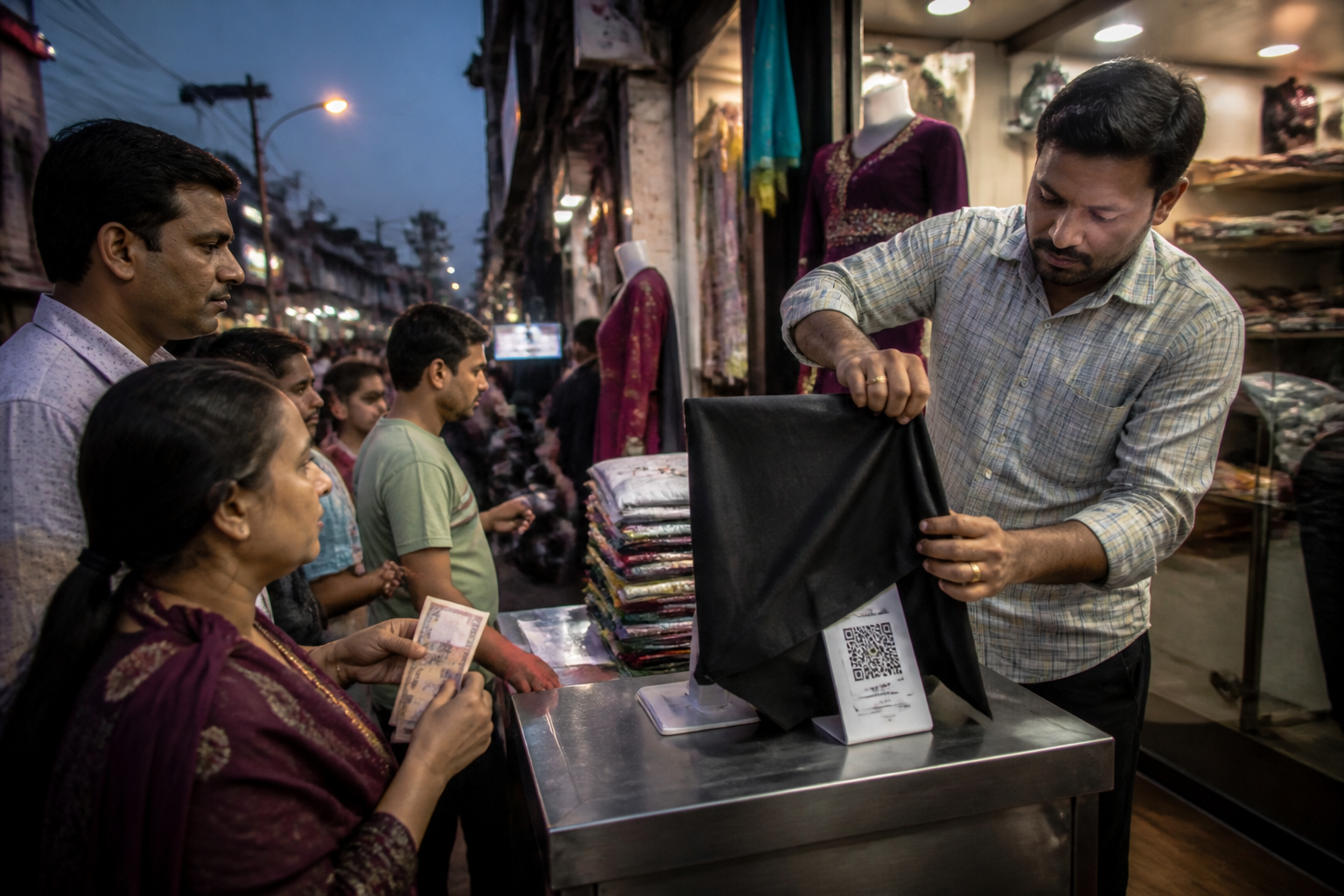
Delhi’s proposed No UPI Day protest has brought a structural question in India’s digital economy into view: who should pay for the payment infrastructure that allows millions of small businesses to accept instant transactions? The Chamber of Trade and Industry, or CTI, has appealed to traders to cover UPI QR codes, scanners and sound boxes with black cloth on 2 October and accept only cash in protest against a reported merchant discount rate, or MDR, on UPI payments above ₹2,000 from 15 October 2026.
The immediate dispute is about cost. CTI says a ₹3,000 UPI payment could result in a charge of about ₹12 for the merchant, while a ₹50,000 transaction could cost around ₹200. The organisation has also said that the charge for large transactions would be capped at ₹300. These figures imply a direct reduction in the amount retained by the merchant, particularly in businesses that operate on narrow margins.
The protest is therefore not simply a dispute over a payment fee. It is a conflict over how India’s rapidly expanded digital-payments system should be funded. UPI has become part of the everyday operating infrastructure of shops, markets and service businesses. A payment method that was promoted for convenience and scale is now being examined by traders through the lens of transaction-level economics.
CTI has said it is not opposed to digital payments. Its office-bearers, including general secretary Gurmeet Arora and Ramesh Ahuja, have argued that an additional cost could create difficulties for retailers and distributors working with low margins. The organisation’s position is that the issue is not whether customers should be able to pay digitally, but whether small merchants should absorb the cost of providing that facility.
That distinction matters because merchant payment infrastructure is now visible at street level. QR codes and sound boxes are present in neighbourhood shops, food outlets and market establishments, allowing customers to pay without cash and enabling merchants to receive confirmation of a transaction. For a large business, a payment charge may be treated as an operating expense spread across substantial turnover. For a small trader, the same charge is deducted from individual transactions and can become more noticeable when margins are limited.
The scale cited in the report shows why the disagreement has attracted attention. CTI, citing government figures, said UPI recorded about 24,162 crore transactions in financial year 2025-26, with a total value of approximately ₹314 lakh crore. It said UPI accounted for about 84 per cent of all digital transactions during the period. Person-to-merchant payments, or P2M transactions, were valued at about ₹198 lakh crore, according to the organisation.
CTI also said transactions above ₹2,000 represented only about 4 per cent of UPI transactions by volume but accounted for approximately ₹131 lakh crore in value. On its calculation, payments above that threshold represented about 66 per cent of the total value of UPI payments made to merchants. This difference between volume and value is central to the dispute: a relatively small share of transactions can still represent a large share of the money moving through the merchant-payment system.
The figures also illustrate why a threshold-based charge can affect traders unevenly. A shop that receives mostly small digital payments may see limited exposure to the reported MDR. A distributor, retailer or business handling higher-value purchases could face a more direct impact. The same payment network therefore produces different cost consequences depending on the size, frequency and margin structure of a merchant’s transactions.
The finance minister’s position, as reported by Aaj Tak Business, addresses the institutional side of the issue. Nirmala Sitharaman said the government had not imposed MDR on UPI. According to her, the charge is collected by the National Payments Corporation of India from banks and payment companies for the service, and the money will not go to the government. She also clarified that the charge on UPI payments above ₹2,000 would be paid by the shopkeeper or merchant rather than the customer.
That explanation separates the public policy decision from the operational payment arrangement. Merchants may experience the charge as a direct business cost, while the government’s position is that it is not a tax or a revenue measure. The distinction does not remove the commercial concern, but it identifies the institutions involved: NPCI, banks, payment companies and merchants occupy different points in the payment chain.
The reported arrangement also raises a question about the economics of digital inclusion. UPI has expanded because it is easy for customers to use and relatively simple for small businesses to adopt. QR-based acceptance does not require the same physical infrastructure as a card terminal, and payment confirmations through sound boxes have made the process more practical in crowded retail environments. However, the wider the network becomes, the more important the question of who finances its operation.
For merchants, the answer is linked to cash flow and margins. A charge deducted from a ₹3,000 transaction may appear small in isolation, but its effect depends on the merchant’s profit on that sale and the number of similar transactions processed. CTI has used the examples of ₹12 on ₹3,000 and ₹200 on ₹50,000 to demonstrate the cumulative impact it expects. The report does not establish how many merchants would face each level of exposure, or how the charge would vary across banks, payment companies or categories of transactions.
CTI has claimed that about six crore shopkeepers, traders and entrepreneurs could be affected. That figure is an organisational estimate cited in the report and is not independently established there. Similarly, CTI chairperson Brijesh Goyal has warned that cash transactions could increase and that UPI payments could fall by as much as 50 per cent. The report clearly presents this as CTI’s concern, not as an official forecast or confirmed outcome.
Those qualifications are important because payment behaviour is shaped by more than a single fee. Customers may prefer UPI because it avoids the need to carry cash, creates a digital record and works across different types of businesses. Merchants may prefer cash for some transactions but may also value faster reconciliation and reduced cash handling. The reported protest will test how strongly these established habits influence participation when traders object to the cost of digital acceptance.
The proposed No UPI Day also reveals a governance challenge. Digital payment systems are often experienced by citizens as a seamless public utility, but they are operated through a network of public institutions, banks, technology companies and private businesses. Decisions about pricing can therefore produce a chain of effects: a payment-system rule reaches merchants, merchants respond through a collective protest, and customers may encounter restrictions at the point of sale.
For urban markets, this question is particularly significant. Small shops and informal or semi-formal businesses are embedded in neighbourhood access systems. They serve daily needs and increasingly rely on digital payment acceptance to transact with customers who may not have cash. If merchants cover their QR codes, even temporarily, the result would be visible not in a financial institution but on the street, at the counter and in the customer’s attempt to complete a purchase.
The available evidence does not yet establish whether the proposed charge will be implemented uniformly, how the ₹300 cap will operate across payment providers, or whether exemptions or compensating arrangements will apply. It also does not establish whether the reported 50 per cent decline in UPI payments would occur. These are material details for assessing the eventual effect on businesses and consumers.
What is established is the underlying tension. UPI’s scale has made it a critical part of commercial life, but scale alone does not settle the question of cost allocation. CTI is demanding that the reported decision be withdrawn, while the finance minister has said the government did not impose the charge and that the merchant, not the customer, would bear it. The next milestones are the proposed 2 October protest and the reported 15 October 2026 start date for the MDR on UPI payments above ₹2,000. Those developments will show whether the dispute remains a traders’ campaign or becomes a wider test of how India funds its cashless retail economy.
