


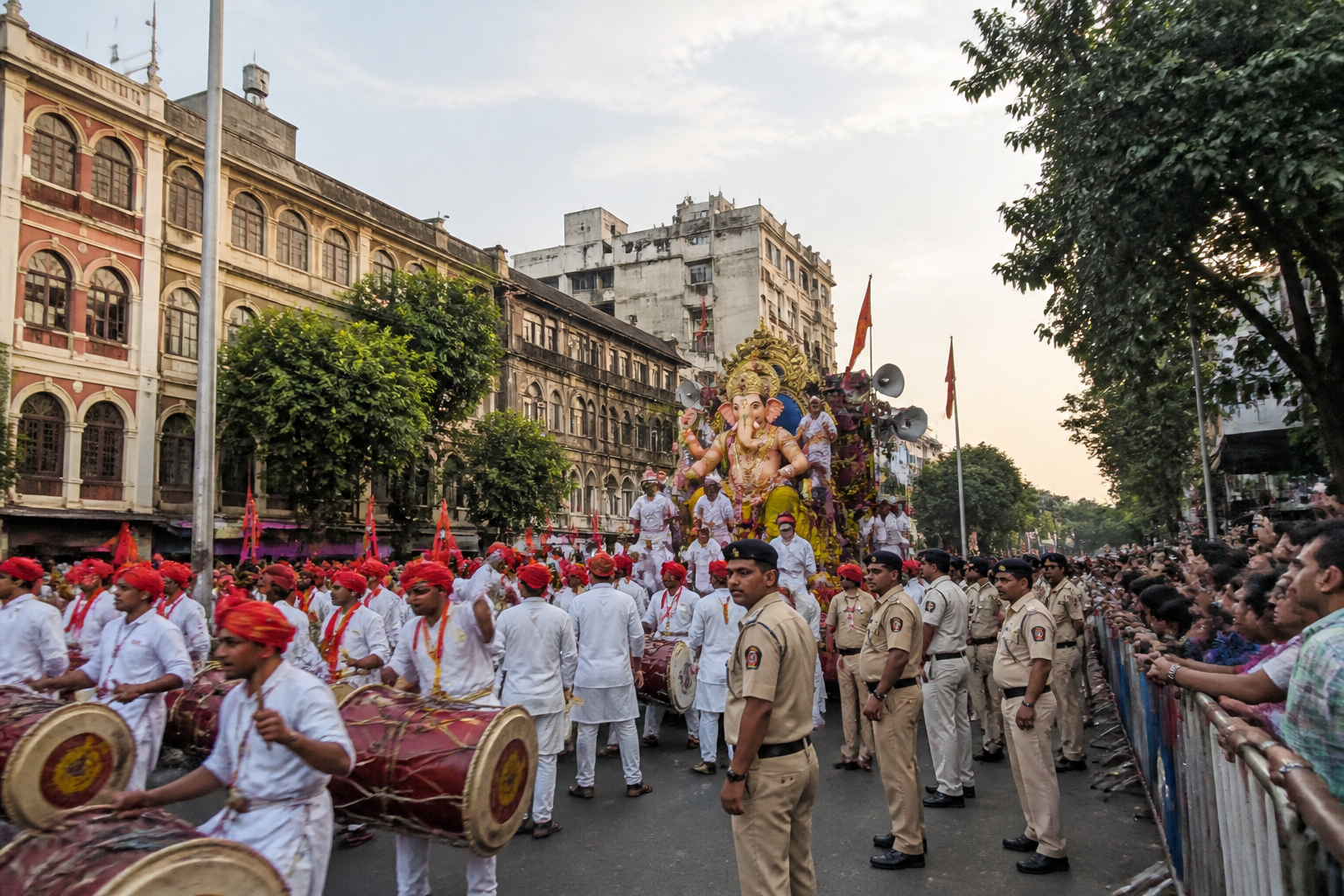
Pune police have tightened sound and procession rules for the Ganesh visarjan ceremony, limiting each participating mandal to two dhol-tasha groups and allowing no more than 10 minutes of stationary performances at major junctions. Police said violations of prescribed noise limits could lead to the seizure of sound equipment and criminal cases.
The rules will apply along key immersion procession routes, including Laxmi Road, Kelkar Road, Tilak Road and Kुमthekar Road. Police Commissioner Amitesh Kumar said officials had discussed the arrangements with office-bearers of 638 Ganesh mandals that will pass through these routes.
Sound levels will be measured using decibel meters during the procession. The police have also spoken to the leaders of dhol-tasha groups and appealed to them to remain within the permitted noise limits. The enforcement plan places responsibility both on the mandals organising the procession and on the groups providing musical performances.
The restrictions are based on the Supreme Court’s rules concerning noise pollution, according to the police. Officials said the objective was to ensure that the immersion celebrations were conducted within the prescribed framework while limiting the impact of amplified sound on residents, pedestrians, traffic movement and other people using the city’s central roads.
Police have also issued specific directions regarding loudspeaker systems. Mandals have been asked to use such equipment in a controlled manner and have been prohibited from using ‘pressure mid’ and ‘plasma sound’ devices. The police have permitted the use of four bass units and four top speakers.
The loudspeaker systems of mandals participating in the immersion procession will be inspected on site, police said. If a system is found to exceed the permitted sound limit, it may be seized immediately. Police Commissioner Amitesh Kumar also warned that offences could be registered against those violating the directions.
The enforcement measures follow discussions held by the police with mandal representatives before the festival and after the Dahi Handi celebrations. The consultations were intended to communicate the restrictions in advance and secure compliance during one of Pune’s largest public processions.
The rules are significant for the operation of the immersion routes, where large crowds, processions, performances and traffic diversions converge. Limiting stationary performances at major junctions is expected to regulate the time spent by each procession at crowded points, while the cap on dhol-tasha groups and restrictions on loudspeaker equipment create specific conditions for mandals moving through the central city.
Police said monitoring and equipment inspections would continue during the procession. The next enforcement step will be the measurement of sound levels and on-site checks of loudspeaker systems along the designated immersion routes.
