


Bengaluru fake drug investigations have led Karnataka’s Food Safety and Drugs Administration (FSDA) to cancel the licences of 16 retail and wholesale pharmaceutical firms and suspend those of eight others, including Pfizer’s depot, over their alleged links to the sale or supply of spurious medicines.
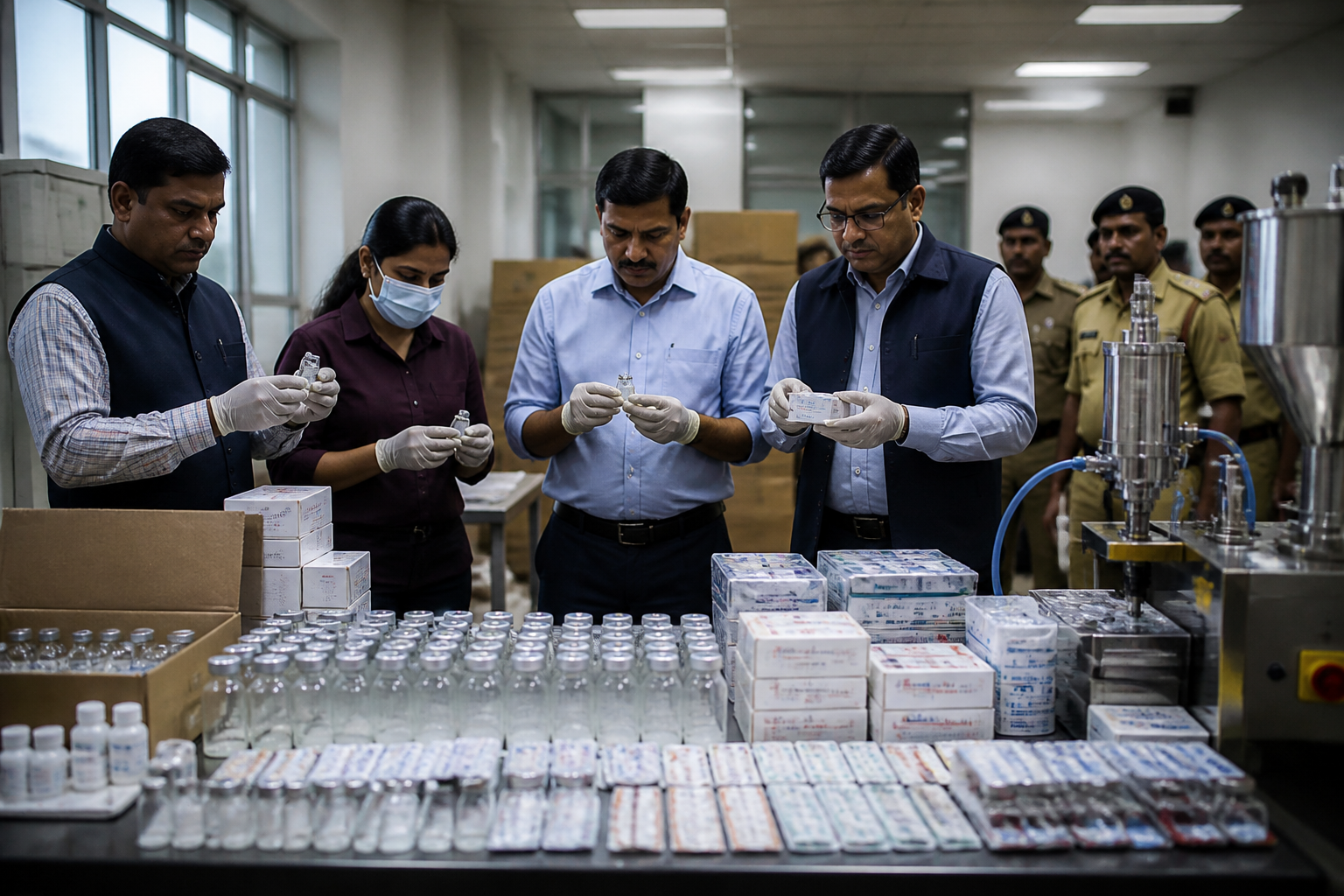
Health Minister U T Khader said the action followed FSDA raids at farmhouses in Bidadi and Dodderi in Bengaluru South district on August 18. Officials seized suspected counterfeit medicines estimated to be worth around Rs 5 crore, along with forged invoices, injection-filling equipment, counterfeit labels and stamps. A Special Investigation Team was subsequently formed to examine the wider network.
Khader said Pfizer’s sale in Karnataka had been stopped because the company did not cooperate with the investigation. The Indian Express reported that it had emailed Pfizer seeking a response to the suspension and the FSDA’s allegations. Pfizer had not replied at the time of publication.
According to the FSDA’s preliminary findings, the premises were allegedly being used to procure low-cost medicines from neighbouring states. These medicines were then purportedly refilled into new vials and relabelled to imitate expensive, life-saving products sold under multinational brands, particularly imported products carrying the Pfizer name.
The agency said the counterfeit packaging included QR and scanning codes intended to make the products appear genuine. The codes were found to be non-functional when checked, it said. The FSDA also warned that the suspected counterfeit medicines could lack active medicinal ingredients or contain harmful substances, creating risks for patients who depend on injectable drugs.
The seized material included 5,640 vials of counterfeit Cefiavigent 2.5 injection, falsely branded under Eucratia Healthcare Pvt Ltd and valued at more than Rs 3.38 crore. Officials also seized 1,531 vials of Hizlam injectables, allegedly attributed to Welcure Remedies and valued at Rs 52.24 lakh, and 264 vials of Emblaveo falsely branded as Pfizer products, valued at Rs 20.59 lakh.
The seizure further included 30 boxes of expired medicines valued at Rs 35 lakh. Officials said these medicines appeared to be prepared for reintroduction into the market. Other suspected counterfeit injectable batches named by the FSDA included Xavitaz, Zavicefta, Tigynt, Tigvnet, Aztreo and Trezam.
The FSDA has blocked batch numbers associated with the seized medicines on its portal to prevent their further sale or distribution. Samples have been sent to government laboratories for chemical testing to establish their composition, sterility and potency.
The action has also exposed the enforcement challenge created by a medicines market that depends on multiple layers of manufacturers, distributors, depots, wholesalers and retail pharmacies. In this case, the investigation spans both pharmaceutical firms and pharmacies, with the department cancelling licences where it found suspicious activity and suspending others pending further inquiry or because they allegedly did not cooperate with the SIT.
The licences cancelled include those of Avesco Healthcare, Bangalore Speciality Pharma, Patel Medi Trade, Rajarajeshwari Pharma, Surya Speciality Pharma, SWS Pharma, Krupa Healthcare, St Philomena Hospital Drug Centre, Sagar Pharma, Zymus Pharma, Fortune Medical Solutions, Excelcare Pharma, Patel Medicals and a Bangalore Speciality Pharma outlet in Chamarajpet.
Licences suspended pending further inquiry include those of Med Pharma, Surya Speciality Hospital, Sagar Pharma’s Unit-II, Vivantha Pharmaceuticals, Maruthi Medicals, Viva Pharma in Belagavi, Hi-5 Pharma and Pfizer.
The FSDA has advised patients and citizens to purchase life-saving medicines only from licensed pharmacies and to insist on valid tax invoices. It has also asked people to report suspicious changes in packaging or non-functional QR codes to drug enforcement authorities. Laboratory testing and the SIT’s continuing investigation will determine the composition of the seized medicines and the further regulatory action against the firms involved.
