


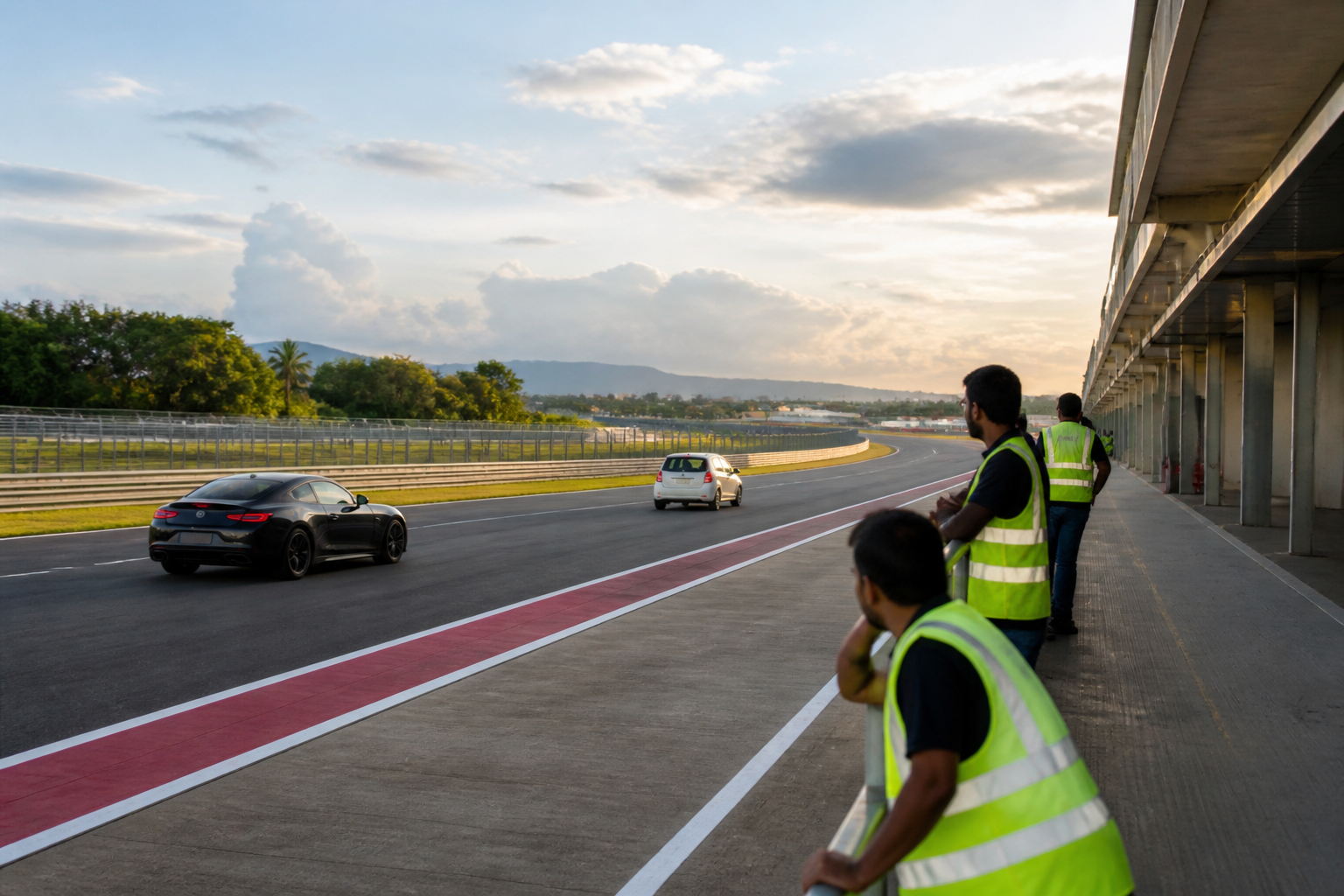
Tamil Nadu’s motorsport infrastructure is moving beyond race weekends. Rising participation at tracks in Chennai and Coimbatore, growing academy enrolments, new karting facilities and weekday demand from vehicle manufacturers are turning racing into a wider platform for skills, testing, custom manufacturing and technical employment. The shift is also prompting government interest in building infrastructure and developing talent, although the industry still faces gaps in sponsorship, viewership and capacity.
The change matters because motorsport is not only a spectator activity or a pathway for professional drivers. It is an urban production system that depends on circuits, engineering firms, component makers, fabrication workshops, data specialists, logistics providers, training institutions and vehicle manufacturers. Tamil Nadu already has many of these capabilities through its automotive and engineering base. The emerging question is whether the state can connect them into a structured ecosystem rather than allow growth to remain dependent on individual academies, private tracks and occasional events.
The immediate signals are visible in Chennai and Coimbatore, the state’s two principal motorsport corridors. Racing academies and institutes are reporting stronger participation from professional aspirants as well as amateurs seeking supervised track time. That demand is creating business opportunities around rider management, marketing, custom manufacturing, specialised engineering and technical support.
The expansion is being supported by a broader increase in public visibility. Social media and digital broadcasting have made racing more accessible to audiences, while the growing availability of karting tracks, racing schools, championships and arrive-and-drive programmes has made participation easier. The result is a gradual movement from motorsport as something watched from outside the circuit to an activity in which enthusiasts can buy structured experiences and training.
Rajini Krishnan, a nine-time national champion who runs RACR academy, said professionals and enthusiasts across age groups were using circuits to fulfil racing ambitions or gain practical experience. He also linked the growth in track training to road behaviour, saying superbike owners were enrolling in courses to develop stronger riding skills and ride more maturely on public roads.
Krishnan said children from 12 and 13 years of age and young adults were joining academies for structured training aimed at national-level competition. Competitive pathways are also beginning earlier. According to him, original equipment manufacturers and academies are introducing junior programmes, with some opportunities available to children as young as four. The stated objective is to narrow a six-to-eight-year gap with international practice, from parts of Asia to Spain, and create a longer development pipeline for Indian drivers and riders.
That pipeline is important because talent development in motorsport is cumulative. A participant needs access to basic training, suitable equipment, safe circuits, coaching, competition and progression into higher categories. Without continuity between these stages, early interest may not translate into national or international performance. The new karting and junior programmes are therefore not simply recreational additions; they are attempts to build a feeder structure around a sport that has historically struggled to produce sustained pathways.
At the Madras Motor Sports Club facility in Irungattukottai, the country’s oldest track and one of only three certified tracks in India, entries have risen by 30% to 40% compared with previous years, according to chief event manager Nagarajan Thangaraj. He said the increase was visible across both car and bike categories, with existing teams conducting training sessions that attract competitors from across India.
MMSC is also preparing to open a CIK-certified karting track for two-wheeler training for children from the age of eight, in partnership with TVS. The facility is intended to create a domestic feeder route aligned with platforms such as the MiniGP World Series. Its significance lies in the connection between certification, age-appropriate training and competition. A recognised facility can give young participants a more consistent route from local instruction to organised racing, although the report does not establish the final opening date or the scale of the programme.
The track itself is becoming a more diversified piece of infrastructure. At Kari Motor Speedway in Coimbatore, weekday testing by OEMs and electric-vehicle startups accounts for up to 60% of utilisation, according to executive director Tharunkumar S. Manufacturers use circuits to test vehicle dynamics, battery performance and components such as suspension systems. This creates a revenue base that is less dependent on race calendars and helps support other track activities.
Tharunkumar said track business models now include racing events, open-track sessions, arrive-and-drive days for enthusiasts and corporate brand events, including product launches with drift demonstrations. He also said weekday OEM revenue subsidises academy track costs. This cross-subsidy is a significant feature of the emerging model: commercial testing can help make training more affordable or financially viable, while academies and events keep the facility connected to the wider public.
The same infrastructure can support a range of technical services. Tharunkumar is involved in making custom go-karts, pocket bikes and racing kit bikes for younger children, and identified technical and research consultancies, trained test riders and data logging as additional revenue streams. These activities extend the value of a circuit beyond the track surface. They create demand for technicians, engineers, fabricators and analysts, while giving manufacturers a controlled environment for development.
Narain Karthikeyan, India’s first Formula One driver, said Tamil Nadu’s existing automotive capabilities provide a strong base for this expansion. The state has OEMs, component manufacturers, engineering companies, testing facilities and a technically skilled workforce. He described motorsport as an ecosystem involving engineers, fabricators, machinists, electronics specialists, tyre specialists, logistics providers and other disciplines, rather than a field centred only on drivers.
Coimbatore illustrates that connection between racing and industrial capacity. Karthikeyan said the city’s motorsport culture developed alongside its engineering and automotive ecosystem and contributed to his own development as a driver. The implication is that local industrial depth can support motorsport when circuits, manufacturers and technical institutions interact regularly. Racing then becomes both an output of the engineering economy and a platform for improving it.
This is also why the government’s interest in international events has implications beyond tourism or event branding. The Tamil Nadu government has announced plans to build motorsport infrastructure and develop talent. Separately, the Union government has constituted a task force to bring Formula One races to India. Industry representatives believe that hosting world championships could expand the domestic market and strengthen the ecosystem.
However, an international event alone would not create a durable development system. A championship can generate temporary demand for hospitality, logistics, broadcasting and event operations, but the longer-term value depends on what remains after the event leaves: certified facilities, trained personnel, junior programmes, testing capacity, local suppliers and regular competition. The available evidence shows movement in several of these areas, but it does not yet establish the scale, funding or implementation timetable of the government’s infrastructure plans.
The economic opportunity is similarly visible but not fully measured. The report cites a KPMG estimate that emerging sports—including motorsport, table tennis, tennis, rugby and chess—represent a collective opportunity of $500 million. It also notes that motorsport ranks among the top 10 sports in India’s social fan base outside cricket. These figures indicate audience and commercial potential, but they do not provide a standalone estimate for Tamil Nadu’s motorsport industry. The sector’s precise employment, revenue and investment footprint remains unclear.
That lack of measurement is important for policymaking. Without a clear account of track utilisation, academy participation, equipment manufacturing, testing revenues, employment and event-related activity, it is difficult to determine whether public support should prioritise new circuits, upgrades to existing facilities, junior training, safety standards, competition calendars or engineering research. The industry’s size may be growing, but its institutional visibility appears to lag behind its activity.
The structural constraint is not only physical infrastructure. Industry representatives also identify insufficient corporate sponsorship, audience viewership and broader infrastructure as continuing weaknesses. Grassroots driver support is expected to require stronger corporate participation, particularly if young talent is to progress through multiple levels of competition. Training fees, equipment, travel and race participation can all become barriers when the pathway depends largely on families or private academies.
Tamil Nadu’s advantage is that motorsport can be linked to an existing industrial geography rather than developed as a stand-alone entertainment sector. Chennai provides access to automotive companies, engineering talent and the MMSC facility, while Coimbatore combines manufacturing capabilities with Kari Motor Speedway and an established motorsport culture. Connecting these assets could allow the state to support both participation and product development.
The evidence therefore points to a transition rather than a finished industry. Tracks are seeing higher entries, manufacturers are using circuits for testing, academies are broadening age-based training and the government is signalling interest in infrastructure and global events. What remains uncertain is whether these developments will be coordinated through a formal pathway with measurable targets, stable financing and wider access.
Tamil Nadu’s motorsport opportunity will ultimately be judged not by the number of high-profile events alone, but by whether the infrastructure produces durable skills, engineering capability, employment and competitive talent. The next milestones are the implementation of the state’s infrastructure plans, the opening of the CIK-certified karting facility and the extent to which manufacturers, sponsors and public agencies convert current interest into a sustained domestic ecosystem.
