


Mumbai’s Ganesh immersion arrangements at Girgaon’s Swarajyabhoomi Chowpatty have been reviewed by a team from IIM Mumbai, 13 Indian Revenue Services officers and experts, who examined crowd management, civic facilities, emergency preparedness and coordination between agencies during Ganeshotsav 2026.
The study team visited the site to understand how the civic administration manages the arrival of lakhs of devotees and the immersion of Ganesh idols at one of Mumbai’s busiest immersion locations. Officials said the team praised the Brihanmumbai Municipal Corporation, Mumbai Police and other agencies for their planning and coordination.
The visit was organised by IIM Mumbai under its Public Policy Management Programme, PGPExPPM. According to an official statement, the programme was intended to provide practical exposure to large-scale public event management, urban governance and field-level implementation.
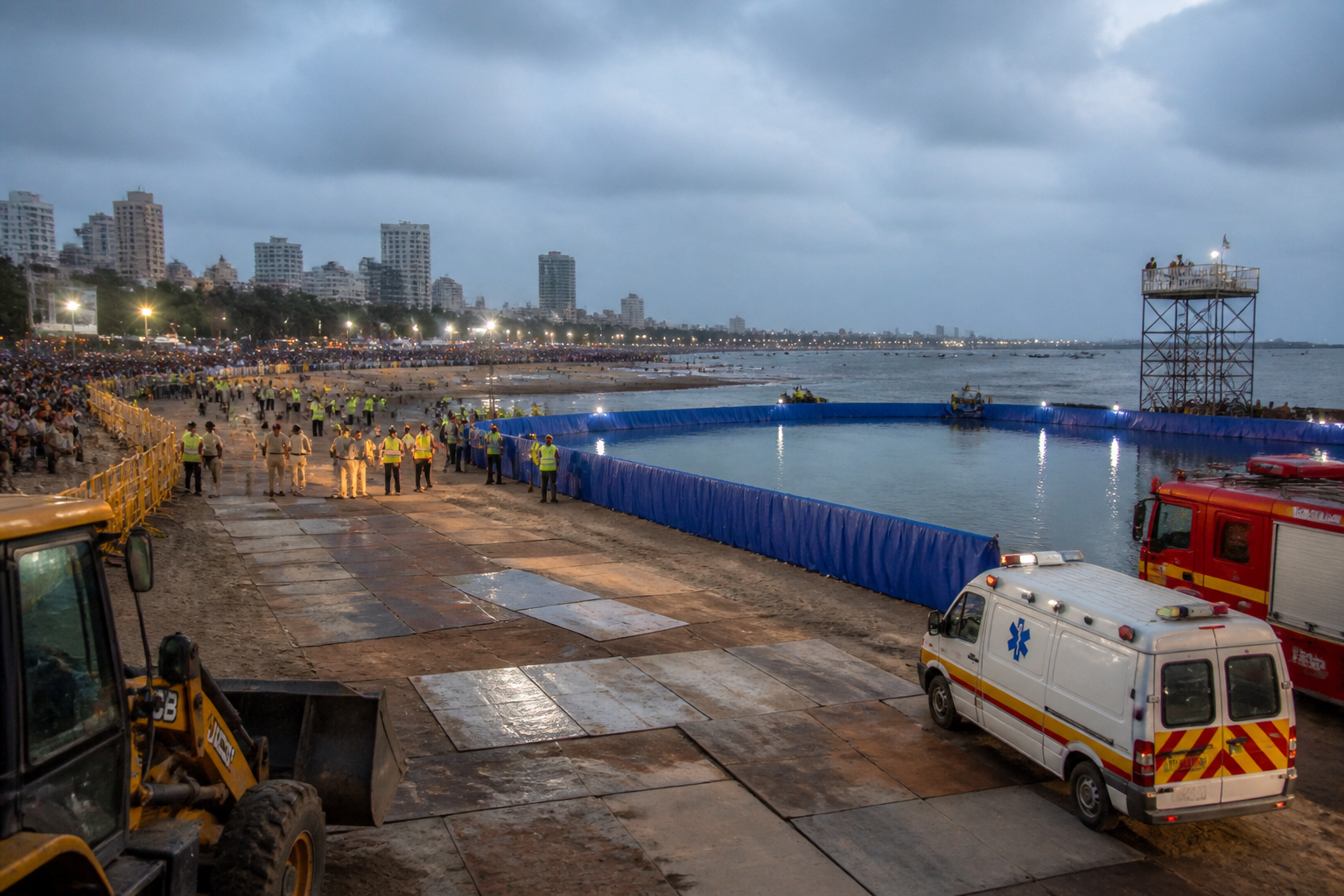
BMC Assistant Commissioner of D Ward Santosh Salunkhe explained the arrangements at the immersion site, including the control room and civic facilities. The deployment includes 20 towers, 12 artificial ponds, 90 toilets, 22 rafts, 1,194 German-steel plates, 22 bins for collecting nirmalya or floral offerings, one primary health centre, 548 floodlights, 11 searchlights, three ambulances and around 1,000 personnel.
The civic body begins preparations approximately three months before the festival. Around 1,200 steel plates have been laid on the sand to prevent vehicles carrying idols from getting stuck. Artificial ponds have also been provided for idols up to six feet in height. Other facilities at the site include drinking water, mobile toilets, a health centre, lifeguards and round-the-clock cleanliness operations.
The study team was also briefed on emergency management and crowd control. Rashmi Lokhande, Chief Officer of the BMC’s Disaster Management Department, presented details of the city’s emergency management system and the arrangements for Ganesh immersions. The presentation covered the control room, inter-agency coordination, crowd management, traffic regulation, emergency response, sanitation, health facilities, eco-friendly measures and real-time monitoring through technology.
Assistant Commissioner of Police Dnyaneshwar Wagh briefed the team on police security arrangements, crowd management and the use of artificial intelligence technology to monitor crowds and help prevent accidents. The arrangements involve coordination between the civic administration, police and other agencies responsible for safety, traffic, health, sanitation and immersion operations.
The participating officers and IIM Mumbai faculty members said that managing the safety, health and civic requirements of lakhs of devotees while ensuring peaceful and orderly immersion provided an important example of public and urban administration. The study team included senior officials from the Union Finance, Environment, Forest and Climate Change, Revenue, Home, and Information and Broadcasting ministries, along with representatives from the judiciary, banking, industry, non-profit organisations and consultancy firms. BMC officials were also present during the visit.
