


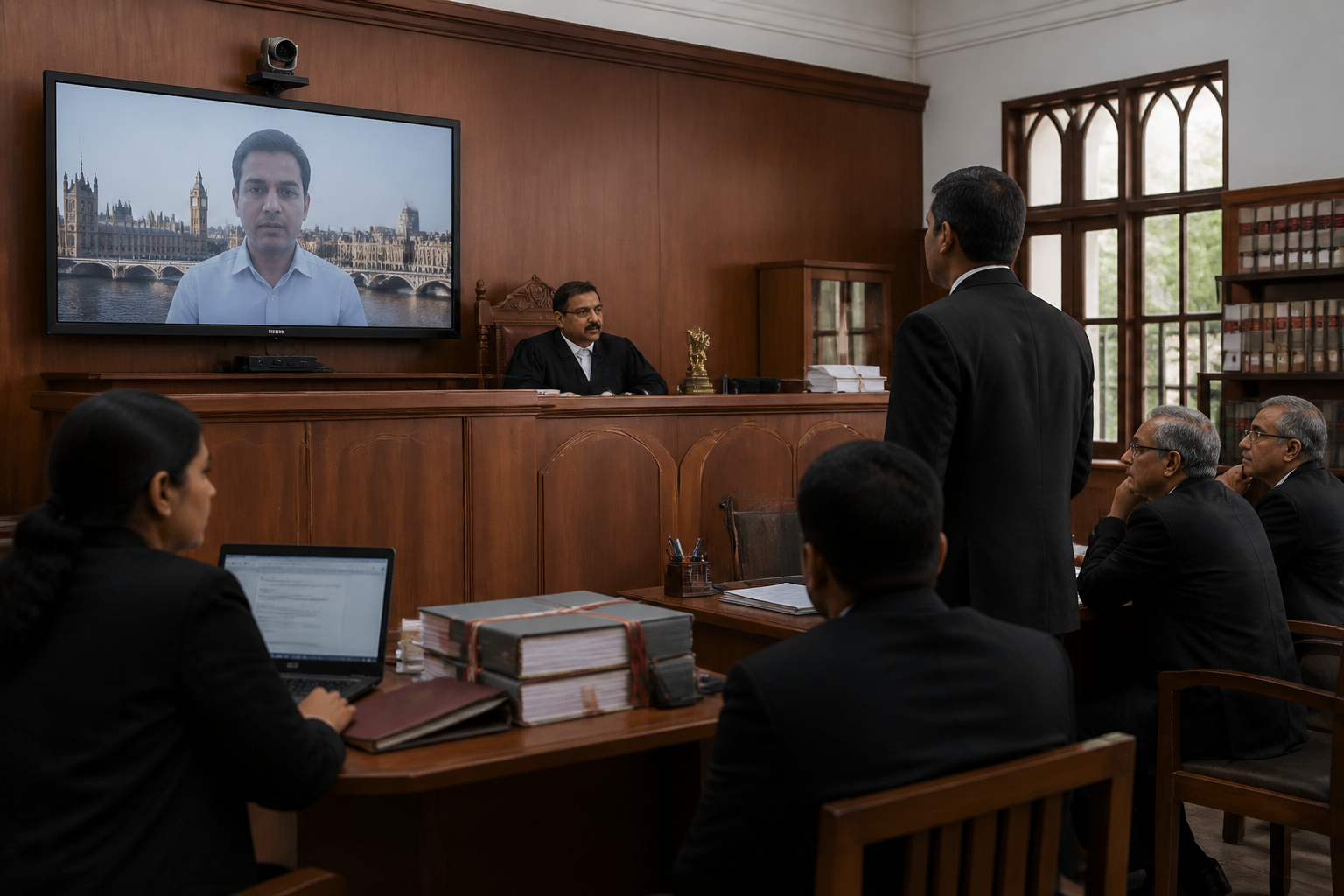
The Madras High Court has said trial courts cannot refuse to examine witnesses through video-conferencing merely because a case involves complex issues or a large volume of documents, strengthening the use of digital hearings in civil proceedings.
Justice N Anand Venkatesh made the observation while allowing K Balasundaram, a 72-year-old practising doctor based in London, to give evidence before a district court in Coimbatore through video-conferencing. Balasundaram had undergone bypass surgery and had been advised against undertaking long-distance travel.
The court said his age and health conditions justified his appearance through video-conferencing. It directed that the trial court must strictly follow the Madras High Court Video Conferencing Rules, 2026, while recording his evidence and conducting the proceedings.
The ruling addresses a practical issue in court administration: whether the complexity of a case can itself be treated as a reason to deny remote witness examination. The High Court said trial courts could not refuse video-conferencing on that ground, noting that several complex arbitration matters involving large turnovers and numerous documents were already being conducted conveniently through online proceedings.
The court said the Madras High Court Video Conferencing Rules, 2026, had been notified to prescribe the procedure for recording evidence through video-conferencing. The rules therefore provide the framework under which the district court is required to conduct the witness examination in the Coimbatore case.
The dispute concerns a partition suit in which Balasundaram is seeking the allotment of a one-third share in the suit properties. He has also sought a declaration that a judgment and decree dated March 17, 2024, passed by the District Munsif Court, Coimbatore, is null and void.
The High Court said the matter was not so complex as to prevent Balasundaram’s cross-examination through video-conferencing. It consequently allowed him to give evidence remotely while requiring the lower court to follow the notified rules during the trial.
The decision places the focus on the operational safeguards governing digital evidence rather than on whether a proceeding takes place physically or online. In this case, the court’s direction allows the trial to continue without requiring an elderly witness with a documented health concern to travel from London to Coimbatore.
The district court will now conduct the examination and cross-examination through video-conferencing in accordance with the Madras High Court’s 2026 rules. The reported order does not indicate any wider change to the legal requirements governing the partition dispute itself.
