


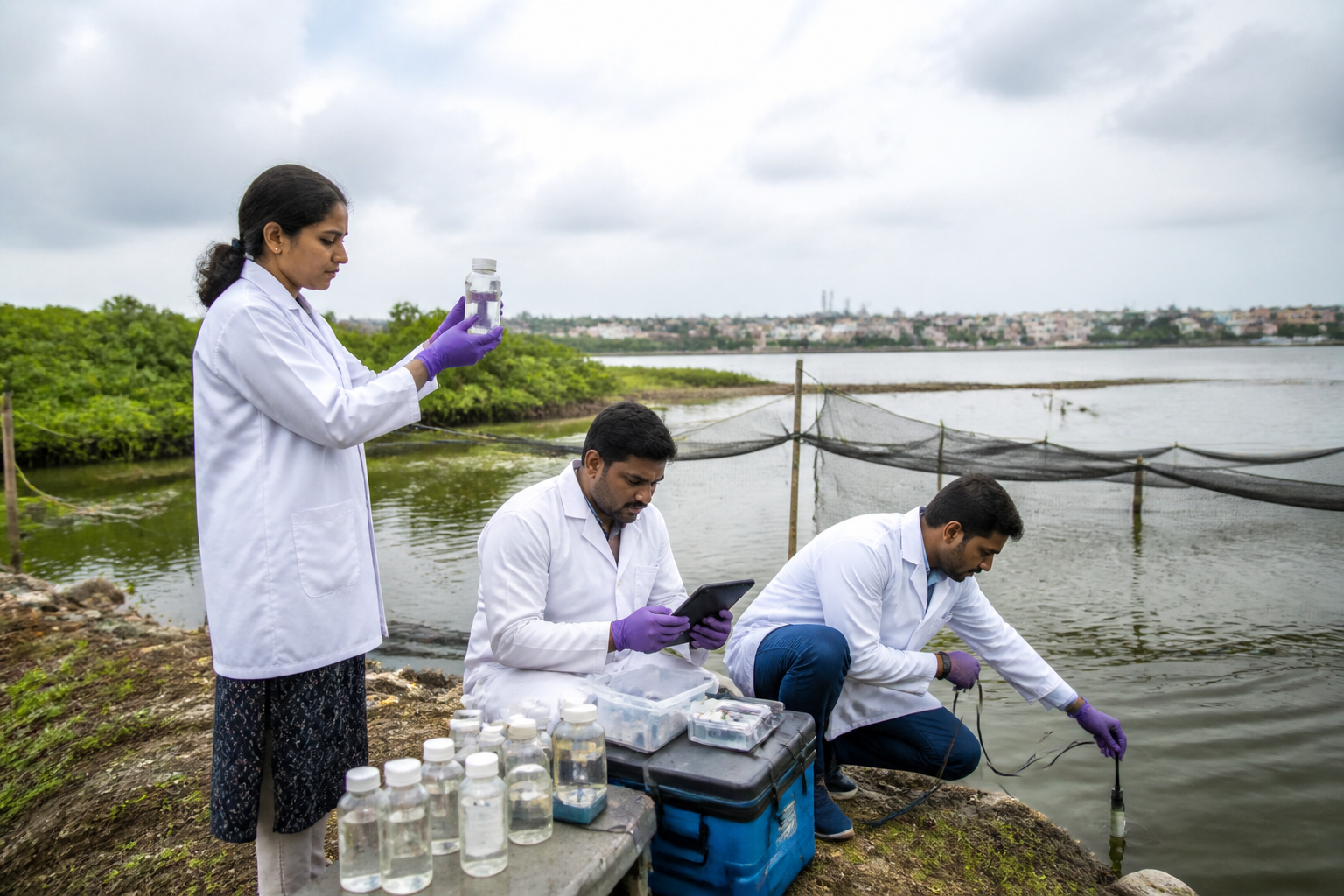
The aquaculture chemicals database developed by Chennai researchers does more than catalogue substances used in fish and seafood production. ReCAnt, created by the Institute of Mathematical Sciences (IMSc) with the National Centre for Coastal Research (NCCR), brings scattered information on 690 chemicals into one publicly accessible resource. Its significance lies in the problem it makes visible: aquaculture depends on a wide range of antibiotics, disinfectants, pesticides, anaesthetics and water-treatment agents, while information about their ecological effects and regulatory status remains uneven.
Aquaculture is closely connected to the health of coastal environments and food systems. Chemicals used to prevent disease or improve production may not remain confined to the farms where they are applied. The study behind ReCAnt records information on the environmental fate of these substances, their movement through food webs, therapeutic and toxic effects, and regulatory status in multiple countries. The database therefore links production practices with questions of aquatic ecosystem health and potential human exposure.
That connection is important for a coastal city such as Chennai, where environmental management cannot be separated from the condition of surrounding water systems. The supplied study does not quantify chemical contamination in Chennai’s aquaculture areas, nor does it establish that any specific substance is causing harm locally. What it does provide is a system for organising the evidence required to identify chemicals that may warrant closer monitoring and risk assessment.
The researchers’ central contribution is to address an information problem. The study, published in Cell Reports Sustainability, found that relevant information was distributed across scientific literature and databases. ReCAnt consolidates that material and makes it available free of charge. Areejit Samal, the study’s corresponding author, said the resource includes structural and physicochemical characteristics of the chemicals and integrates information from toxicological databases.
This is not simply a technical improvement in data access. Monitoring agencies need to know what substances are being used, how they behave in water and organisms, what hazards have been documented, and whether regulatory authorities have assessed them. When these details are dispersed or difficult to compare, oversight can become reactive. A database cannot replace field sampling, laboratory testing or enforcement, but it can help determine what should be examined and where evidence is missing.
The regulatory findings underline the scale of that gap without proving that the chemicals are unregulated. Of the 605 chemicals for which the researchers reviewed the curated literature for regulatory information, 558 had no regulatory information reported in the reviewed literature. Forty-seven had at least one reported regulatory status. After cross-referencing established regulatory lists, the number of chemicals with some associated regulatory information rose to 57.
These figures require careful interpretation. The researchers explicitly cautioned that the assessment was not exhaustive and that the absence of regulatory information did not mean a chemical was unregulated. It could instead mean that information was not reported in the literature reviewed, was difficult to locate, or was recorded differently across regulatory systems. That distinction is essential: a documentation gap is not the same as a legal gap.
Even with that limitation, the numbers show why chemical governance in aquaculture cannot depend only on lists of prohibited or approved substances. Regulators and researchers also need information on exposure pathways, persistence, toxicity and the possible movement of chemicals through food webs. ReCAnt’s value is therefore partly classificatory. It creates a common evidence base from which more specific assessments can begin.
The database also reflects the institutional complexity of aquaculture oversight. Chemical use intersects with farm management, aquatic ecology, public health, food safety and environmental regulation. No single dataset can resolve all these responsibilities. A resource such as ReCAnt may help different institutions work from a shared understanding, but decisions about monitoring, permissions and enforcement remain dependent on the authorities responsible for particular aquaculture systems and chemicals.
The study’s One Health framing brings those connections together. The researchers said the resource supports informed decision-making and sustainable chemical management intended to safeguard aquatic ecosystems, food security and human health. In practical terms, that means chemical assessment cannot focus only on whether a substance helps control disease or increase production. It must also consider what happens after use, including possible accumulation in organisms and movement through connected ecological systems.
The database’s free availability is another important feature. Access matters because chemical risk assessment is not limited to regulators. Researchers can use the resource to identify areas requiring further study; monitoring agencies can use it to screen chemicals of potential concern; and aquaculture stakeholders can use it to understand the evidence associated with substances used in production. The researchers said ReCAnt could be adapted to specific aquaculture systems for screening and risk assessment.
That adaptability is relevant because aquaculture practices and chemical exposure are not identical everywhere. A substance used in one system may have a different risk profile depending on the species, production method, water conditions and pathways through which it enters the environment. The supplied study does not provide a Chennai-specific risk ranking, and ReCAnt should not be read as one. Its immediate role is to make the underlying information more usable for system-specific assessments.
The Chennai connection also illustrates how urban research institutions can contribute to environmental governance beyond city boundaries. The Institute of Mathematical Sciences and the National Centre for Coastal Research are not presented as enforcement agencies in the report. Their contribution is the creation of a research and information tool. Its eventual impact will depend on whether the database is taken up in monitoring programmes, risk assessments and regulatory decision-making.
What the evidence confirms is that information about aquaculture chemicals has been fragmented and that documented regulatory information was limited for most of the chemicals reviewed in the literature. What it does not confirm is the extent of chemical exposure in Chennai, the safety or danger of any particular substance, or the effectiveness of existing enforcement systems. Those questions require additional field-level and institutional evidence.
ReCAnt’s importance, then, is not that it closes the regulatory debate. It gives researchers and authorities a more organised starting point for asking better questions about chemical use, ecological effects and food-system risks. The next measure of its value will be whether the database is adapted to specific aquaculture systems and used to support monitoring and risk assessment rather than remaining a stand-alone catalogue.
