


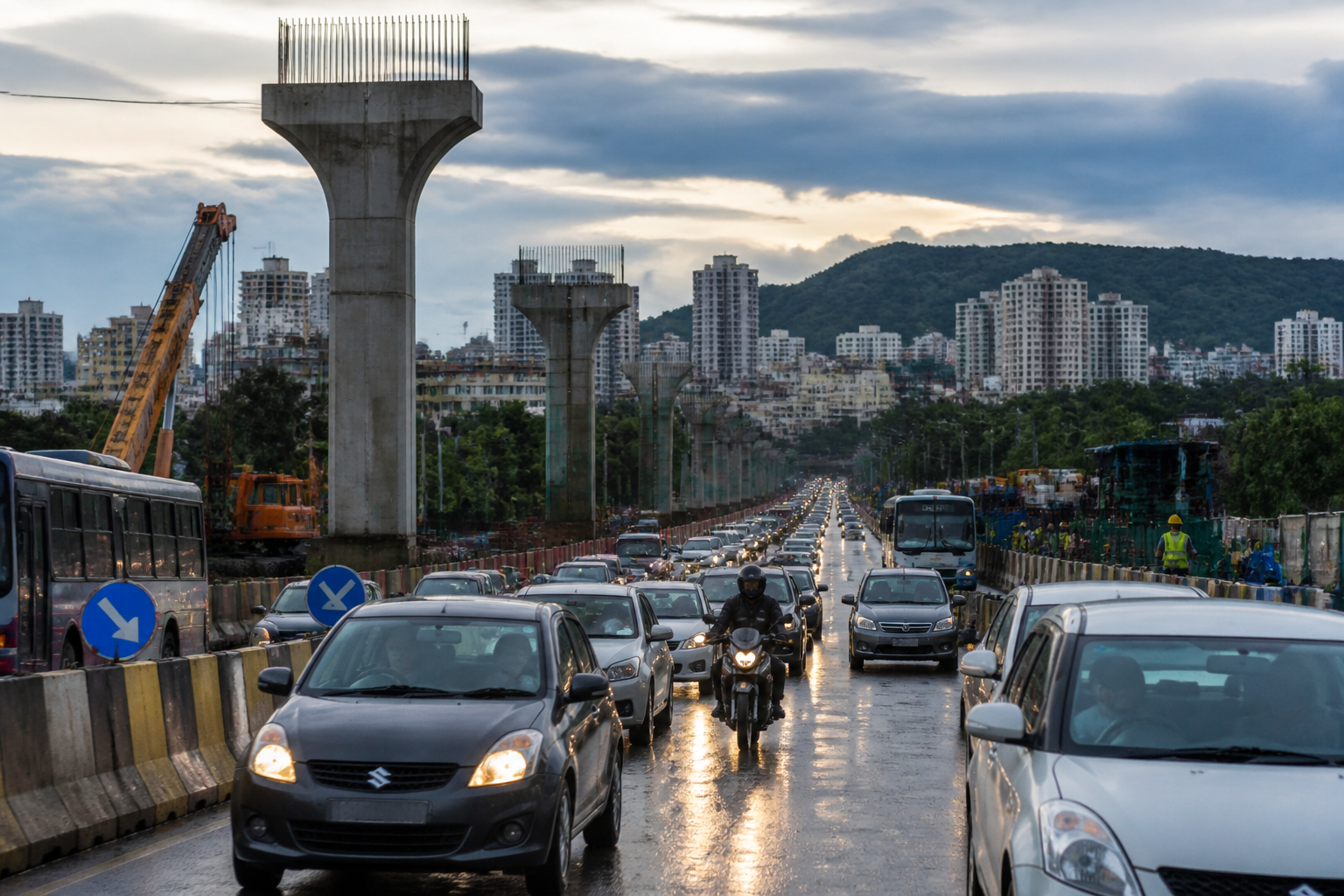
Pune is surrounded by an expanding pipeline of metro lines, ring roads, elevated corridors and proposed underground routes. Yet the city’s central transport problem remains unchanged: traffic congestion continues even as public authorities announce or advance projects worth thousands of crores. The contradiction is not simply that Pune needs more infrastructure. It is that the city is building, planning or promising several major systems at the same time without any one of them being close enough to completion to provide rapid relief.
A report published by Loksatta – Pune describes Pune as overwhelmed by projects, with work underway, projects awaiting commencement and proposals at different stages spread across the metropolitan region. The report links this project expansion to the city’s rising population and fast physical growth. As more people and vehicles enter the urban system, the responsibility for providing transport capacity rests with the state government and local authorities. The evidence presented in the report suggests that this responsibility has not been matched by timely infrastructure planning.
The result is visible in daily traffic conditions. The report identifies persistent congestion across Pune and its surrounding areas as the clearest sign of the infrastructure shortfall. The underlying planning challenge is straightforward: a growing population increases travel demand, while rising vehicle ownership places additional pressure on roads. If capacity, public transport and land-use expansion are not planned together, individual projects may add infrastructure without resolving the wider movement problem.
## Pune infrastructure projects are expanding faster than relief
Pune Metro is the most prominent example of the city’s attempt to shift travel away from roads. Services currently operate on the Vanaz–Ramwadi and Pimpri-Chinchwad–Swargate corridors. According to the Loksatta report, the two corridors have a combined designed daily carrying capacity of about 600,000 passengers, while current ridership is around 250,000 passengers a day.
The gap between designed capacity and current use is important, but it cannot by itself resolve Pune’s congestion. Metro capacity becomes most useful when the network reaches major employment areas, residential growth zones and interchange points, and when passengers can reach stations conveniently. The source report does not provide a detailed assessment of feeder services, station access or fare patterns. It does, however, show that the existing network is only one component of a much larger and unfinished transport system.
The Hinjewadi–Shivajinagar metro corridor has received approval for services across 12 stations, but its inauguration is still awaited, the report says. Work is also underway on the Pimpri-Chinchwad–Nigdi and Swargate–Katraj routes. Other proposed routes include Ramwadi–Wagholi, Kharadi–Khadakwasla and Nal Stop–Manikbag. The report says these proposals have not yet gathered sufficient momentum.
This creates a familiar urban infrastructure pattern: a city may have a large project pipeline, but the citizen experiences only the projects that are operational. Announcements, approvals and proposals can signal future capacity, yet they do not reduce today’s travel time. The difference between these stages is therefore central to understanding Pune’s congestion problem.
The same sequencing issue appears in road infrastructure. The Maharashtra State Road Development Corporation is currently working on an outer ring road intended to enable faster movement around Pune. The work is underway, but the report says it is not progressing at the expected pace. At the same time, the Pune Metropolitan Region Development Authority has begun steps towards land acquisition for an inner ring road.
The two ring roads are intended to perform different functions within the wider metropolitan road system. An outer route can help traffic bypass the built-up core, while an inner route can redistribute movement around the city. But neither can provide immediate relief while land acquisition, construction and related approvals remain incomplete. The report does not establish a completion date for either route, making it difficult for residents to know when their intended transport benefits will become operational.
## The elevated-road and underground proposals add another layer
Pune Municipal Corporation has also moved to accelerate the High Capacity Mass Rapid Transit Route, or HCMTR, according to the source. The project is planned as an elevated route over Pune’s roads. Alongside it, Chief Minister Devendra Fadnavis has announced an underground route referred to in the report as “Paatal Lok”, for which the preparation of a project plan is underway.
Together, these projects reveal the scale of the response being assembled around Pune’s congestion. Metro lines seek to provide higher-capacity public transport. Ring roads are meant to distribute traffic around the metropolitan region. Elevated and underground corridors seek to create additional routes within or near the existing urban structure. The city is therefore pursuing multiple infrastructure forms at once rather than relying on a single intervention.
That variety may be necessary in a rapidly expanding metropolitan region, but it also raises an institutional question: who is responsible for integrating the projects into one transport strategy? The source identifies the state government, local government bodies, the Maharashtra State Road Development Corporation, the Pune Metropolitan Region Development Authority and the Pune Municipal Corporation as actors involved in different projects. It does not describe a unified delivery timetable or a single authority coordinating all corridors.
Without such coordination, construction activity can overlap geographically and operationally. Roads may be dug up for one project while traffic is diverted because of another. Land acquisition for one corridor may proceed while a neighbouring route remains at the proposal stage. The supplied report does not quantify these disruptions, but its description of projects spread across nearly every part of the metropolitan area points to the administrative difficulty of building several large systems in a densely occupied city.
The central issue is not whether Pune needs infrastructure. It clearly does. The issue is whether project selection, funding, land acquisition, construction and operations are being sequenced around actual travel demand. A long list of projects can create the appearance of momentum while the absence of completed links leaves the existing road network carrying the burden.
## Toll roads and the timeline problem
The project pipeline extends beyond the immediate urban area. Proposed elevated expressways include Pune–Shirur, Hadapsar–Yavat and Talegaon–Chakan–Shikrapur. The report says these routes will levy tolls. Their foundation ceremonies have taken place, but construction is expected to begin only in the following year, with completion planned within four years after work starts.
This timeline has direct consequences for current commuters. Even if the projects are completed within the planned period, the report concludes that motorists will remain exposed to congestion for at least the next four years. This is the defining gap between infrastructure planning and citizen experience. A project can be formally initiated, publicly presented and assigned a target schedule while offering no immediate change to the daily journey.
The toll component also introduces an access question, although the supplied material does not provide proposed toll rates or a detailed user-impact assessment. The routes may create additional capacity for longer-distance and regional traffic, but the financial cost of using them will determine which commuters can rely on these corridors. Any evaluation of their urban impact will therefore need to consider not only construction and travel speed, but also affordability and the distribution of benefits across Pune’s metropolitan population.
The report’s account of Pune’s infrastructure expansion points to a broader planning challenge in Indian cities: responding to congestion through successive large projects rather than through a clearly integrated mobility programme. The source does not claim that any one project is unnecessary. Instead, it shows that several projects are moving through different stages, with no immediate completion capable of changing the overall traffic situation.
For citizens, this produces a city in permanent transition. Roads and neighbourhoods become sites of construction, proposed corridors alter expectations about future development, and authorities announce new solutions as congestion continues. For institutions, it creates a delivery problem involving multiple jurisdictions, different funding and implementing agencies, land acquisition, construction schedules and the eventual operation of the completed infrastructure.
The available evidence confirms three points. Pune’s population and urban footprint are expanding; the city’s transport demand is increasing; and the public infrastructure response is large but fragmented across projects at different stages. Metro ridership remains below the combined designed capacity of the two operating corridors, while several additional metro, ring-road, elevated and underground projects are incomplete, awaiting launch or still under proposal.
What remains uncertain from the supplied material is when the various projects will become operational, how they will connect with one another and how their costs will be distributed between taxpayers, commuters and toll users. Those details will determine whether Pune’s current project boom becomes a functioning metropolitan transport network or remains a long queue of partly completed solutions. Until then, the city’s most visible infrastructure fact is that construction is expanding faster than congestion relief.
