


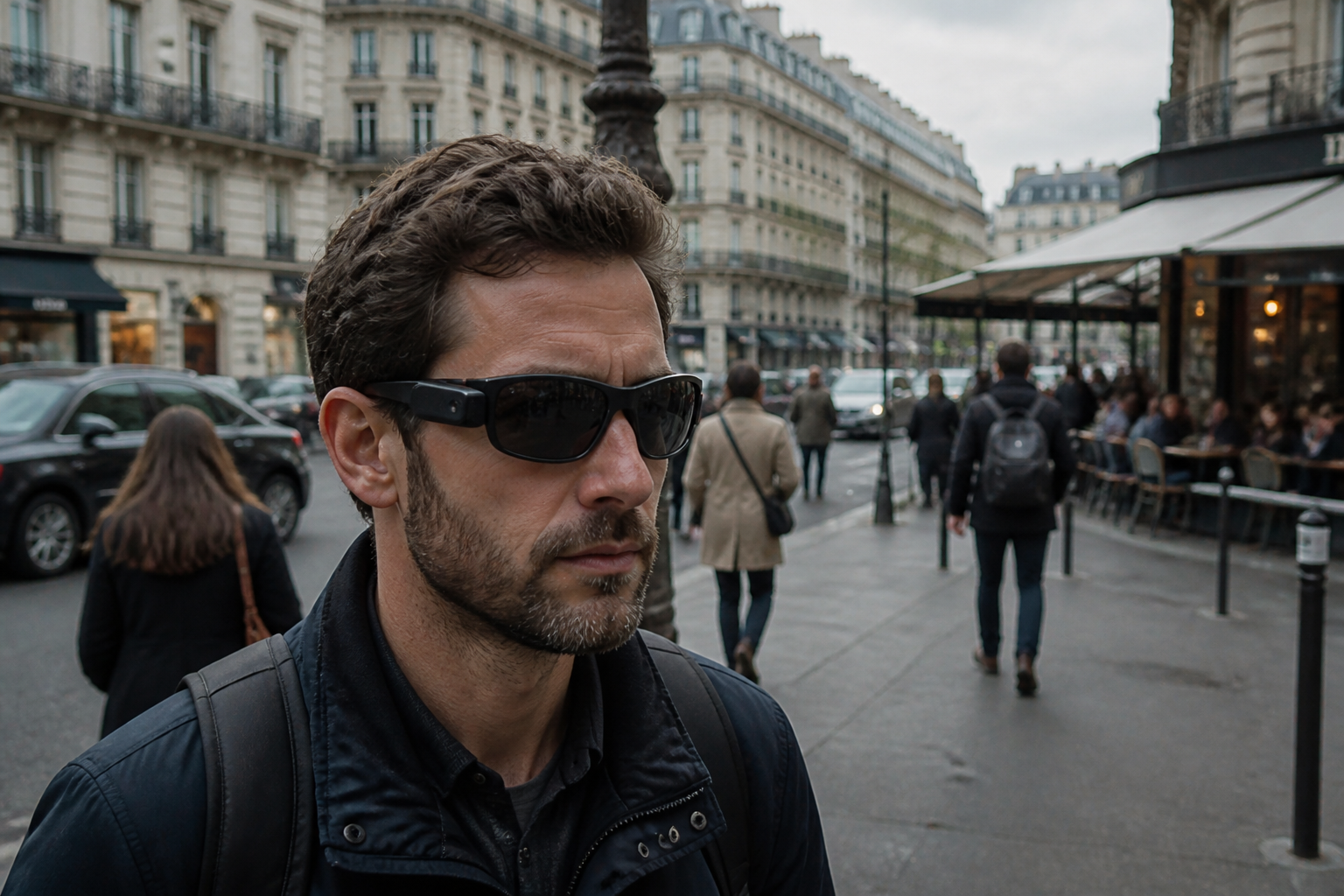
A criminal probe in Paris into the alleged use of smart glasses to film women without their consent has brought a new form of surveillance into focus: recording devices that can be worn in ordinary public spaces while appearing to be conventional eyewear. The case is not only about a new consumer gadget. It raises a difficult governance question for cities and workplaces—how can people know when they are being recorded, and what protection do they have once the footage is distributed online?
The Paris prosecutor’s office told Reuters that it had recently opened at least one criminal investigation after complaints linked to a social media trend involving smart glasses. The complaints concerned videos of women being filmed on the street without their consent and then posted online. The prosecutors did not specify the brand of glasses involved and declined to provide further details.
The cybercrime unit tested the devices two weeks before the report to understand the potential offences they could enable. That step is significant because the issue is not limited to whether a person can technically activate a camera. It concerns the gap between a device’s design, the expectations of people sharing a street or workplace, and the ability of authorities to identify and prosecute misuse after content has travelled across online platforms.
Smart glasses are part of a wider shift in the way cameras are distributed through cities. Conventional surveillance cameras are generally fixed in identifiable locations and operated by institutions. Wearable cameras are mobile, privately controlled and capable of capturing people at street level without the visible equipment, signage or institutional setting normally associated with recording. The result is a less legible form of surveillance in which the person being filmed may not know who is operating the device, what is being recorded or where the footage will appear.
The market is currently led by Meta’s glasses, made in collaboration with EssilorLuxottica. The source report said the company held roughly 76% of the global smart-glasses market and that its AI-enabled glasses, which include a small embedded camera, sold 7 million units last year. EssilorLuxottica’s latest sales figures pointed to exponential growth in 2026. The figures indicate that the privacy question is developing alongside rapid consumer adoption rather than after a long period of institutional testing.
Meta said it had built privacy into its AI glasses from the beginning and would continue strengthening protections as the devices became more capable. EssilorLuxottica declined to comment. The Paris investigation therefore sits within a larger debate involving prosecutors, regulators, rights organisations and businesses over how wearable cameras should operate in public and professional settings.
France’s data protection authority, CNIL, said it had received fewer than 10 complaints about the use of smart glasses in workplaces. It did not disclose the brands involved. CNIL also said businesses were increasingly contacting it to ask whether they could ban smart glasses at work. Those enquiries show that the governance problem is not restricted to streets or social media. Employers are also being asked to define acceptable behaviour in offices, shops and other places where workers and visitors may reasonably expect rules around recording.
CNIL’s head of economic affairs, Nacera Bekhat, said smart glasses created real challenges in informing people that they were being filmed and obtaining consent when it was required. That challenge is built into the form factor. A camera worn on the face can move through a crowded environment, record incidental subjects and capture moments before anyone nearby understands what is happening. The device’s mobility makes conventional workplace or venue policies harder to apply consistently.
The manufacturers have attempted to provide a visible signal. A small light in the frame indicates that filming is taking place. Rights groups, however, argue that the signal does not solve the underlying consent problem. Ines Legendre, a legal expert at internet safety organisation e-Enfance, said seeing a light does not mean a person has consented to being filmed or to having their image distributed to thousands of people afterwards.
That distinction separates notice from consent. A person may be able to see that recording is occurring and still have no practical opportunity to refuse, prevent publication or remove the resulting material. In a busy street, the burden of noticing the signal falls on people who may not know the device’s design or may be focused on commuting, work or personal safety. Once footage is uploaded, the individual being filmed may also have to identify the content, locate the account that posted it and seek remedies across platforms and jurisdictions.
Rights groups said women were the primary targets of abuse involving smart glasses. Ines Girard, who works on technology-facilitated gender-based violence at feminist organisation Hubertine Auclert, said the technology industry should do more to prevent misuse. She argued that asking people being surveilled to remain more vigilant places an additional burden on women, gender minorities and people already exposed to violence, online abuse and scrutiny in public spaces.
This is where smart glasses become an urban governance issue rather than only a consumer technology story. Streets, transport hubs, shopping areas and workplaces are shared environments governed by overlapping expectations. People can generally see fixed cameras, security staff or a person openly holding a phone. A wearable camera changes those visual cues. It can make recording less apparent while allowing the wearer to collect footage from close range and in motion.
Existing legal frameworks provide some protection, but the source report also shows why enforcement is difficult. The European Union’s AI Act and the General Data Protection Regulation regulate AI-enabled wearable devices and the use of personal data. French law protects privacy and includes penalties of up to one year in prison or a €45,000 fine for recording a person’s image in a private place without consent. CNIL and legal sources said enforcement becomes harder when content is rapidly disseminated online.
The legal framework also contains an important boundary. Recording in a private place without consent is specifically identified in the reported French provision, while the complaints described by prosecutors involved filming women on the street. The supplied material does not establish how the current investigation will apply those rules to the alleged conduct. That uncertainty is central: public visibility does not automatically settle questions of harassment, image rights, data processing or unlawful distribution.
Other countries and institutions are beginning to respond through restrictions. Some cinemas in the United Kingdom have banned smart glasses. A German consumer advocacy group filed a criminal complaint against Meta and other companies involved in selling the devices in Germany, citing privacy laws. Australia said it was considering barring camera-equipped smart glasses in government workplaces because of privacy and security concerns, potentially making it the first ban of its kind.
These responses reveal a fragmented policy landscape. Cinemas can set venue rules, businesses can ask whether workplace bans are lawful, government departments can consider security restrictions and data protection authorities can interpret existing regulations. But no single measure addresses every setting. A ban may be workable in a cinema or government office, while streets and public transport require a different approach because access is shared and enforcement cannot depend on every passer-by recognising a product.
The numbers in the report underline the speed of the change. Meta’s glasses reportedly sold 7 million units last year, its estimated market share was about 76%, and EssilorLuxottica described sales growth in 2026 as exponential. Against that scale, CNIL’s fewer than 10 workplace complaints in France should not be read as a measure of the full level of misuse. The figure records complaints received by the authority, not every incident, unreported experience or piece of content circulating online. The source does not provide a broader prevalence estimate.
The more immediate lesson is that complaint systems are likely to encounter only the visible portion of the problem. People may not know they have been filmed, may not know which device was used, or may discover the recording only after it has been reposted. Prosecutors testing the devices suggests that authorities themselves are still building operational knowledge about how the products work and how they may be used to commit offences.
For cities, the issue also complicates the familiar idea that safety and privacy can be managed through visible infrastructure. Rules for fixed cameras often rely on location, signage and an identifiable operator. Wearable cameras move the point of capture into the crowd. Their privacy impact is therefore shaped not only by the hardware but also by platform distribution, workplace rules, venue policies and the ability of authorities to trace the original recording.
The Paris probe does not establish that smart glasses as a category are unlawful, nor does it identify the brand used in the complaints. It does show that criminal investigators, data regulators, businesses and rights groups are dealing with the same underlying problem from different positions. Authorities are examining possible offences, regulators are receiving complaints and advising organisations, companies are defending their privacy safeguards, and rights groups are warning that individuals should not carry the primary responsibility for avoiding covert recording.
What remains uncertain is how the Paris investigation will proceed, whether additional complaints will lead to further cases and how French authorities will interpret existing protections in relation to street filming and online distribution. The developments to watch are the prosecutor’s findings, CNIL’s guidance to workplaces and any formal restrictions adopted by public institutions or private venues. The central urban question will remain whether consent and accountability can keep pace with cameras that are increasingly worn, mobile and difficult to see.
