


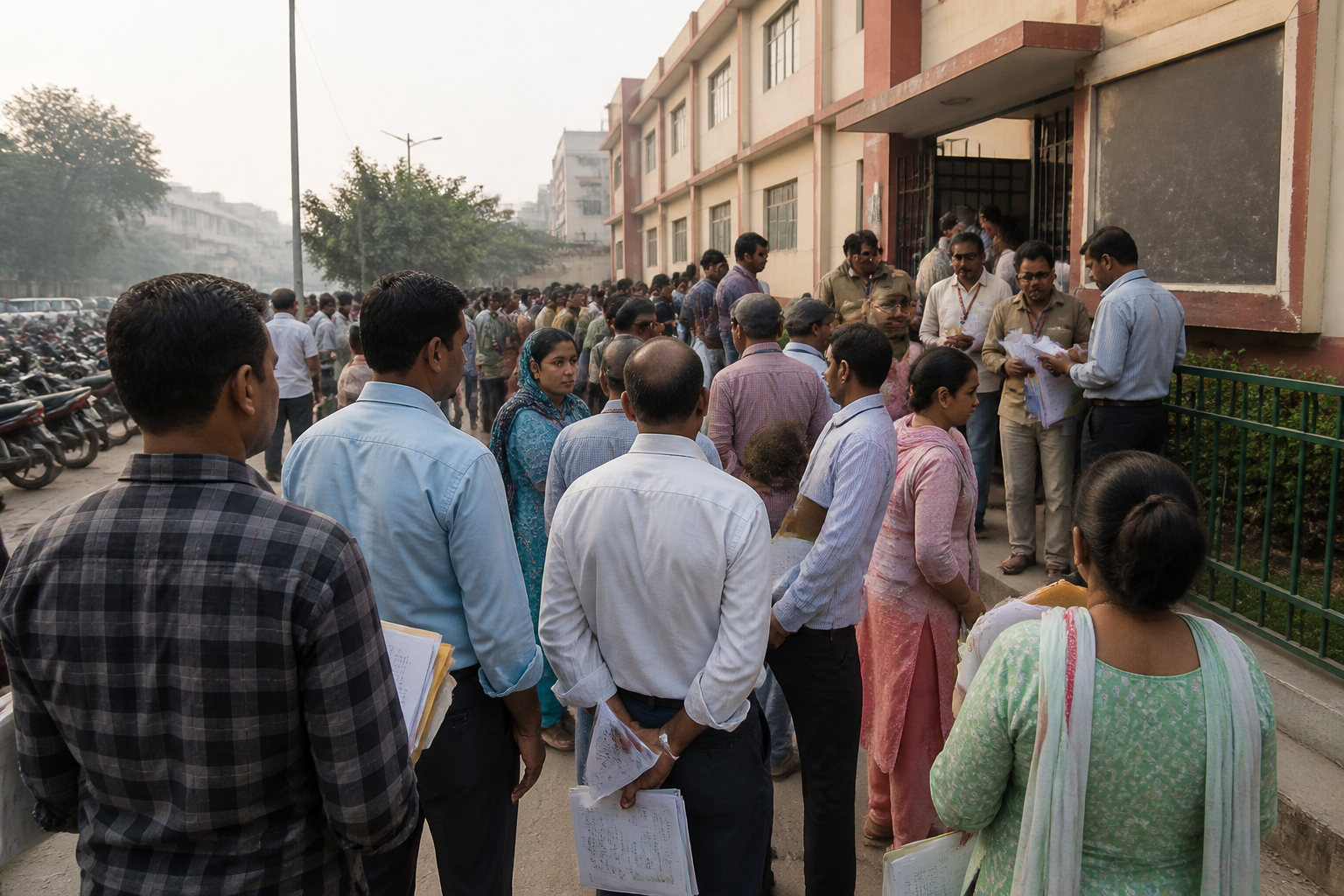
Delhi’s Special Intensive Revision of electoral rolls is turning into a test of whether a large civic verification exercise can remain accessible while operating under a fixed deadline. The Hindu’s reporting from hearing venues shows a widening gap between the number of electors scheduled to appear, those who reach the centres and those whose documents are successfully processed. The problem is not simply low attendance. It involves limited staff, unclear document instructions, repeated visits, language barriers and compressed hearing schedules.
The exercise covers 33.1 lakh electors included in the draft roll who have received, or are to receive, notices for “no mapping” or “logical discrepancies”. The hearings and document verification must be completed by October 29, ahead of publication of the final electoral roll on November 4. This makes the administrative design of the exercise central to its outcome: every delay, incomplete submission or unnecessary revisit reduces the time available for cases to be disposed of before the deadline.
At one hearing venue in the Chandni Chowk constituency, an elector identified in the report as Vaishali reached at 4.20 p.m. for a hearing scheduled between 3 p.m. and 5 p.m. She was told that tokens were no longer being issued and that she would have to return the next morning, unless she was willing to wait until 7.30 p.m. and had the required documents. She had already taken time off work and carried her Class 10 marksheet, but was later told that a document belonging to one of her parents was also required.
Her experience illustrates how the process can become difficult even when an elector follows the notice and reaches the assigned venue within the stated time. The report says the elector had recently married and no longer lived with her parents. The requirement for an additional parental document therefore created not only a documentation problem but also a practical reason for another visit.
The scale of the mismatch is visible in the figures reported from different constituencies. At the Chandni Chowk venue, an Assistant Electoral Registration Officer said that at least 300 hearings for booth numbers 41 to 90 had been scheduled each day since September 9. Nearly half of those called did not turn up. Of those who arrived, only around 120 cases were successfully processed.
In Mustafabad, between 1,200 and 1,500 people were reported to be turning up on a day against 2,000 scheduled hearings spread across three shifts. Yet documents were successfully submitted in only about 500 cases on average. The constituency has more than 79,000 notices, around 60,000 of them relating to logical discrepancies. These numbers show that attendance alone is not a measure of administrative capacity. The more important measure is how many cases can be completed correctly within the available time.
The exercise is being conducted through a system that combines physical hearings, document uploads, booth-level verification and photographic attendance. At the Chandni Chowk venue described in the report, only three officials were present, including one handling document uploads on the Election Commission website and ensuring photographic attendance with the AERO. When hundreds of cases are scheduled daily, even a modest delay in checking documents or recording attendance can create a queue that extends beyond the allotted time.
Officials cited several reasons for the gap between scheduled hearings and successful processing. Some electors do not turn up. Others arrive without the documents officials require, seek rescheduling or need additional time to locate supporting records. The result is a process in which the appointment itself does not guarantee resolution. A person may attend, wait, discover that another document is needed and then return later, using additional time and possibly losing wages.
The document requirements have added another layer of complexity. Under the SIR guidelines described in the report, electors born before 1987 need to submit only their own document. Those born between 1987 and 2004 need to submit their own document and one belonging to a parent. Those born after 2004 need documents for themselves and both parents. However, the notices list 12 indicative documents without setting out these requirements according to the elector’s year of birth.
That difference between the formal rule and the communication received by the elector is significant. A notice can be technically accurate while remaining operationally incomplete if it does not explain which documents apply to the person receiving it. In a process involving millions of people, that ambiguity shifts the burden of interpretation to electors and frontline officials. It also increases the likelihood of repeated visits, inconsistent expectations and longer queues at hearing venues.
The list of documents includes government-issued documents from before 1987, birth certificates, matriculation or other educational certificates, passports, permanent residence certificates and government employee identity cards, among others. The report says officials were accepting documents brought by electors even when they were not on the listed set, while some people arriving with only Aadhaar or PAN cards were asked to find additional supporting documents. Aadhaar cannot be submitted as the sole document, although the list is indicative and the Electoral Registration Officer may consider other documents for verification.
This arrangement gives officials discretion, but it also makes clear communication more important. If the notices do not explain what will be accepted in a particular case, electors may arrive with documents that appear relevant to them but are insufficient on their own. The process then becomes dependent on a second interaction at the hearing centre, rather than on information supplied before the appointment.
Language is another access issue. The Hindu reported that the notices were being served only in English and that people who did not understand the language were facing an additional challenge. The report also said several electors had not been informed about the option of uploading documents by scanning a QR code in the notice. Under this arrangement, Booth Level Officers can verify documents and record photographic attendance at an elector’s home.
The online and home-verification options could reduce pressure on hearing centres, particularly for logical discrepancies such as name or age mismatches. In such cases, an elector may not need to attend a hearing if the BLO verifies and attests the documents through the BLO application. For unmapped electors, a hearing is required, although online document upload remains available. The distinction between these categories therefore matters to how many people must physically travel to a centre.
In New Delhi constituency, the Electoral Registration Officer said around 9,000 electors who had received notices for anomalies had already uploaded documents, while notices for another 11,000 unmapped electors were yet to be distributed. These figures indicate that digital submission is being used, but the report does not establish how evenly the option is reaching electors across constituencies or how many people are able to use it without assistance.
The institutional challenge is therefore spread across several levels. The Election Commission sets the procedural framework. Electoral Registration Officers and Assistant Electoral Registration Officers manage the hearings and disposal of cases. Booth Level Officers communicate with electors, verify documents and may assist with home-based processes. At the venue, officials must schedule people, issue tokens, inspect documents, upload records and record attendance. A weakness at any one stage can affect the rest of the chain.
The deadline intensifies these pressures. The authorities must complete hearings and document verification by October 29, after which the final roll is scheduled for publication on November 4. The report says that disposal of cases where documents have been uploaded had yet to begin. This creates a distinction between submission and completion: an elector may have provided documents, but the case still has to be assessed and formally disposed of before the final roll is published.
The evidence from Chandni Chowk and Mustafabad also shows why raw scheduling numbers can present an incomplete picture of administrative performance. A centre may list 2,000 hearings, record attendance from 1,200 to 1,500 people and still complete only around 500 document submissions. Similarly, scheduling 300 cases at a venue does not mean that 300 decisions can be made if the same officials are simultaneously responsible for uploading records and recording attendance.
For residents, the cost of this mismatch is practical and unevenly distributed. A salaried worker may need to take another half day off. A daily-wage worker may lose income. An elderly elector may find repeated travel difficult. A person who does not understand English may be unable to interpret the notice without help. People who have recently changed households or family circumstances may struggle to produce documents linked to parents who live elsewhere.
The report does not establish how many eligible electors will ultimately be excluded or how many cases will be rejected. It does establish that the present process is generating confusion and repeated interactions at a scale large enough to affect the functioning of the exercise. That distinction is important: the available evidence points to an administrative access problem, but does not by itself prove the final outcome of the roll revision.
The larger urban governance question is whether a city-wide verification exercise can be designed around the capabilities and constraints of its residents. Delhi’s electors are being asked to navigate multiple venues, time slots, documentation rules, digital tools and officials before a case can be completed. When instructions are incomplete or services are concentrated in short hearing windows, the ability to comply depends partly on time, language, mobility, digital access and family documentation.
The immediate milestones are clear. Notices will continue to be served, hearings and document verification are to be completed by October 29, uploaded documents must be processed, and the final electoral roll is scheduled for publication on November 4. What remains to be watched is whether the gap between scheduled hearings, attendance and completed cases narrows before those deadlines, and whether the digital, BLO-assisted and home-verification channels reduce the pressure on physical centres.
