


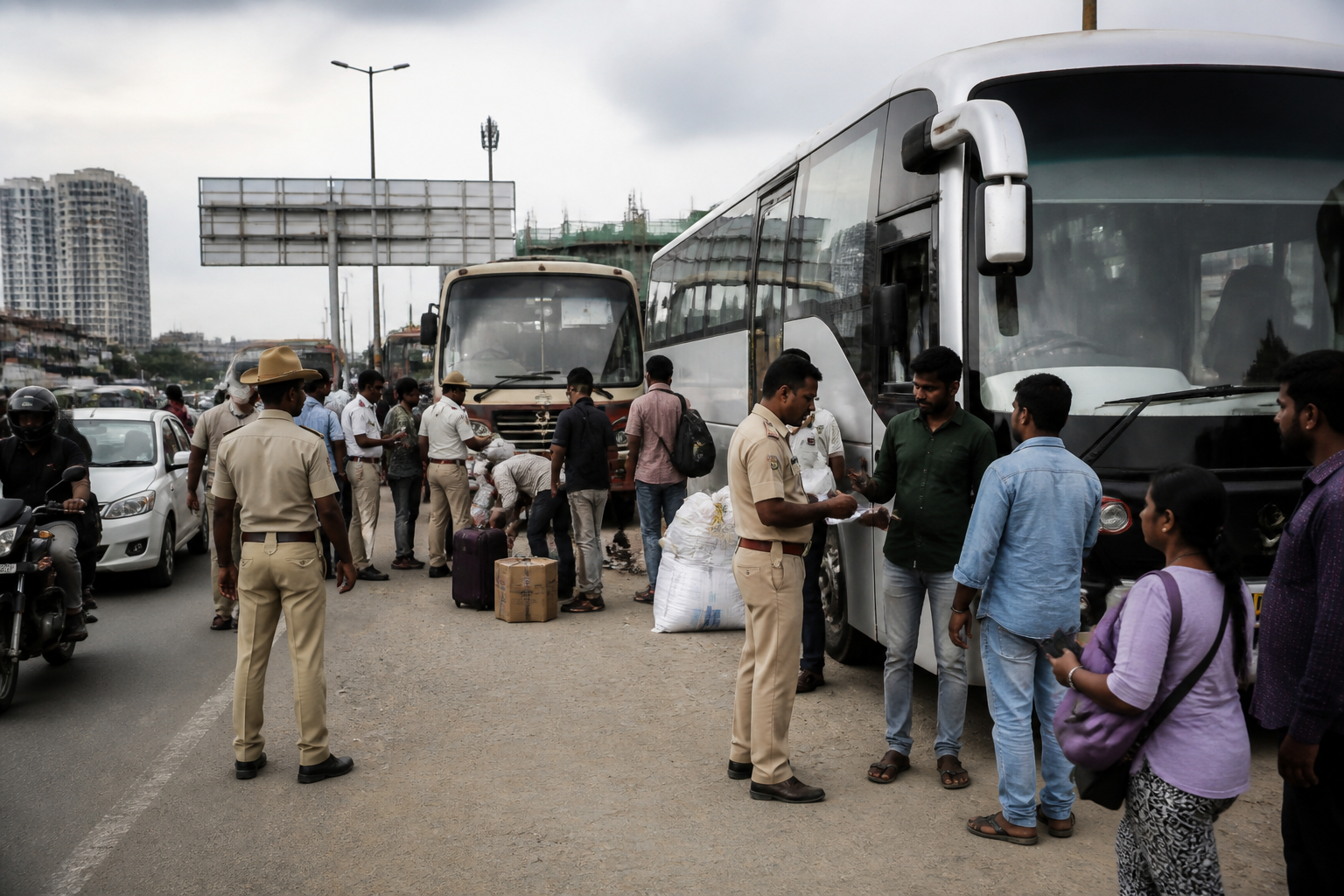
Karnataka’s action against private bus operators has produced a large enforcement tally, but the numbers also expose a deeper problem in the state’s inter-city mobility system: passengers continue to face steep and potentially opaque fares when demand rises during festivals, weekends and holidays. Between September 11 and 15, regional transport offices inspected 14,987 private buses, booked 3,756 cases, seized 33 vehicles and collected Rs 73.6 lakh after receiving complaints about overcharging and other violations.
The immediate trigger was a five-day enforcement drive launched after complaints from passengers during the Ganesha Chaturthi season. The transport department’s action covered private buses operating within Karnataka as well as inter-state services. In one reported instance, passengers were charged Rs 7,000 for a journey from Bengaluru to Hubballi. The source report does not establish how many passengers paid that fare, whether the amount applied to a particular service or class of travel, or what fare was officially permissible for that journey. It does, however, place the complaint within a wider enforcement exercise that found violations beyond pricing.
That distinction matters. The cases were booked for several types of violations, including permit-rule breaches, excess fare collection and tax evasion. Officials also found operators violating rules while transporting passengers’ luggage. As a result, the headline figure of 3,756 cases should not be read as 3,756 confirmed instances of fare overcharging. It represents cases booked across multiple categories during the inspection period. The enforcement data nevertheless shows that passenger complaints coincided with wider compliance failures in the private bus sector.
## What the enforcement numbers reveal
The most significant feature of the drive is the gap between the scale of the network examined and the number of vehicles taken off the road. Officials inspected nearly 15,000 private buses in five days, while 33 were seized. That does not by itself indicate whether enforcement was strong or weak. Seizure is only one form of action, and the report does not provide a breakdown of how many cases related specifically to fares, permits, taxes or luggage rules. But the numbers show that the transport department relied on a broad inspection campaign rather than responding only to individual passenger complaints.
The Rs 73.6 lakh collected during the drive included Rs 40.3 lakh in penalties. The difference between the total collections and the stated penalties suggests that the remaining amount came from other categories of dues, although the supplied report does not provide that breakdown. This is an important limitation when interpreting the financial outcome. The collections demonstrate that violations had monetary consequences, but they do not show whether the penalties were sufficient to deter operators or compensate affected passengers.
The enforcement exercise also illustrates how complaints enter the administrative system. MP Omkareshwari, additional commissioner for transport enforcement for South and Bengaluru Urban, said the drive was launched following complaints from the public. She said officials identified violations during document verification and inspections, and that complaints had been forwarded to the respective registering authorities for further action.
That process involves more than checking a bus at a roadside inspection point. A complaint about a fare may concern the amount charged, the service advertised, the ticket issued, the operator’s permit, or the authority responsible for registration. The official statement indicates that complaints were being sent to registering authorities, which means follow-up action may extend beyond the enforcement team that conducted the inspection. The supplied material does not state how many complaints were resolved, how many refunds were ordered, or how long the follow-up process would take.
## Why festive fares become an urban mobility issue
Private buses form part of the practical transport network linking large cities such as Bengaluru with regional destinations. When demand rises during a festival, a weekend or a holiday, passengers who need to travel may have limited alternatives. The report identifies weekends and holidays as periods when passengers frequently complain of steep fares. This makes fare enforcement a question not only of commercial conduct but also of access to mobility during predictable demand peaks.
The reported Bengaluru-Hubballi fare of Rs 7,000 illustrates the problem from the passenger’s perspective, even though the source does not provide the journey’s service category or the applicable fare rules. A traveller may be able to compare prices under normal conditions, but that choice becomes more constrained when tickets are purchased close to a festival or when available services are limited. In such situations, the difference between a legitimate premium service and an unlawful or misleading charge depends on documentation, transparency and the ability of authorities to verify what was sold.
The report does not say that all private bus operators overcharge, nor does it establish that every complaint was proved. It does show that overcharging complaints were substantial enough to prompt a state-wide, five-day drive involving thousands of inspections. The recurring nature of the complaints, as described in the report, points to a problem that reappears during predictable periods rather than a one-off breakdown.
## Enforcement can identify violations, but it cannot by itself create transparency
The drive’s design appears to have combined preventive inspection with punitive action. Officers checked documents, inspected vehicles, examined operating practices and booked cases where violations were found. This can help authorities identify non-compliance that individual passengers may not be able to pursue on their own. It also creates a visible enforcement presence during a period when operators and passengers know that demand is unusually high.
However, the supplied data does not show whether inspections were concentrated on routes with the highest complaints, whether passengers received information about permissible fares, or whether ticketing records were systematically compared with operator declarations. Without such information, it is difficult to determine whether the campaign addressed the mechanism through which overcharging occurs or mainly punished violations after they had taken place.
The same limitation applies to the penalties. Rs 40.3 lakh in penalties is a measurable enforcement outcome, but the report does not identify the average penalty per case, the number of operators involved, or whether repeat offenders faced stronger action. Nor does it state whether passengers who paid excessive fares were reimbursed. These details would determine whether enforcement functioned primarily as revenue collection, deterrence, passenger redress or a combination of all three.
The involvement of inter-state services adds another administrative layer. A private bus may operate across state boundaries, while its permit, registration and tax records may be linked to a particular registering authority. The official statement that complaints were forwarded to the respective registering authorities suggests that responsibility may be distributed across jurisdictions. For passengers, however, the journey is a single transaction. They experience the fare, ticket and service as one system even when enforcement powers are divided between agencies.
## The larger governance question
Karnataka’s enforcement figures therefore raise a question about how urban and regional mobility is regulated during predictable surges in demand. The state appears able to mobilise inspectors quickly and process a large number of cases. What remains unclear from the available information is whether the system can offer passengers timely information before they purchase a ticket, a simple channel for documenting complaints, and a clear route to redress after an alleged violation.
This is particularly relevant to Bengaluru, where private bus services connect the metropolitan region to other parts of Karnataka and neighbouring states. The city’s role as a major origin point means that fare disputes during festivals affect not only local commuters but also migrant workers, students, families and other passengers travelling to regional destinations. The report does not provide a demographic breakdown of complainants, so the precise distribution of impact cannot be established. The broad travel pattern is nevertheless clear: demand peaks create conditions in which passengers may be more exposed to high prices and weak bargaining power.
The enforcement campaign also highlights the difference between counting action and measuring outcomes. Inspections, cases, seizures and collections are important administrative indicators. They show that the department acted and that violations were recorded. They do not yet reveal whether operators changed their practices, whether repeat violations declined, whether fares became more transparent or whether passengers recovered money they believed had been wrongly collected.
Those outcomes would require follow-up data. Relevant indicators would include the number of fare-specific cases, the disposal status of the 3,756 cases, repeat-offender records, refunds or compensation, and the number of complaints forwarded to other registering authorities that resulted in action. None of these figures is provided in the source material, so it would be premature to judge the campaign as either a lasting success or a failure.
For now, the evidence supports a narrower conclusion. Karnataka’s transport enforcement machinery responded to a surge in public complaints with an extensive inspection drive, and the inspections uncovered violations across fares, permits, taxes and luggage handling. The scale of the response confirms that passenger concerns were not limited to isolated disputes. It also shows that the state’s current approach depends heavily on inspections after complaints emerge.
The next significant measure will be what happens after the drive: whether forwarded complaints are resolved, whether penalties and other action are completed, and whether passengers see clearer and more predictable fare practices during the next period of high demand. Those steps will determine whether the five-day operation was a temporary crackdown or part of a more accountable system for regulating private bus travel.
