


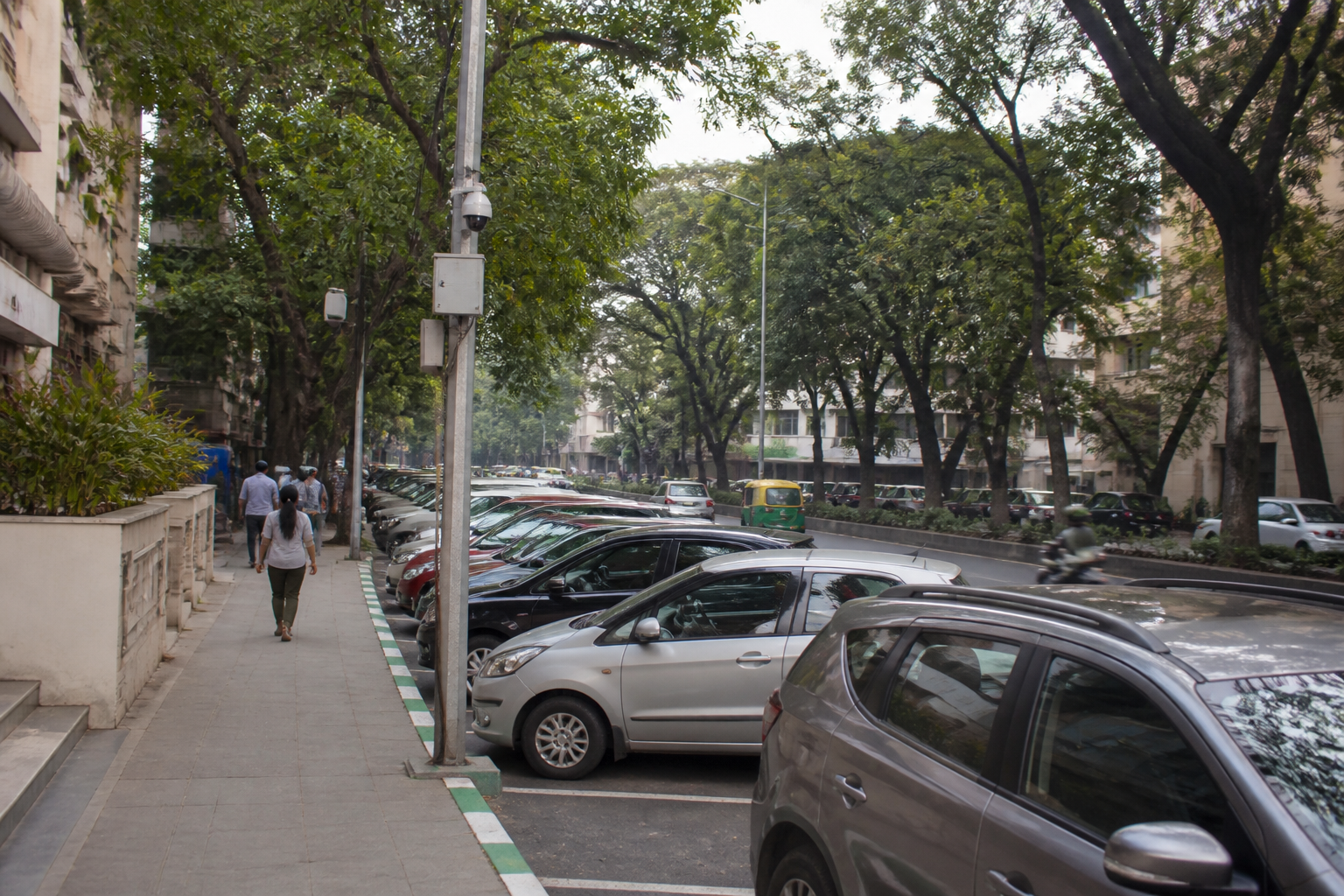
Bengaluru South City Corporation is preparing to introduce an AI-based smart parking system on selected roads in Jayanagar, requiring motorists to pay digitally within five minutes of parking and face wheel-locking and penalties for violations. The pilot is being developed with ParkLens and will be coordinated with traffic police and BESCOM.
Commissioner K.N. Ramesh reviewed the proposed system at a coordination meeting involving traffic police and BESCOM officials. He directed officials to design the parking arrangement to make better use of road space while protecting pedestrians in Jayanagar, a busy commercial and residential neighbourhood.
The proposed system will use a network of AI cameras to identify vacant parking spaces in real time. Motorists will be able to scan QR codes installed at parking locations and pay the applicable fee directly through UPI. ParkLens representatives told officials that payment would be mandatory within the first five minutes after a vehicle is parked.
The civic body is also considering angled parking on selected roads to reduce cross-parking and disorderly vehicle placement. Chief Engineer Basavaraj Kabade said angled parking could allow more vehicles to be accommodated while reducing obstruction to other vehicles during parking and exit movements.
The enforcement system will cover two main violations: failing to pay the parking fee within the stipulated period and remaining in a space after the paid parking time has expired without digitally extending the session. In both cases, an automatic alert will be sent to enforcement personnel. Officials arriving at the location will be authorised to place a wheel lock on the violating vehicle and attach a penalty receipt to its windscreen. The vehicle can be taken away only after the penalty has been paid.
The project will first be tested on selected major roads in Jayanagar rather than being introduced across the entire area at once. The corporation said the pilot would be assessed on the basis of public response, technical performance and its effect on traffic movement before a full-scale rollout is considered.
Reliable electricity supply will be required for the AI cameras and sensors. Commissioner Ramesh directed BESCOM officials to ensure uninterrupted power for the equipment and told ParkLens representatives that civic street-light poles could be used for installing cameras. The meeting was attended by Additional Commissioner Dr. Naveen Kumar Raju, South Division Traffic Deputy Commissioner of Police Gopal Byakod, Chief Engineer Basavaraj Kabade, BESCOM Executive Engineer Yogesh and technical representatives of ParkLens.
