


Delhi’s bus strike has turned a dispute over daily wages into a wider test of how the Capital organises essential public transport. On the third day of the stoppage, buses remained parked at depots while drivers and conductors described a system in which long routes, daily travel costs and family expenses leave little room for savings. The immediate disruption is visible to commuters, but the deeper issue is the employment model supporting bus operations.
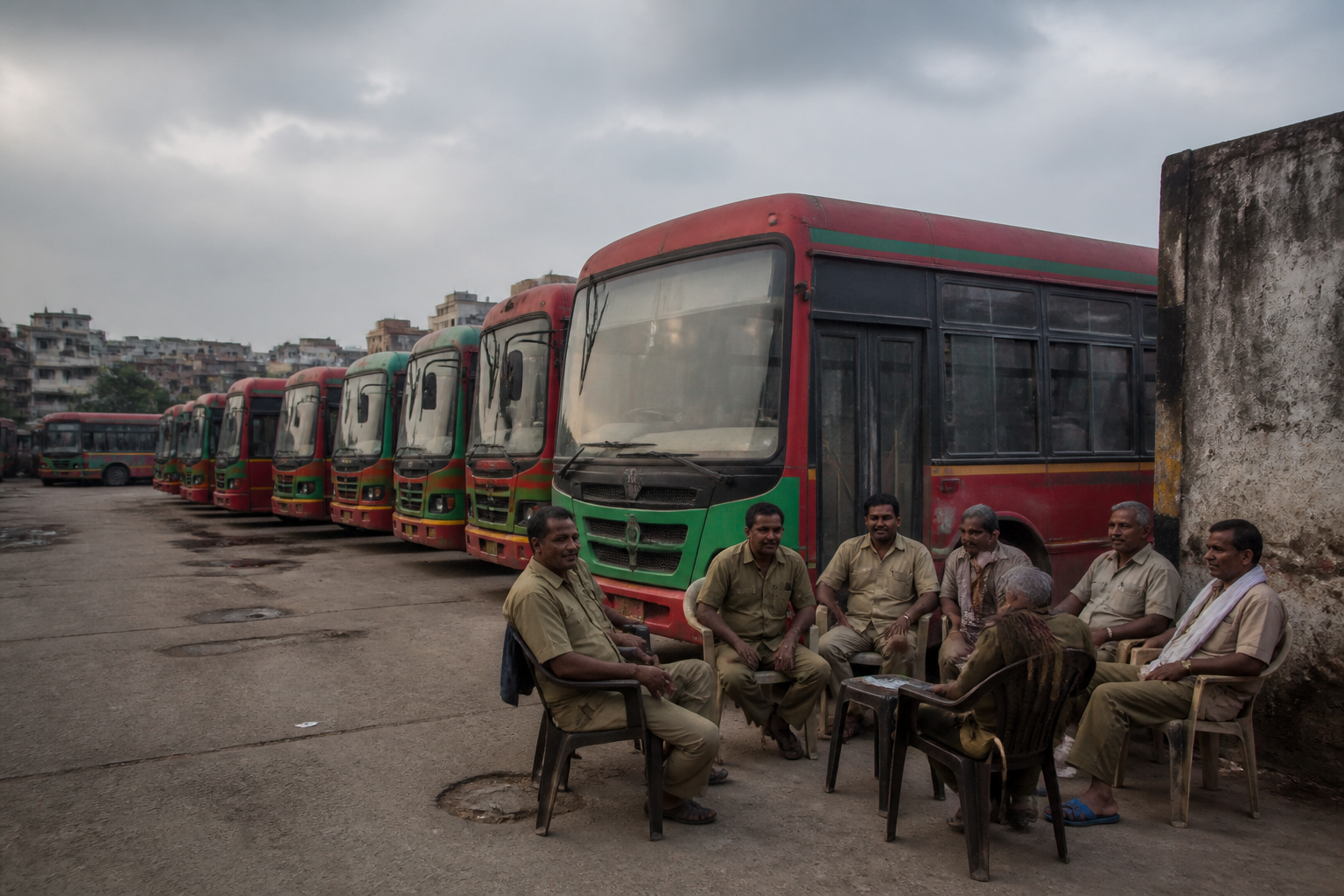
At the Wazirpur depot in northwest Delhi, all 150 Delhi Transport Corporation buses were parked on Thursday afternoon as drivers sat outside on mattresses. A similar situation was reported at the GT Karnal depot, where 121 buses stood idle. The strike, which began on Tuesday, has disrupted services across the Capital and forced commuters to look for other modes of transport.
The workers’ accounts show that the dispute is not limited to a request for a higher payslip. Joginder Singh, a DTC driver who has worked for three years, said he earns Rs 862 per day and travels from Jhajjar to work by bus, spending Rs 80 each day. He drives 105 km daily, making three rounds between the Wazirpur and Nand Nagri terminals. His monthly expenses include school fees of Rs 2,500 to Rs 3,000 for his two children, and he said he is currently asking friends to pay the EMI on his motorbike.
At the GT Karnal depot, Ashu Panchal said he spends about Rs 200 a day on petrol and another Rs 100 on food while travelling to work and back to Sonipat. He said he supplements his income by working on a gig-ride platform and is unable to save even Rs 300 a month. These accounts connect the reliability of the bus network to the financial security of the people who operate it. When workers must spend a significant share of their earnings simply reaching the depot, the nominal wage does not describe the full cost of employment.
The DTC Karamchari Ekta Union, which called the strike, says the Rs 862 daily wage is the minimum wage fixed by the Delhi government. According to union president Lalit Chaudhary, that rate is generally associated with daily-wage labourers, factory workers or employees of small companies, while bus drivers and conductors carry responsibility for a public service and work under demanding operating conditions.
The union also says the dearness allowance, which is revised every six months under applicable rules, has not increased for one-and-a-half years. It further says the basic increment due every five years was last implemented in 2019 and has been pending since 2024. These claims place the present strike within a longer dispute over wage revision rather than presenting it as a sudden breakdown.
The union’s demands include a minimum daily wage of Rs 2,000 for equal work, payment for government holidays, an annual bonus and social security measures, including a medical scheme. The gap between the current daily wage and the demand is substantial, but the supplied account does not establish whether the government or operating agencies have accepted, rejected or formally negotiated each demand.
That institutional gap is central to the dispute. The report says agencies operating DTC buses earn from the government on a per-kilometre basis but are required only to pay the minimum wage. The union argues that this arrangement does not require operators to pay more to workers whose qualifications and responsibilities may exceed the wage category being applied to them. In effect, the public authority determines or supports the service, while the employment relationship is mediated through operating agencies.
This structure can make accountability difficult during a service failure. The government may be responsible for the broader transport system, the DTC may be the public-facing institution, and private concessioners may manage individual operations and workers. For commuters, however, the distinction disappears when buses do not leave the depot. The disruption is experienced as a failure of public mobility regardless of which layer controls wages, contracts or day-to-day operations.
Transport Minister Pankaj Singh said on Wednesday that the government had directed private concessioners managing DTC electric buses to resolve the drivers’ issues immediately. The union, however, said no government representatives had reached out to it. The contrasting positions indicate that an instruction to operating agencies had not, at least according to the union’s account, translated into direct engagement with the striking workers by the third day.
The strike also reveals the dependence of Delhi’s bus service on the working conditions of a workforce that is largely invisible in transport planning. Route maps, depots and vehicle numbers describe the physical network, but they do not show whether drivers can afford the journey to work, whether conductors receive social security or whether wage revisions are processed on time. The accounts from Wazirpur and GT Karnal suggest that these employment conditions are directly connected to operational continuity.
The reported numbers make the pressure concrete. The Wazirpur depot alone had 150 buses parked, while GT Karnal had another 121. Workers described journeys of up to 105 km a day, daily fuel spending of about Rs 200 and a wage of Rs 862 per day. These are not system-wide performance statistics, and the supplied report does not establish the total number of affected workers or buses. They do, however, show how the cost of operating the network is distributed between the institution, the contractor and the worker.
The dispute therefore raises a question about what equal work means in a contracted public transport system. The union’s demand uses that phrase to argue that drivers and conductors should receive Rs 2,000 a day. The government and operating agencies would need to determine how such a revision would affect contracts, per-kilometre payments and the overall cost of service. The report does not provide the financial terms of the concessions or explain whether the existing contracts contain provisions for wage revision.
Nor does it establish how long negotiations have been under way, whether alternative transport arrangements have been activated, or when the strike may end. Those gaps matter because a public bus stoppage has consequences beyond the depot. Commuters who depend on buses for work, education and household responsibilities must find alternatives, while workers who are already reporting financial strain face the risk of losing income during the dispute. The source material records the disruption but does not quantify its wider economic or passenger impact.
The immediate policy response is now tied to whether the concessioners and the union can move from statements to a documented settlement process. The minister has said the operating agencies were directed to address the issue, while the union says it has not received direct government outreach. The next step, according to the available information, is engagement over wages, allowances, increments, holidays, bonuses and social security.
Delhi’s bus strike has consequently become more than a stoppage over one daily rate. It has exposed how the affordability and reliability of urban mobility depend on the conditions of the workers who deliver it. The evidence confirms the scale of the depot-level disruption and the financial pressure described by drivers and conductors. It leaves unresolved the contractual responsibilities of the operating agencies, the government’s position on the union’s demands and the timeline for restoring services.
