


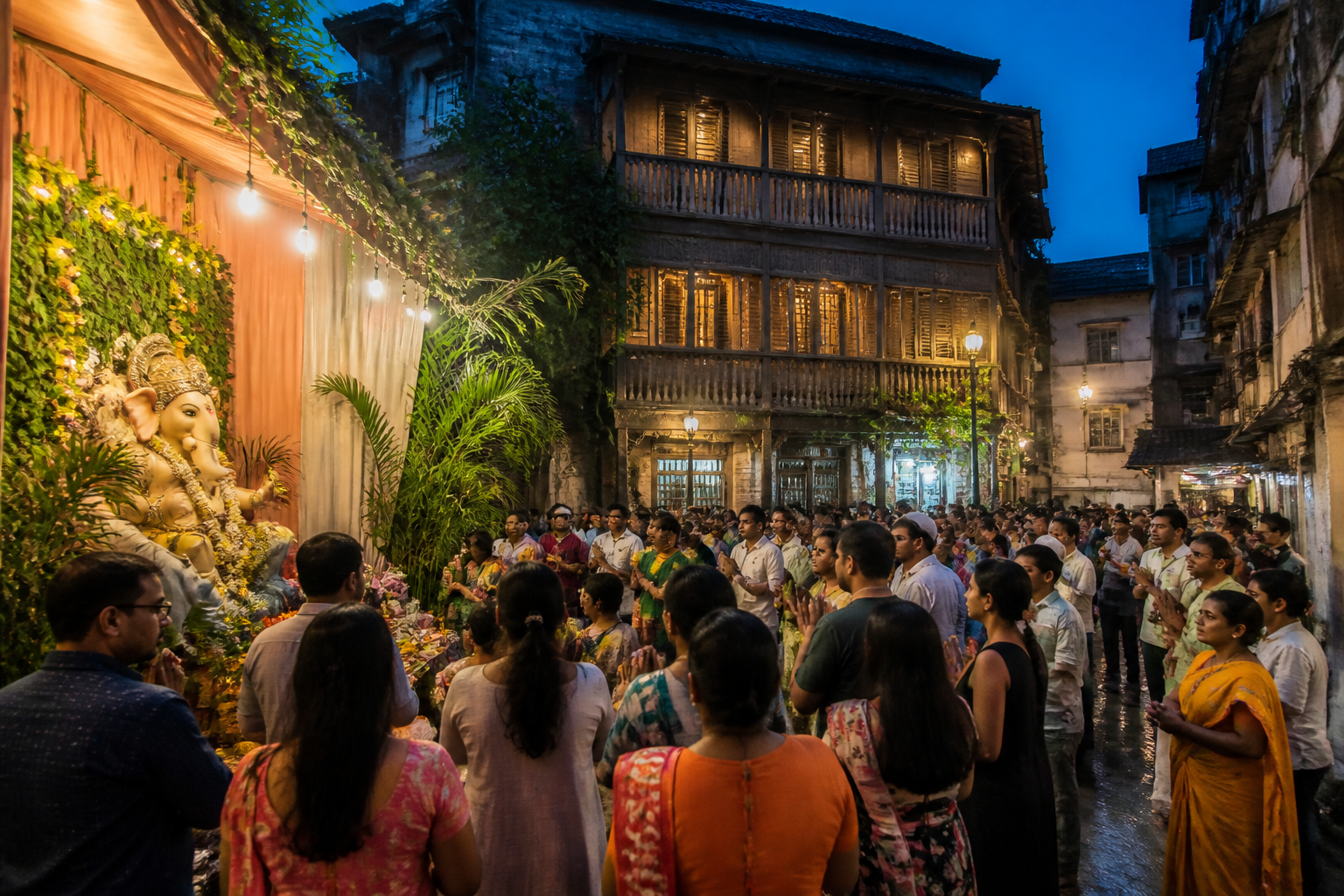
The Girgaon Ganeshotsav centenary being marked by three South Mumbai mandals is more than a milestone in religious celebration. It records how neighbourhood institutions became part of the social and civic fabric of a rapidly changing city, linking migration, community organisation, public education and the freedom movement through a festival that began nearly a century ago.
According to a report by Loksatta – Mumbai, the Kudal Deshkar Gaud Brahmin Niwas, Khotachi Wadi and Ganeshwadi Ganeshotsav mandals in Girgaon are celebrating their centenary this year. The three mandals were established in 1927 by community workers from the neighbourhood, at a time when public Ganeshotsav was being used to bring people together under colonial rule.
The report places these mandals within the wider history of public Ganeshotsav in Mumbai and Pune. Lokmanya Bal Gangadhar Tilak had started the public festival as a means of social mobilisation. The celebration at Keshavji Naik’s Chawl is identified as an important early example in Mumbai. Following that model, public Ganeshotsav celebrations spread to several wadas in South Mumbai, including Girgaon.
That history matters because the festival did not emerge in an empty urban space. Girgaon’s public celebrations took shape in a neighbourhood of chawls, wadas and community residences, where social life was organised through close physical proximity. The source report identifies Jagannath Shankar Sheth Road and the Kudal Deshkar Gaud Brahmin Niwas as part of this setting. These were not simply locations for a temporary event; they were neighbourhood institutions through which a migrant community built a collective presence in the city.
The 1927 founding date also reflects a specific phase in Mumbai’s urban and social history. The report notes that many unemployed young people were arriving in Mumbai from the Konkan region. A large number of Kudal Deshkar Gaud Brahmin community members from Kudal, Malvan, Vengurla and surrounding areas were also moving to the city. Their arrival created the need for community networks that could provide social connection and a sense of belonging in an unfamiliar urban environment.
The three mandals therefore represent a form of community infrastructure. The term usually brings to mind roads, railways, water lines or public buildings. But the history recorded in Girgaon shows another layer of urban infrastructure: institutions created and maintained by residents themselves. Such institutions can help migrants retain cultural ties, meet other members of their community and participate in the public life of the city.
The source does not claim that these mandals alone drove the freedom movement. It records, however, that public Ganeshotsav in Girgaon helped strengthen the freedom struggle through public education and that the founders recognised the need to contribute to the movement. This distinction is important. The festival’s historical significance lies not only in its religious character, but also in the way public space and collective organisation could support civic communication during a period when India remained under British rule.
Public celebration provided a format through which people could gather. In the account supplied by Loksatta – Mumbai, the broader freedom movement included both revolutionary groups that took up arms and moderate groups inspired by Mahatma Gandhi who followed non-violent forms of protest. Public Ganeshotsav became part of the social environment in which such ideas could reach communities. The report describes public education as one of the ways through which Girgaon’s celebrations strengthened the movement.
This connection between festivals and urban public life is especially visible in the spatial history of South Mumbai. The report refers to chawls and wadas rather than only to large institutional venues. That suggests a neighbourhood-scale model of public culture, in which streets, courtyards and shared community settings became places for collective activity. The available material does not provide details of the mandals’ current routes, programmes, budgets or visitor numbers. It does establish that their origins were closely tied to the built form and social networks of Girgaon.
The centenary also draws attention to continuity. A community that had arrived in Mumbai in search of work created institutions that have remained active for 100 years, according to the report. The milestone is consequently a record of organisational endurance as much as a celebration of tradition. It shows how a neighbourhood association can survive across generations while carrying memories of migration, community leadership and public participation.
That continuity should not be confused with an unchanged city. Girgaon has been part of a South Mumbai landscape shaped by dense settlement and long-established neighbourhoods. The source provides no detailed account of redevelopment, changes in land use or the present condition of the original premises. It does, however, place the mandals within named neighbourhood spaces whose identities were built through community residence and shared activity. The centenary makes those local histories visible at a time when the meaning of old neighbourhood institutions can easily be reduced to heritage symbolism.
The report describes the centenary celebration as culture- and tradition-conscious as well as environmentally friendly. It also presents the current celebrations as a response to Tilak’s original appeal. These descriptions indicate an attempt to connect historical continuity with present-day public responsibility. The supplied material does not specify the environmental measures being adopted, so their nature cannot be assessed from the report alone. What can be established is that the mandals are presenting the centenary as both a preservation of tradition and an effort to conduct the festival in an environmentally conscious manner.
The institutional question raised by the story is who sustains urban culture. In this case, the answer begins with community members and social workers who came together in 1927. The mandals were not described as state-created bodies or commercial ventures. Their origin lay in collective action by residents and members of a migrant community. That makes the centenary relevant to the wider study of how cities are built: public life is shaped not only by municipal agencies and formal plans, but also by local organisations that create durable systems of participation.
The story also complicates the idea that migration weakens neighbourhood identity. The account of Konkan migrants arriving in Mumbai suggests that community institutions helped transform movement into settlement. People who came to the city for work did not remain socially disconnected from their places of origin. Through the mandals, their community identity became part of Girgaon’s public life. The resulting urban culture was therefore produced through interaction between incoming residents and the neighbourhood they entered.
There is also a distinction between private worship and public institution-building. The centenary concerns public Ganeshotsav mandals, not only household religious practice. Their significance comes from the collective form of the celebration and its location within shared neighbourhood spaces. The report links this public form to social mobilisation, public education and the freedom movement. It therefore presents the mandals as institutions whose history extends beyond ritual into civic association.
For Mumbai, the value of this history lies in its specificity. The story is not simply that a popular festival is old. It is that three named Girgaon mandals can be traced to a particular year, a particular community setting and a particular moment of political and urban change. Their centenary offers a way to understand how South Mumbai’s neighbourhoods were organised by people who were building new lives in the city.
The evidence supplied in the report confirms the 1927 founding of the three mandals, their connection with the Kudal Deshkar Gaud Brahmin community, the role of public Ganeshotsav in the wider history associated with Tilak, and the link made between Girgaon’s celebrations and public education during the freedom movement. It does not establish the present membership of the mandals, the scale of their celebrations, their finances, the number of visitors or the exact environmental practices being followed today. Those details would require further documentation or direct reporting.
What the centenary does establish is a durable urban relationship between community, place and public culture. The Kudal Deshkar Niwas, Khotachi Wadi and Ganeshwadi mandals began in 1927 amid migration and political mobilisation. Their continued existence gives Girgaon a living record of how residents used collective institutions to participate in Mumbai’s civic life. The next chapter of their history will depend on how that legacy is documented and carried forward while the neighbourhood around them continues to change.
