


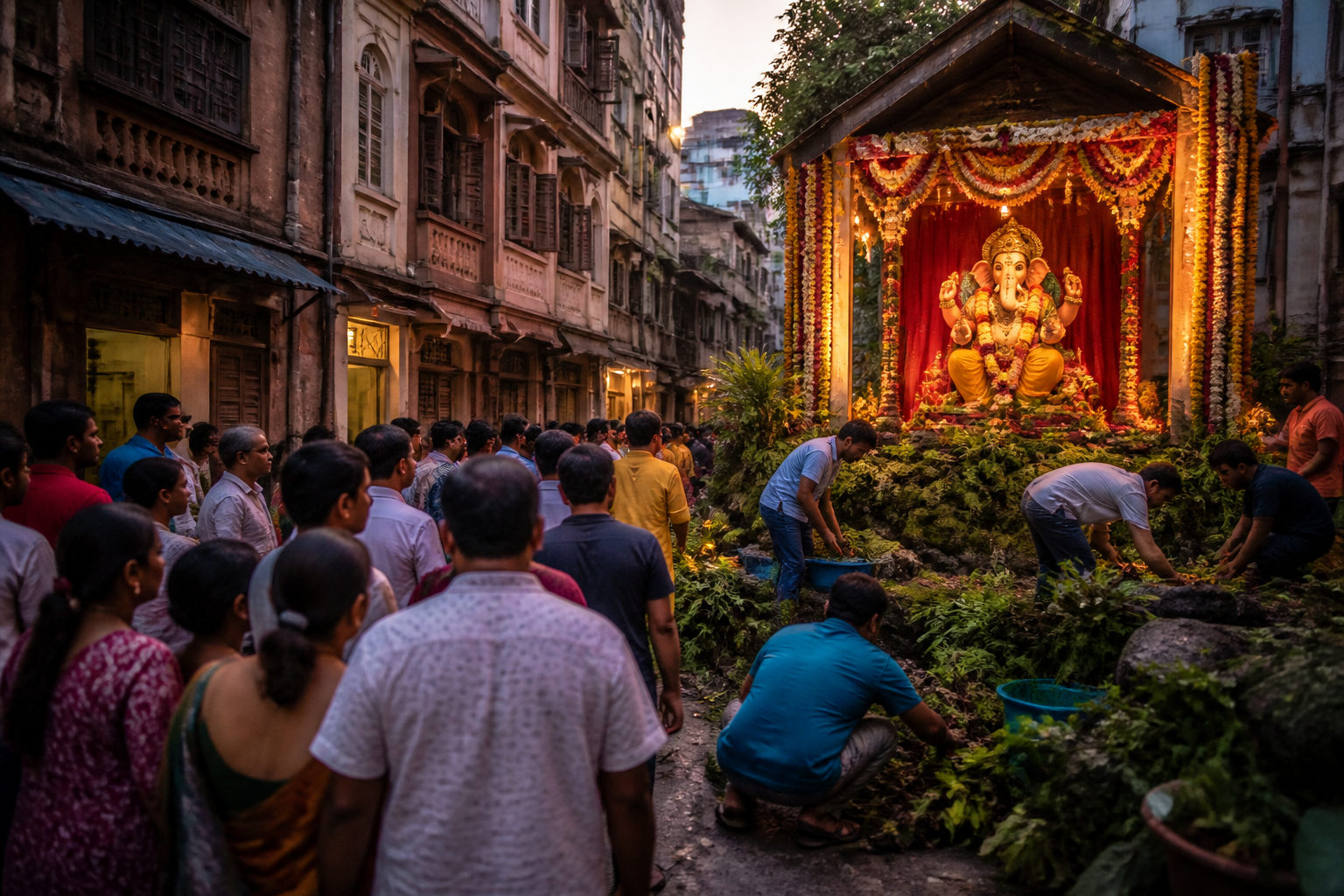
Three public Ganesh festival mandals in Girgaon are celebrating their centenary year, carrying forward a civic and cultural tradition that took shape in south Mumbai during the freedom movement, according to a report by Loksatta – Mumbai.
The Kudhal Deshkar Gaud Brahmin Niwas mandal on Jagannath Shankarseth Road, along with the mandals in Khotachiwadi and Ganeshwadi, began organising public Ganesh festivals in 1927. The three organisations are marking 100 years of their public celebrations this year.
The report places their origins within the wider history of the public Ganesh festival associated with Lokmanya Bal Gangadhar Tilak. The festival was promoted as a means of bringing people together at a time when India was under British rule. Public celebrations gradually spread across Mumbai and Pune, with local community leaders establishing mandals in neighbourhoods and settlements.
In Girgaon, these festivals also became a means of public education and social mobilisation. The report states that public Ganesh celebrations in the area helped strengthen the freedom movement by creating spaces where residents could come together and engage with wider social and national concerns. The mandals were formed by community workers who believed that they, too, should contribute to the independence movement.
The development of these mandals followed the start of public Ganesh celebrations at Keshavji Naik Chawl in Mumbai. Other neighbourhoods and wada settlements in south Mumbai subsequently adopted the practice. The Girgaon mandals formed part of that expansion, embedding the festival within the social life of the locality.
The centenary also reflects the role of migration and community networks in shaping Mumbai’s neighbourhood institutions. The report notes that, during that period, unemployed young men were arriving in Mumbai in large numbers from the Konkan region. Many members of the Kudhal Deshkar Gaud Brahmin community from Kudhal, Malvan, Vengurla and surrounding areas were among those moving to the city.
For these migrants, community residences and neighbourhood associations provided an organisational base in an unfamiliar city. The public festival became one expression of that collective life, connecting people who had arrived from the same region while also participating in the wider civic culture of Mumbai.
The three mandals are now presenting their centenary celebrations as a continuation of that history. Their observance combines cultural tradition with an emphasis on preserving local heritage and conducting an environmentally friendly Ganesh festival, the Loksatta report states.
The anniversary places the three mandals within a longer story of how Mumbai’s neighbourhood institutions were built—not only through formal civic agencies, but also through community-led spaces, shared rituals and local organisations. Their history shows how public festivals became part of the city’s social infrastructure, particularly in older south Mumbai settlements where residents, migrants and community groups formed enduring networks.
The centenary celebrations will continue this year at the three Girgaon mandals. The report does not provide further details on the programme schedule or specific installations planned for the celebrations.
